India is advancing AI in healthcare through the SAHI framework and BODH platform, ensuring ethical, patient-centric adoption that supports medical professionals. Built on Ayushman Bharat Digital Mission, success depends on addressing algorithmic bias, data privacy under the DPDP Act 2023, and AI transparency challenges.
Copyright infringement not intended
Picture Courtesy: PIB
Context
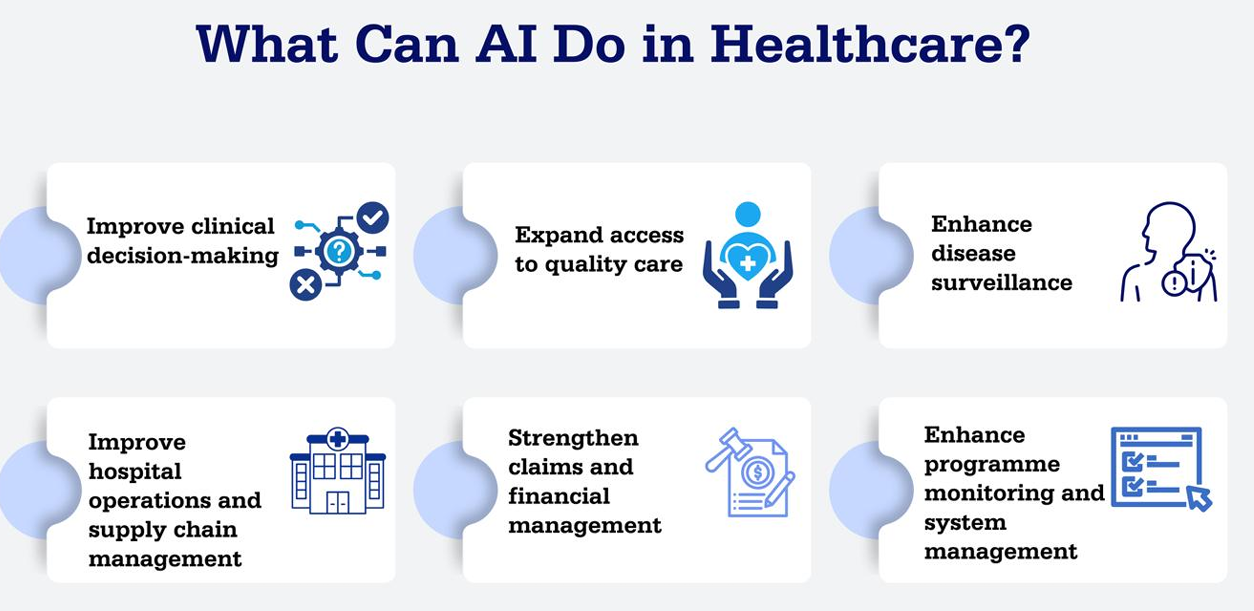
AI is transforming healthcare through diagnostics, predictions, streamlined practices, improved management, drug discovery, and research, but faces low adoption despite the development of new tools.
|
Read all about: AI In Healthcare Explained l India Joins Health AI Global Network l Artificial Intelligence in Healthcare l AI in Healthcare India l Generative AI in Healthcare |
AI in Indian Healthcare
Healthcare challenges in accessibility, affordability, and quality, especially in rural areas due to professional shortages and poor infrastructure, are being addressed by Artificial Intelligence (AI) through enhanced diagnostics, personalized treatments, and workflow optimization.
The Indian health technology market is estimated to grow at an annual rate of 22%, reaching US$ 35.8 billion by 2030, with the digital health market expanding from US$ 12.20 billion in 2023 to US$ 25.64 billion by 2027. (Source: IBEF)
The healthcare workforce is projected to grow from 7.5 million to 9 million by 2027, with 1-2% comprising technology experts, creating 2.7-3.5 million new technology jobs. (Source: IBEF)
What are the Applications of AI in Healthcare?
Disease Diagnosis and Screening
AI algorithms improve the speed and accuracy of diagnostics by analyzing medical images like X-rays, CT scans, and MRIs to detect anomalies that may be missed by the human eye.
Public Health Surveillance
The Integrated Disease Surveillance Programme (IDSP) under the National Centre for Disease Control (NCDC) utilizes an AI-powered tool to detect early warning signals of potential disease outbreaks by scanning millions of online news reports and social media feeds daily.
Clinical Decision Support & Hospital Management
AI-powered systems assist clinicians in making faster, more informed decisions and help optimize hospital operations for better efficiency.
Government's Policy Framework for AI in Healthcare
|
Policy / Initiative |
Key Objectives and Features |
|
Released by NITI Aayog, it identified healthcare as a priority sector for AI deployment. It envisioned an '#AIforAll' approach focused on leveraging AI for social development and inclusive growth. |
|
|
The Ayushman Bharat Digital Mission is establishing a national digital health ecosystem, with over 79.9 crore Ayushman Bharat Health Accounts (ABHA) created and more than 67.1 crore health records digitally linked as of November 2025, providing structured data for AI model training. |
|
|
Released by the Indian Council of Medical Research (ICMR), these guidelines establish 10 key principles, including accountability, data privacy, safety, fairness, and transparency, to provide an ethical framework for all stakeholders. |
What are the Challenges Hindering AI Adoption?
Data-Related Challenges
The effectiveness of AI depends on large, high-quality datasets. Key issues include a lack of standardized data, poor data quality, interoperability problems, and bias in datasets that often do not represent India's diverse population.
Infrastructure and Skill Gaps
The digital divide, characterized by limited rural connectivity and digital infrastructure, is a major barrier, compounded by a critical shortage of professionals with dual expertise in AI and medicine, as reported by NASSCOM.
Ethical and Regulatory Concerns
A lack of a specific legal framework for AI creates ambiguity regarding liability and accountability for AI-generated errors. Ensuring patient consent and data privacy, in line with the Supreme Court's Puttaswamy judgement (Right to Privacy), is paramount.
High Cost and Lack of Trust
The high initial cost of developing and implementing AI solutions is prohibitive for many smaller healthcare facilities. Building trust among clinicians and patients requires transparent and "explainable AI" (XAI) models whose decisions can be understood by humans.
Way Forward
To harness AI's full potential, India needs a multi-pronged, collaborative, and inclusive strategy guided by a 'SAFE-AI' framework:
Learn Lessons from Global Best Practices
UK's NHS AI Lab
Provides a model for a state-led initiative that helps test, evaluate, and scale safe and ethical AI technologies within a public health system, creating sandboxes to validate AI tools before large-scale deployment.
US FDA's Regulatory Framework
The U.S. Food and Drug Administration's risk-based framework for "Software as a Medical Device" (SaMD) offers a clear pathway for validating and certifying AI/ML tools, ensuring their safety and reliability.
WHO's Guidance on AI Ethics
The World Health Organization (WHO) outlines six core principles for ethical AI in health: protecting human autonomy, ensuring safety, ensuring transparency, fostering accountability, ensuring equity, and promoting sustainable AI.
Conclusion
Artificial Intelligence promises to revolutionize Indian healthcare, and with a focus on policy, ethics, and skill development, India can leverage this potential to achieve universal and equitable health coverage.
Source: PIB
|
PRACTICE QUESTION Q. While AI offers transformative potential for achieving universal health coverage, its deployment is fraught with ethical and governance challenges. Discuss. 150 words |
SAHI, or the Strategy for AI in Healthcare for India, is a framework launched by the Ministry of Health. It aims to guide the responsible, ethical, and patient-centered integration of Artificial Intelligence into India's health system by establishing policy "guardrails".
The framework is built on five core pillars: governance, evidence-generation standards, safe and transparent digital and data infrastructure, and workforce readiness. These pillars work together to create a sustainable and inclusive AI-for-health ecosystem.
BODH (Benchmarking Open Data Platform for Health AI) is a platform developed by IIT Kanpur and the National Health Authority. It provides a secure, privacy-preserving environment where AI models can be tested and validated against real-world data before being deployed in the healthcare system, ensuring their safety and reliability.



© 2026 iasgyan. All right reserved