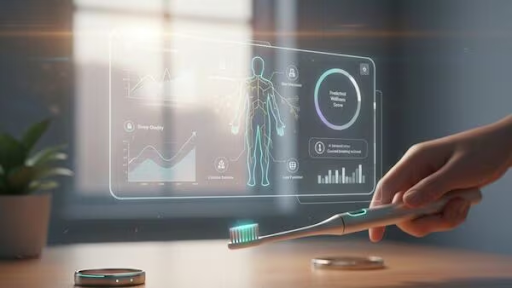
AI is revolutionizing healthcare by moving from passive tracking to proactive protection, using miniaturized wearables and smart breath analysis to continuously monitor over 300 biomarkers. This enables early disease detection and longevity optimization. However, this shift toward "industrialization of the self" requires strong health data security to balance innovation with individual privacy rights.
Copyright infringement not intended
Picture Courtesy: LIVEMINT
The rapid integration of Artificial Intelligence (AI) and smart devices is reshaping the healthcare landscape, promising a future of personalized and proactive wellbeing.
AI in healthcare focuses on enhancing diagnostics (radiology, pathology), improving telemedicine (e-Sanjeevani), enabling personalized medicine, and boosting public health surveillance, while addressing rural access gaps.
Key Applications & Initiatives
Diagnostics: AI assists in detecting diseases from X-rays (like diabetic retinopathy), pathology slides, and medical images faster and more accurately, helping overcome specialist shortages.
Telemedicine: Integrated into the e-Sanjeevani platform, AI provides Clinical Decision Support (CDSS) for differential diagnoses, improving consultation quality.
Public Health: Tools like 'Media Disease Surveillance' (MDS) track digital news for early outbreak detection, and AI aids in personalized care and predicting health risks.
Personalized Medicine: AI analyzes patient data (genetics, lifestyle) to tailor treatment plans, seen in initiatives like Apollo Hospitals' AI-Precision Oncology Center.
Drug Discovery: Machine learning accelerates identifying potential drug candidates, cutting costs and time.
Mental Health: Apps like Wysa offer AI-driven mental health support, bridging gaps in access.
Role & Impact
Force Multiplier: AI empowers nurses, technicians, and community health workers to perform early screenings, extending specialist reach.
Efficiency: Automates tasks, optimizes hospital operations (staffing, inventory), and reduces diagnostic errors.
Accessibility: Democratizes healthcare by connecting rural communities with urban specialists via AI-powered telemedicine.
Vulnerability to Cyberattacks
According to India Cyber Threat Report 2025, the healthcare sector accounted for 21.82% of all cyberattacks, making it the most targeted industry in India.
|
Case Study: AIIMS, Delhi Attack In November 2022, ransomware attack on the All India Institute of Medical Sciences (AIIMS) compromised the data of millions of patients. It paralyzed hospital services for over two weeks, highlighting the vulnerability of India's critical health infrastructure. |
Algorithmic Bias
AI models using non-representative data can worsen health inequities. For example, an algorithm trained on one demographic's data may poorly diagnose diseases in others, causing health disparities.
Data Privacy & Consent
The complexity of "black-box" algorithms makes ensuring genuinely informed consent challenging, as patients and doctors struggle to understand AI's decision-making, raising ethical questions about data usage.
Accountability & Liability
Determining who is responsible for an AI-driven diagnostic error is a complex legal and ethical problem.
Foundational Legal Pillars
The Supreme Court affirmed the Right to Privacy as a fundamental right under Article 21 of the Constitution, establishing the constitutional basis for data protection laws, covering informational privacy and bodily integrity.
Digital Personal Data Protection Act (DPDPA), 2023: India's first comprehensive data protection law. For healthcare, it mandates:
Ayushman Bharat Digital Mission (ABDM)
Launched in 2021, ABDM aims to create a national digital health ecosystem based on the principle of "privacy by design."
|
Framework |
Region |
Key Features & Lessons for India |
|
European Union |
|
|
|
HIPAA (Health Insurance Portability and Accountability Act) |
USA |
|
India must adopt a comprehensive strategy to harness AI's potential in healthcare while safeguarding citizens' rights. This strategy depends on:
Balancing technological innovation with public trust is vital for establishing a resilient, equitable, and patient-centric digital health ecosystem that benefits every Indian.
Source: LIVEMINT
|
PRACTICE QUESTION Q. Analyze the dual-use nature of AI in healthcare, where data collected for 'wellness' can potentially lead to 'biometric surveillance' by private corporations. (250 words) |
The DPDPA, 2023 aims to protect citizens' personal data by making it mandatory for healthcare providers (Data Fiduciaries) to obtain explicit consent before collecting or processing data, implement strong security measures to prevent breaches, and promptly notify both the authorities and affected individuals if a breach occurs.
ABDM ensures privacy through its "privacy by design" approach. Its core feature, the 'Consent Manager', empowers individuals by giving them direct and granular control over their health data. Patients can decide which records to share, with which doctor, and for how long, ensuring that all data exchange is based on their explicit and informed consent.
Algorithmic bias occurs when an AI system produces prejudiced results because it was trained on biased or non-representative data. In healthcare, this is a major concern as an AI trained on data from one demographic group might misdiagnose or provide incorrect treatment recommendations for other groups, thus worsening existing health inequities.





© 2026 iasgyan. All right reserved