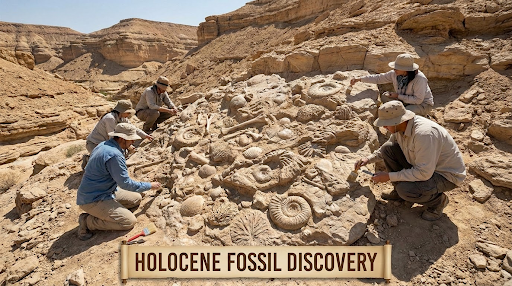
Researchers in Thoothukudi discovered a Holocene fossil bed with marine remains, proving past sea-level rises. This find helps reconstruct Palaeo-environments and contextualizes Iron Age sites like Adichanallur amidst shifting coastal dynamics.
Why In News?
A rare fossil bed dating back to the Holocene period has been discovered in the Arasadi area of Thoothukudi, Tamil Nadu.
About The Discovery
Nature of the Discovery
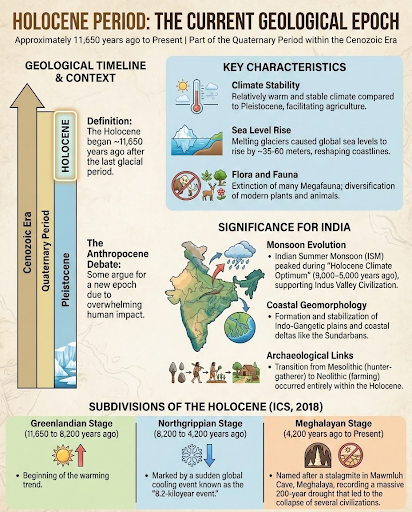
Significance of the Holocene Period
Source: NEWSONAIR
|
PRACTICE QUESTION Q. The recently discovered fossil bed in Arasadi, Thoothukudi, primarily consists of: A) Vertebrate mammalian remains B) Marine gastropods and bivalves C) Mesozoic dinosaur eggs D) Carbonized floral imprints Answer: B Explanation: According to the researchers from V.O. Chidambaram College, the discovery includes a variety of marine mollusks, specifically gastropods and bivalves, which were found embedded in the sedimentary layers of the Arasadi area. |
It is a geological discovery in the inland Arasadi area of Thoothukudi district, Tamil Nadu, where highly preserved remains of Holocene-era marine life (like gastropods and bivalves) were found embedded in terrestrial sedimentary layers.
Marine transgression is a geological process where sea levels rise relative to the land, causing the shoreline to move inland. The discovery of marine fossils miles away from the current Gulf of Mannar shoreline is direct evidence of this phenomenon.
The Holocene Highstand was a period roughly 4,000 to 6,000 years ago when global melting of polar ice caused relative sea levels along the Indian peninsula to rise 1 to 4 meters above present-day levels.





© 2026 iasgyan. All right reserved