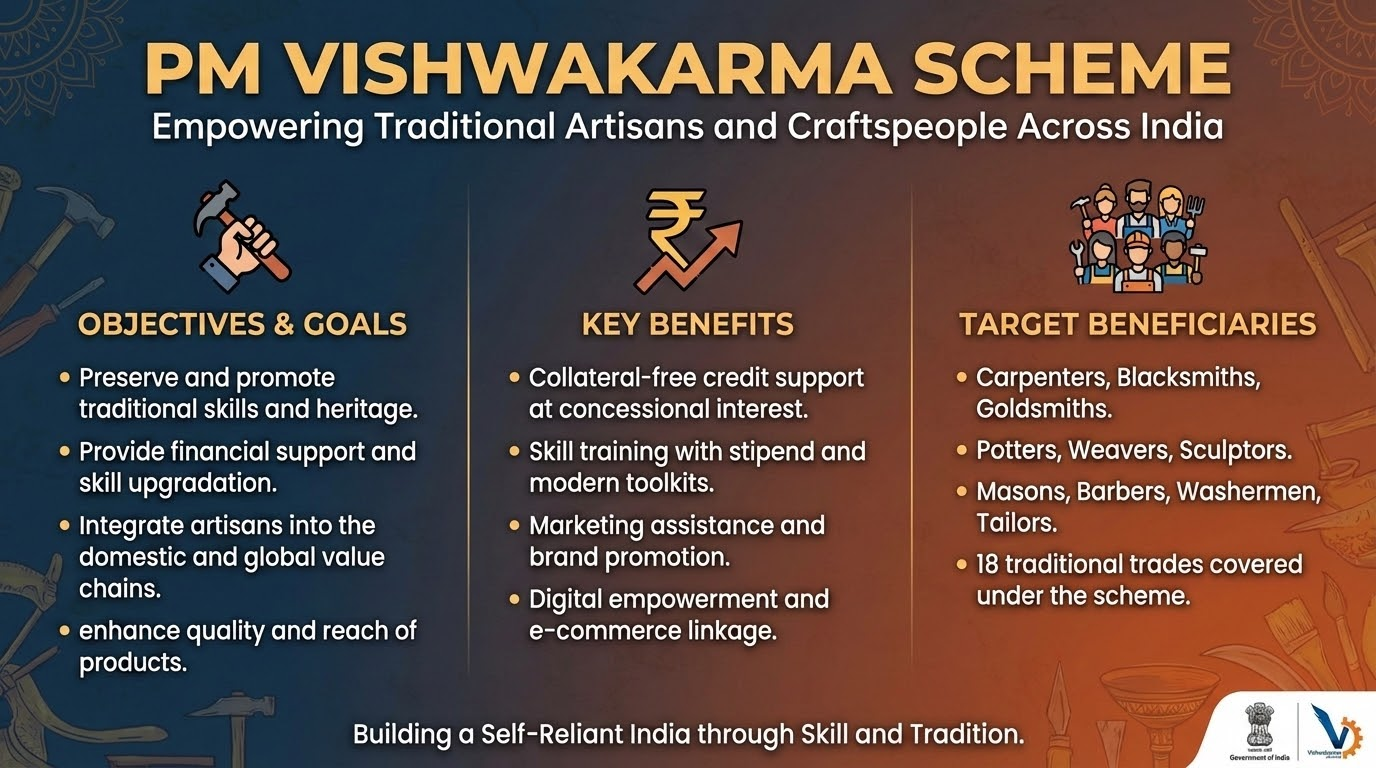
PM Vishwakarma Scheme is a Central Sector Scheme launched in 2023 to provide end-to-end support to traditional artisans in 18 trades. It offers formal recognition, skill upgradation stipends, ₹15,000 toolkit incentives, and collateral-free loans up to ₹3 lakh at 5% interest.
Why In News?
The PM Vishwakarma Scheme achieved its initial 5-year registration target of 30 lakh artisans in just two years.
What is the PM Vishwakarma Scheme?
It is a Central Sector Scheme launched in September 2023.
Objectives: Provide comprehensive, end-to-end support to traditional artisans and craftspeople, who are referred to as 'Vishwakarmas'.
Nodal Ministry: Ministry of Micro, Small and Medium Enterprises (MoMSME).
Collaborating Ministries: Ministry of Skill Development and Entrepreneurship (MSDE) and the Department of Financial Services (DFS), Ministry of Finance.
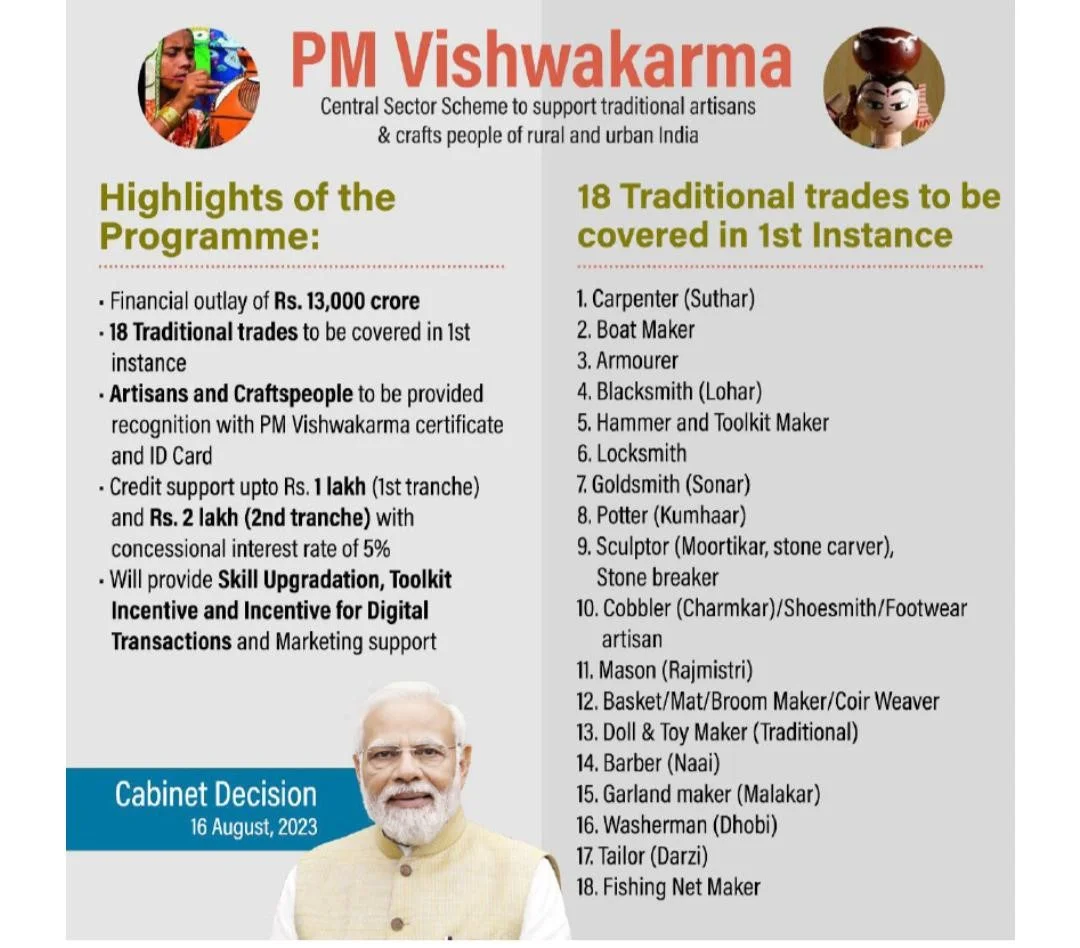
Financial Outlay: ₹13,000 crore for a five-year period (FY 2023-24 to FY 2027-28)
Target Beneficiaries: Artisans and craftspeople engaged in 18 identified traditional trades, such as carpenters, boat makers, armourers, blacksmiths, potters, sculptors, cobblers, and masons.
Core Components and Benefits for Artisans
Recognition: Artisans receive a PM Vishwakarma Certificate and ID Card, providing them with official recognition.
Skill Upgradation: Basic (5-7 days) and Advanced (15 days) skill training with a stipend of ₹500 per day.
Toolkit Incentive: An e-voucher of up to ₹15,000 to purchase modern tools and equipment.
Credit Support: Collateral-free 'Enterprise Development Loans' at a concessional interest rate of 5%.
Digital Transaction Incentive: Incentive of ₹1 per digital transaction (up to 100 transactions monthly) to promote digital payments.
Marketing Support: Assistance with branding, packaging, e-commerce linkage, and quality certification to connect artisans to larger markets.
What is the significance of the PM Vishwakarma Scheme?
Formal Credit Access: Artisans often lack collateral, forcing reliance on moneylenders with high interest (15-20%). The scheme offers collateral-free formal credit.
Support Traditional Trades: The scheme preserves the indigenous Guru-Shishya parampara in sectors like handloom and woodcraft, to ensure continuation of art and trade.
Social and Economic Empowerment: Supporting livelihoods for marginalized communities, the scheme advances social justice, with women representing 68% of skill training beneficiaries. (Source: IMPRI)
Challenges in Implementation
Digital Literacy Gaps: Rural artisans often struggle with digital registration and mandatory biometric authentication.
Bureaucratic Hurdles: The three-tier verification process; Gram Panchayat/ULB level, District level, and Screening Committee - causes administrative bottlenecks and delayed loan disbursements.
Lending Caution: Banks remain hesitant to lend to the unorganized sector due to insufficient formal credit histories.
Weak Market Access: Artisans find it difficult to reach high-end urban markets or compete on e-commerce platforms.
Technology Transition: Artisans struggle to adopt modern, automated tools from advanced toolkits, finding the shift from traditional manual techniques difficult.
Way Forward
Integrate with E-commerce: Onboard artisans onto platforms like the Open Network for Digital Commerce (ONDC) and other e-commerce sites to eliminate middlemen and improve profit margins.
Strengthening Cluster-Based Approach: Developing "Common Facility Centres" (CFCs) where artisans can share high-cost machinery and receive collective bulk orders.
Strengthen Institutional Linkages: Study the model of Germany’s "Handwerk" dual vocational system, to create strong ties between training centers and modern MSME clusters.
Focus on Branding and GI Tags: Focused campaigns to obtain Geographical Indication (GI) tags for craft clusters, enabling premium branding and higher international market pricing.
Regular Impact Audits: Utilizing the Data Governance Quality Index (DGQI) framework to monitor real-time progress and address regional disparities in scheme implementation.
Conclusion
The PM Vishwakarma Scheme integrates traditional skills with modern finance and technology to formalize and empower artisans as micro-entrepreneurs, advancing inclusive Atmanirbhar Bharat.
Source: THEHINDU
|
PRACTICE QUESTION Q. Consider the following statements regarding the PM Vishwakarma Scheme:
Which of the statements given above is/are correct? A. 1 and 2 only B. 2 and 3 only C. 3 only D. 1, 2, and 3 Answer: B Explanation: Statement 1 is incorrect: PM Vishwakarma is a Central Sector Scheme, implemented by the Ministry of Micro, Small and Medium Enterprises (MSME). Statement 2 is correct: One of the primary objectives of the scheme is to strengthen and nurture the Guru-Shishya parampara or the family-based practice of traditional skills by artisans and craftspeople. Statement 3 is correct: The scheme guidelines specify that registration and benefits are restricted to only one member per family. Under this scheme, a 'family' is defined as consisting of the husband, wife, and unmarried children. |
The scheme aims to provide end-to-end support to traditional artisans and craftspeople by offering official recognition, skill up-gradation, modern toolkits, and collateral-free credit, thereby formalizing the rural economy and preserving the indigenous Guru-Shishya parampara.
The Ministry of Micro, Small and Medium Enterprises (MoMSME) is the nodal ministry. It operates in collaboration with the Ministry of Skill Development and Entrepreneurship (MSDE) and the Department of Financial Services (DFS).
Key challenges include skewed export benefits where middlemen absorb profit margins, stark regional disparities in implementation (e.g., high engagement in Karnataka vs. low in Tamil Nadu), and "phantom allocations" in MSME budgets that mask the actual capital available for ground-level implementation.

© 2026 iasgyan. All right reserved