Why In News?
An international coalition of 16 national governments officially signed the Mombasa Declaration at the 11th Our Ocean Conference (OOC11) in Kenya.
What is the Mombasa Declaration?
Background: The United Nations and global environmental bodies convene OOC11 under the theme “Our Ocean, Our Heritage, Our Future.”
Objectives: The declaration operationalizes the Global Charter for Fisheries Transparency. It compels coastal and flag states to adopt 10 low-cost or no-cost policy principles to systematically collect and disseminate vessel data.
Participating Countries: 16 nations across Africa, Asia, Europe, Latin America, and the Pacific ratify the agreement, including Belgium, Cameroon, Chile, the Dominican Republic, France, Gabon, The Gambia, Ghana, Guinea, Liberia, Panama, Papua New Guinea, Peru, Republic of Congo, Somalia, and South Korea.
Key Features of the Declaration
Transparency in Fishing Activities: Governments commit to digitizing and publishing all fishing licenses, vessel authorizations, access agreements, and quota allocations online.
Public Access to Fisheries Data: The treaty promotes open-source architectures, exemplified by Ghana’s Ministry of Fisheries and Aquaculture launching a Fisheries Information System (FIS) to provide public access to national data.
Monitoring Fishing Vessels: Authorities mandate Unique Vessel Identifiers (UVIs) for all large-scale industrial vessels and extend these identifiers to small-scale artisanal fleets to ensure universal tracking.
Accountability in Fisheries Management: The framework requires the disclosure of "beneficial ownership," mapping complex corporate networks and shell entities to identify the individuals profiting from illegal operations.
Why is Fisheries Transparency Important?
Tackling Illegal Fishing: Transparency eliminates the "dark network" where actors use Flags of Convenience (FoCs) to circumvent environmental and labor regulations.
Sustainable Marine Resource Management: Verifiable data supports the World Trade Organization (WTO) Agreement on Fisheries Subsidies, preventing governments from secretly subsidizing destructive overfishing.
Preventing Overfishing: Real-time catch data allows authorities to enforce scientifically-backed quotas, securing long-term food sovereignty.
Global Challenges in Fisheries Governance
IUU Fishing: Illegal, Unreported, and Unregulated fishing facilitates human rights abuses, including forced labor, human trafficking, tax fraud, and arms smuggling.
Marine Biodiversity Loss: Destructive practices like bottom-trawling indiscriminately destroy seabed habitats, coral reefs, and mollusk ecosystems.
Weak Enforcement: Frequent "reflagging" of vessels allows owners to exploit jurisdictional loopholes, paralyzing the enforcement capacity of Regional Fisheries Management Organizations (RFMOs).
Way Forward
Strengthening Data Sharing: Nations must integrate domestic registries with the Fisheries Transparency Initiative (FiTI) Standard to audit beneficial ownership and publish verified records.
Satellite-Based Monitoring: Agencies must deploy digital architectures like Global Fishing Watch to track Automatic Identification System (AIS) signals and detect "dark fleets."
Regional Cooperation: States must establish open communication channels to implement unified regional sanctions, preventing rogue vessels from escaping prosecution.
Regulating Development Finance: Governments must publicly declare terms for all international development finance to ensure capital supports grassroots communities rather than shell companies.
Conclusion
The Mombasa Declaration mandates transparency. Through open data, digital tracking, and unified accountability, the global community creates a robust framework to eliminate IUU fishing and preserve marine heritage.
Source: OCEANA
|
PRACTICE QUESTION Q. Consider the following statements regarding the recently adopted 'Mombasa Declaration':
Which of the statements given above is/are correct? A) 1 and 2 only B) 2 only C) 2 and 3 only D) 1, 2, and 3 Answer: B Explanation: Statement 1 is incorrect. The Mombasa Declaration is not a legally binding UN treaty, nor does it immediately penalize nations. It is a non-binding call to action and a political commitment adopted by a coalition of willing nations (initially 16 countries) to strengthen measures against illegal fishing. The Agreement on Port State Measures (PSMA) is the binding international agreement often cited in this context, but the Declaration itself is a voluntary commitment to transparency. Statement 2 is correct. The declaration explicitly focuses on advancing the Global Charter for Fisheries Transparency. Signatories commit to policy principles such as modernizing vessel registries (which involves using Unique Vessel Identifiers or UVIs), publishing fishing licenses and authorizations, and improving the accessibility of vessel data to combat Illegal, Unreported, and Unregulated (IUU) fishing. Statement 3 is incorrect. India is not a signatory to the Mombasa Declaration. The declaration was signed by countries including Belgium, Cameroon, Chile, Costa Rica, France, Ghana, Kenya, Korea, etc. It was launched in Mombasa, Kenya, which hosted the conference, not initiated by India. |
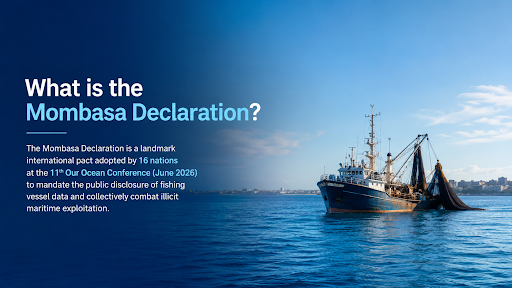
The Mombasa Declaration is a landmark international pact adopted by 16 nations at the 11th Our Ocean Conference (June 2026) to mandate the public disclosure of fishing vessel data and collectively combat illicit maritime exploitation.
IUU fishing (Illegal, Unreported, and Unregulated) refers to illicit global fishing activities—such as operating without licenses or in protected zones—that deplete marine stocks and cost the global economy up to $50 billion annually.
Fisheries transparency is critical because it exposes hidden vessel ownership structures, allows authorities to track industrial fleets in real-time, and prevents rogue actors from plundering sovereign waters.
The declaration supports SDG-14 (Life Below Water) by directly implementing Target 14.4, which explicitly mandates the effective regulation of harvesting and the complete elimination of destructive, illegal fishing practices to restore fish stocks.


© 2026 iasgyan. All right reserved