A World Inequality Lab study highlights India's deep structural land disparity, where the top 10% own 44% of land. To address this, India must adopt smart governance through digital mapping, legalizing tenant farming, and empowering women's collective models.
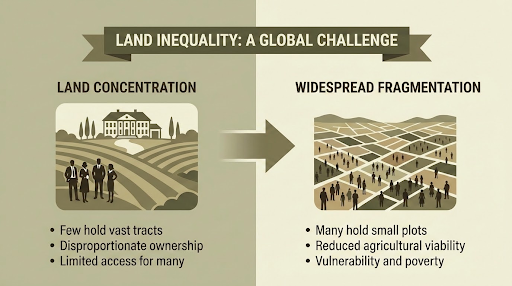
A paper titled ‘Land Inequality in India,’ by the World Inequality Lab (WIL), a research center based at the Paris School of Economics, highlights an extreme concentration of agricultural land.
Extreme Wealth Concentration: The top 10% of rural households own 44% of the total agricultural land, while the top 1% alone controls 18%.
Widespread Landlessness: 46% of all rural households in India are completely landless.
High Village-Level Inequality: Average village land Gini index (a measure of inequality) is an alarming 71 (where 100 is maximum inequality). Kerala has the highest Gini coefficient at 90.
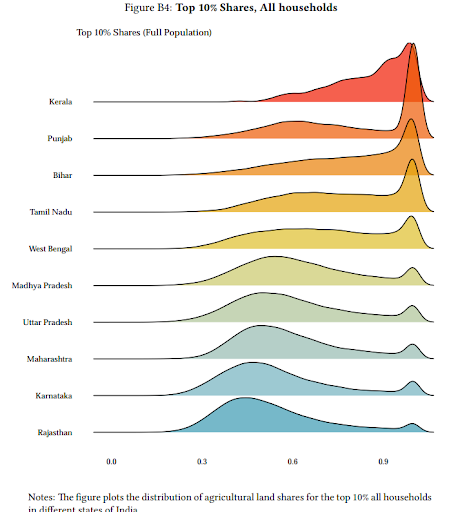
Dominance of Mega-Landholders: On average, the single largest landowner in a village controls 12.4% of the village's land. In 3.8% of villages, a single owner holds over half the land.
Market and Infrastructure Paradox: Villages with better infrastructure and market access show higher land concentration.
Historical Legacy of Colonialism: Former British-ruled villages under the Zamindari system exhibit land inequality 3-4 percentage points higher than former princely states.
Ineffective Post-Independence Land Reforms: While the abolition of intermediaries was successful, the implementation of Land Ceiling Acts largely failed. Landlords used loopholes like:
Socio-Cultural Stratification: Agricultural holdings remain tied to the caste system.
Agrarian Distress & Poverty: Landless households are forced into being daily wage labour, lack of asset ownership traps them in poverty.
Financial Exclusion: Tenant farmers and sharecroppers lack land titles to use as collateral, excluding them from institutional credit, crop insurance, and schemes like PM-KISAN.
Political Elite Capture: Large landowners dominate Panchayati Raj Institutions (PRIs), influencing the allocation of local resources and public works in their favour.
Environmental Degradation: Short-term tenants have no incentive to invest in sustainable practices like soil conservation or efficient irrigation, leading to resource depletion.
Digitize and Formalize Land Records: Accelerate the SVAMITVA Scheme, as it provides villagers the official property cards, which can be used to secure bank loans and reduce disputes.
Legalize and Regulate Land Leasing: Encourage States to adopt the Model Agricultural Land Leasing Act, 2016.
Empower Women through Collective Farming: Women perform a majority of agricultural labour but hold less than 14% of land. (Source: Agriculture Census).
Redistribute Ceiling-Surplus and Wastelands: State governments should distribute ceiling-surplus, Bhoodan, and cultivable wastelands to landless households, prioritizing SC, ST, and women-headed families.
Modernizing land governance through technology, progressive laws, and collective empowerment is essential to tackling India's deep-rooted rural inequality and ensuring inclusive growth.
Source: INDIANEXPRESS
|
PRACTICE QUESTION Q. Despite decades of land reforms, land ownership in rural India remains deeply unequal and inextricably linked to caste and colonial history." Discuss. 150 words |
The study reveals that the top 10% of rural Indian households own 44% of total agricultural land, while 46% of rural households are completely landless. It also highlights extreme village-level inequality, with Kerala having a land Gini coefficient of 90.
Persistent inequality is rooted in the historical colonial legacy (like the Zamindari system), loopholes in post-independence Land Ceiling Acts (such as "Benami" transactions), and deeply entrenched socio-cultural stratification related to the caste system.
SVAMITVA is a central government scheme that uses drone technology to map inhabited rural areas and provide formal property cards. This digital formalization helps reduce land disputes and allows rural citizens to legally monetize their land to access bank loans.




© 2026 iasgyan. All right reserved