Jawaharlal Nehru was a central figure in India’s freedom struggle and the principal architect of the country’s early post-independence framework. As India’s first Prime Minister, he laid the foundations of parliamentary democracy, secularism, planned economic development, scientific advancement, and an independent foreign policy based on the Non-Aligned Movement. His vision of a modern, self-reliant, and progressive nation continues to influence India’s political, economic, and global trajectory.
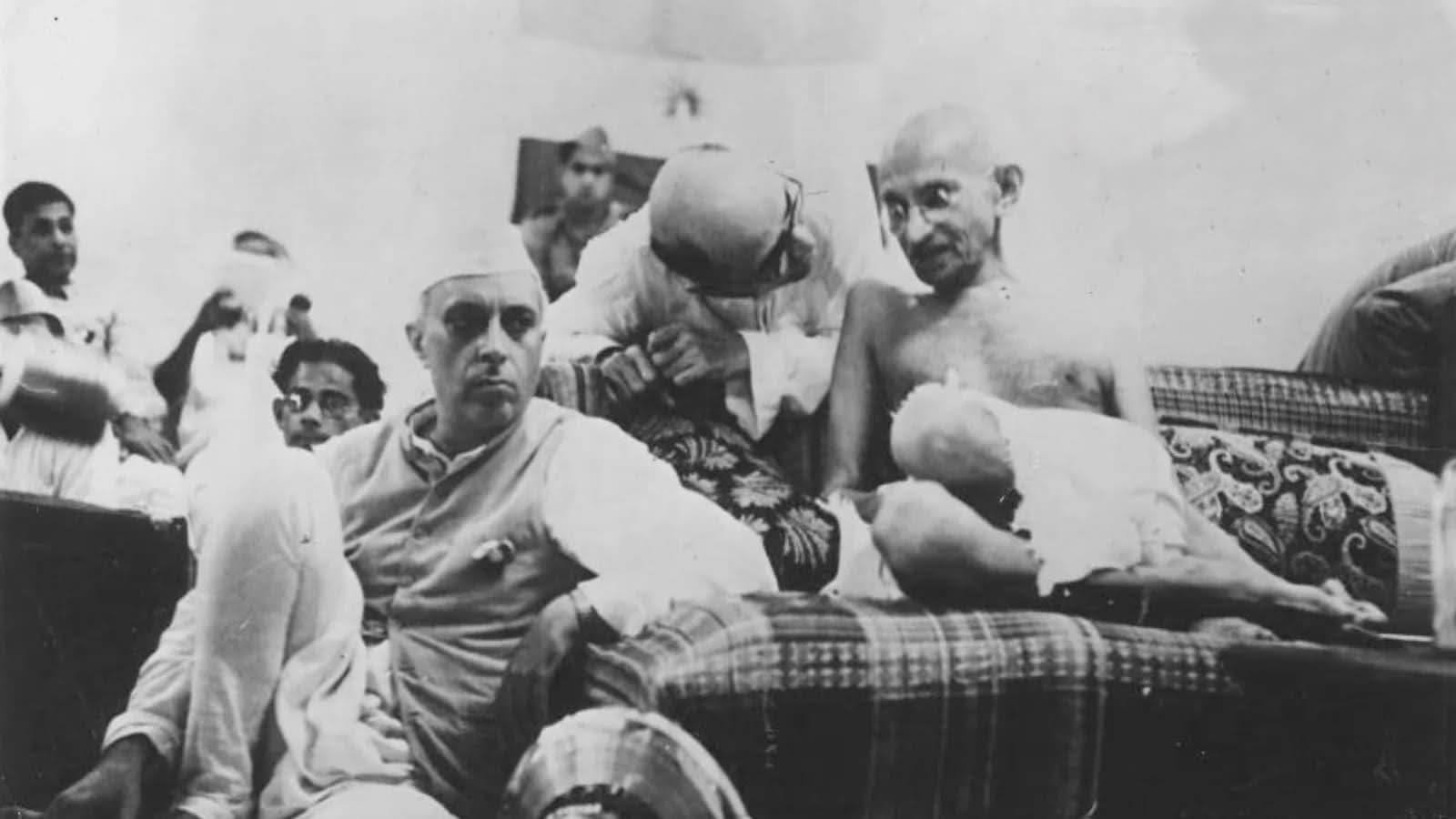
Copyright infringement not intended
Picture Courtesy: Indian Express
Context:
|
Must Read: PANDIT JAWAHARLAL NEHRU | NEHRU MEMORIAL MUSEUM AND LIBRARY (NMML) | |
Prime Minister Narendra Modi’s 97-minute reply to the Motion of Thanks in the Rajya Sabha, dominated by repeated references to Jawaharlal Nehru.
Early Life:
Jawaharlal Nehru was born on 14 November 1889 in Allahabad (present-day Prayagraj) into a prominent Kashmiri Pandit family. His father, Motilal Nehru, was a renowned lawyer and a two-time President of the Indian National Congress, while his mother was Swarup Rani Nehru.
Nehru received his early education in England, studying at Harrow School and later at Trinity College, Cambridge. After completing legal training, he returned to India in 1912 and briefly practised law before entering active politics.
Ideological orientation:
Nehru’s political thought combined nationalism, democracy, secularism, and social justice. He was influenced by Fabian socialism as well as elements of Marxist analysis, which shaped his vision of a modern, industrial, and socially equitable India.
Role in the Freedom Struggle:
Role in the Interim government and nation-building:
Constitutional vision: As the head of the Interim Government and a leading figure in the Constituent Assembly of India, Nehru played a foundational role in shaping the political framework of independent India. He moved the Objective Resolution, which articulated the principles of sovereignty, democracy, justice, and equality, and later became the philosophical foundation of the Preamble to the Indian Constitution.
Economic and scientific development: After independence, Nehru focused on building a modern and self-reliant nation through planned economic development. He advocated a mixed economy with a strong public sector to drive industrial growth while also encouraging import substitution industrialisation to reduce external dependence. Recognising the importance of knowledge and innovation, he established premier institutions of higher education and scientific research, while also promoting advancements in atomic energy, infrastructure, and technological capability as essential pillars of long-term national development.
Foreign policy legacy: Nehru was the chief architect of India’s early foreign policy, which aimed to safeguard national autonomy in a polarised Cold War environment. His approach emphasised Non-Aligned Movement and strategic independence from military blocs, while promoting peaceful coexistence among nations. At the same time, he supported anti-colonial struggles and encouraged cooperation and solidarity among newly independent countries in Asia and Africa, positioning India as a leading voice of the developing world.
Differences Between Mahatma Gandhi and Jawaharlal Nehru:
|
Basis |
Mahatma Gandhi |
Jawaharlal Nehru |
|
Vision of India |
Gandhi envisioned India as a decentralised civilisation where self-sufficient villages formed the core of political, economic, and social life, thereby ensuring harmony, participation, and grassroots democracy. |
In contrast, Nehru imagined India as a modern, unified nation-state in which strong central institutions, constitutional governance, and national planning would drive stability and progress. |
|
Development Approach |
Consistent with his village-centric vision, Gandhi emphasised rural upliftment, cottage industries, and local self-reliance so that development could generate employment while preserving social balance and sustainability. |
Building on his modernist outlook, Nehru prioritised large-scale industrialisation, infrastructure development, and economic planning, believing that rapid structural transformation was necessary to overcome poverty and backwardness. |
|
Economic Philosophy |
Gandhi’s economic thought flowed from his ethical principles, as he advocated trusteeship, limits on consumption, and voluntary redistribution to achieve social justice through moral responsibility. |
By contrast, Nehru supported a socialist-oriented mixed economy in which the state would actively plan production, expand the public sector, and intervene to reduce inequalities and accelerate growth. |
|
View on Technology |
Reflecting his concern for human welfare, Gandhi remained cautious about excessive mechanisation, fearing that uncontrolled industrial technology could displace labour and weaken social cohesion. |
Nehru, however, saw science and technology as instruments of national empowerment and therefore promoted heavy industries, research institutions, and modern infrastructure as the foundations of a new India. |
|
Political Structure |
In line with his faith in local communities, Gandhi preferred a bottom-up political order with power decentralised to village institutions and minimal dependence on central authority. |
Nehru, responding to the challenges of governing a diverse and newly independent country, favoured a strong central government capable of maintaining unity and implementing nationwide policies. |
|
Method of Political Action |
Gandhi’s political method was rooted in non-violence, Satyagraha, and moral persuasion, through which he mobilised masses and transformed politics into an ethical struggle. |
While deeply influenced by Gandhi’s leadership during the freedom movement, Nehru’s post-independence approach shifted towards institutional governance, administrative efficiency, and policy-driven transformation. |
|
Tradition and Modernity |
Drawing strength from India’s civilisational heritage, Gandhi emphasised spirituality, cultural traditions, and simple living as the moral basis of public life. |
Nehru, on the other hand, promoted secularism, scientific temper, rationality, and a forward-looking modern identity suited to the needs of a contemporary nation. |
|
International Outlook |
Extending his philosophy to global affairs, Gandhi believed India should contribute to world peace through moral leadership and the universal principle of non-violence. |
Translating these ideals into practical diplomacy, Nehru shaped India’s foreign policy around strategic autonomy and leadership in the Non-Aligned Movement, while supporting decolonisation and Afro-Asian solidarity. |
Major works:
Nehru was also a prolific writer. His notable books include:
Awards:
Conclusion:
Jawaharlal Nehru played a pivotal role in both India’s freedom struggle and its early nation-building phase, laying the foundations of parliamentary democracy, secularism, planned economic development, and scientific advancement. As independent India’s first Prime Minister, his vision of a modern, self-reliant, and globally respected nation continues to shape the country’s political, economic, and foreign policy framework.
Source: Indian Express
|
Practice Question Q. Discuss the role of Jawaharlal Nehru in India’s freedom struggle and critically examine his contribution to nation-building after independence. (250 words) |
He laid the foundation of parliamentary democracy, secularism, planned economic development, scientific institutions, and an independent foreign policy, which together shaped the structure and direction of modern India.
Nehru actively participated in major national movements such as the Non-Cooperation Movement, Civil Disobedience, and the Quit India Movement, faced multiple imprisonments, and emerged as a key leader of the Indian National Congress.
Nehru was the chief proponent of strategic autonomy through the Non-Aligned Movement, while promoting peaceful coexistence, decolonisation, and cooperation among newly independent nations.



© 2026 iasgyan. All right reserved