Petroglyphs are prehistoric rock carvings made by incising or picking rock surfaces. India’s first conservation park in Leh protects these "open-air museums" from development, preserving a 5,000-year record of trade, culture, and ecology.
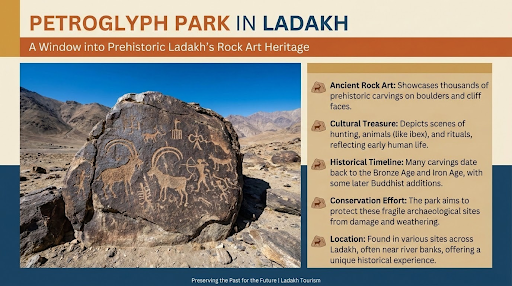
India's first Petroglyph Conservation Park established at Sindhu Ghat in Leh, Ladakh, to protect ancient rock art from the Indus and Zanskar belts.
Petroglyphs are ancient images or symbols created by removing part of a rock surface through carving, incising, picking, or abrading.
Unlike pictographs, which are painted onto rocks, petroglyphs are physically etched into the stone.
Technique: Created by pecking through a rock's dark patina with stone tools to reveal lighter stone beneath.
Purpose: Functioned as non-verbal records of history, territory, and religious rituals.
Durability: Physical engraving makes them weather-resistant, allowing survival over millennia.
The foundation stone for this park was laid at Sindhu Ghat on the banks of the Indus River, to protect Ladakh’s "stone records" from the pressures of modern development.
Threat Mitigation: The park safeguards ancient carvings from unregulated tourism, infrastructure projects, and environmental decay.
Ex-Situ Conservation: Isolated, vulnerable carvings are being relocated to the park to ensure physical safety and facilitate public education.
Institutional Collaboration: The UT’s Department of Archives and the Archaeological Survey of India (ASI) signed an MoU for joint scientific management.
Vast Heritage: Ladakh hosts nearly 400 petroglyph sites predominantly located along the Indus and Zanskar rivers, making it one of the densest rock art clusters in South and Central Asia.
Human Record: These petroglyphs act as "open-air museums," offering a continuous record of human civilization from the Neolithic period to the historical period.
Silk Road Crossroads: The art reflects Ladakh’s historical role as a junction for trade and culture, showing influences from the Indus Valley, Tibet, and Hellenistic cultures.
Fauna: The Ibex is the most frequent motif, historically representing fertility and prosperity. Other figures include snow leopards, yaks, and the Bactrian camel, indicating ancient trade links.
Social Life: Depictions of hunting scenes, dance formations, and early weaponry provide insights into the prehistoric social structure of the Dards and other early settlers.
Religious Transition: Later carvings include Buddhist symbols like Chortens (Stupas) and Tibetan inscriptions, documenting the region's spiritual evolution.
Source: MSN
|
PRACTICE QUESTION Q. What is the primary difference between a petroglyph and a pictograph? A) Petroglyphs are painted; pictographs are carved. B) Petroglyphs are carved; pictographs are painted. C) Petroglyphs are only found in caves. D) Pictographs are older than petroglyphs. Answer: B Explanation: Petroglyphs are images created by removing the surface of a rock. This is done through techniques such as carving, pecking, incising, or scratching to reveal the lighter-colored stone underneath. Pictographs are images created by adding material to the rock surface. They are painted or drawn using natural pigments like charcoal, minerals (ochre, hematite), or plant dyes, often mixed with binding agents like animal fat or plant resin. |
A petroglyph is a prehistoric image, symbol, or carving that is etched, pecked, or engraved directly onto a natural rock surface. Unlike pictographs, which are painted, petroglyphs are physically carved into the stone, making them highly resilient historical records.
India’s first Petroglyph Conservation Park is being established at Sindhu Ghat in Leh, Ladakh.
The main threats include aggressive infrastructure development (such as road construction and rock blasting), unregulated mass tourism that leads to vandalism and degradation, and climate stress that causes increased freeze-thaw cycles, weakening the stone over time.





© 2026 iasgyan. All right reserved