India faces a sharp rise in hate crimes, undermining constitutional values and social harmony. Despite IPC provisions like Section 153A, the absence of a clear legal definition weakens enforcement. The Supreme Court directions in Tehseen Poonawalla and Law Commission advice highlights the need for a dedicated anti-hate crime law.
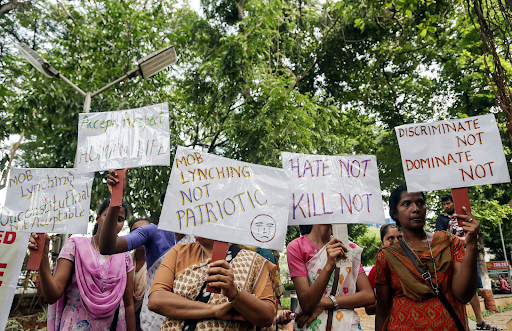
Copyright infringement not intended
Picture Courtesy: institute
Rise in hate crimes in India, including mob lynchings, targeted communal violence, and inflammatory hate speech, threatens the nation's social fabric and constitutional values of equality and secularism.
|
Read all about: HATE SPEECH AND RELIGION l MOB LYNCHING l HATE SPEECH lCOMMUNAL HATRED |
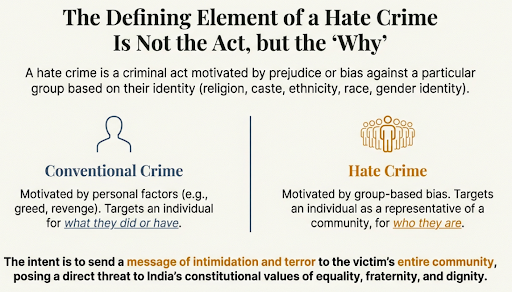
Hate crimes are criminal acts motivated by prejudice against a group's identity. Unlike conventional crimes, a hate crime targets an individual as a community representative, aiming to intimidate the entire group.
In India, hate crimes, though not defined legally, are differentiated by motive: violence based on a victim's religion, caste, ethnicity, race, or gender identity, not their actions.
Tracking hate crimes is difficult because the National Crime Records Bureau (NCRB) stopped collecting specific data on lynchings, religious killings, and hate crimes after 2017, citing reliability issues.
Rising Incidents: Between June 2024 and June 2025, the Association for Protection of Civil Rights (APCR) and the Quill Foundation reported 947 hate-related incidents, including 602 hate crimes and 345 instances of hate speech.
Hate Speech as a Precursor: Data indicates a strong correlation between hate speech and subsequent violence. India Hate Lab, a research group, recorded 1,165 in-person hate speech events in 2024, a 74.4% increase from 668 events in 2023.
NCRB Data on Related Offences: While not direct hate crime data, the NCRB's 'Crime in India 2022' report revealed a 45% increase in cases registered under IPC Section 153A (promoting enmity between groups) between 2021 and 2022.
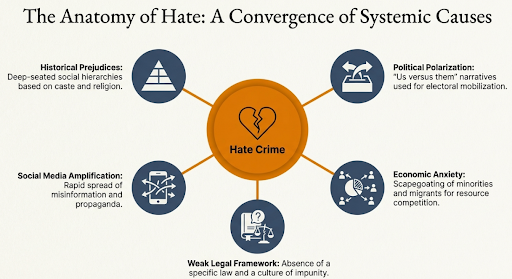
Historical Prejudices
Deep-seated social hierarchies based on caste and religion continue to fuel discrimination and violence. Historical conflicts and colonial-era "divide and rule" policies have left lasting fissures in society.
Political Polarization and Identity Politics
Political actors use "us versus them" narratives and hate speech for electoral gains, escalating communal tensions and promoting a climate of fear and hostility to mobilize vote banks.
Economic Anxiety and Competition
Competition for resources, such as jobs and housing, create hostility, particularly against migrant workers and minority groups who are scapegoated for economic problems.
Role of Social Media
Digital platforms are potent spreaders of misinformation, propaganda, and hate speech. Unverified rumors, especially on platforms like WhatsApp, have been directly tied to inciting mob violence and lynchings.
Weak Legal and Institutional Framework
Absence of a specific law defining and penalizing hate crimes creates legal gaps, and the resulting low conviction rates promote a sense of impunity among perpetrators.
Social Fragmentation
These crimes deepen social divisions, erode trust between communities, and undermine the secular and pluralistic fabric of the nation.
Psychological Trauma
Victims and their communities experience long-term psychological trauma, including fear, anxiety, and a sense of alienation. This fear restricts their freedom of movement, expression, and worship.
Erosion of Trust in State Institutions
Inadequate response from law enforcement and the justice system leads to a loss of public faith in the state's ability to protect its citizens.
Economic Deterrence
Business leaders have warned that rising social instability and hate crimes could damage India's long-term growth by discouraging investment and exacerbating unemployment.
Damage to India's Global Image
Rising intolerance and violence against minorities tarnish India's reputation as a tolerant, democratic nation and attract criticism from international bodies like the UN..
Constitutional Foundation
Bharatiya Nyaya Sanhita (BNS)
The BNS, 2023 (replacing the IPC) contains several provisions used to prosecute hate-related offences, though it still lacks a standalone definition for "hate crime".
Specialized Statutes
State Legislation
Some states are introducing more specific laws to fill federal gaps. For example, the Karnataka Hate Speech and Hate Crimes (Prevention) Bill, 2025 proposes:
Judicial Interventions
Lack of a Specific Definition
Laws lacks a unified definition of "hate crime." Offences are prosecuted under fragmented BNS provisions focused on "public order" rather than bias-motivated harm against individuals.
Subjectivity and Misuse
Vague terms like "injury" or "disharmony" allow subjective judicial interpretation, often resulting in laws being used to suppress political dissent instead of addressing genuine hate speech.
Under-reporting by Victims
Victims often do not report crimes due to fear of reprisal, lack of trust in the police, or the trauma of the event itself.
The "Statistical Blind Spot"
National Crime Records Bureau (NCRB) lacks a distinct hate crime category, merging identity-based violence into generic "rioting" or "group clashes," which obscures the actual scale of the problem.
Law Enforcement Challenges
Police often lack the sensitivity and training to identify bias motivations in crimes, and political pressure hinder proper investigation.
Systemic Bias
Incidents of a "clear bias" in law enforcement, where victims are sometimes detained while perpetrators enjoy impunity, particularly in incidents involving cow vigilantism or interfaith relationships.
Low Conviction Rate
Conviction rate for cases filed under Section 153A was only around 20% in 2020 (Source: Indian Law Watch, 2022). This weak enforcement fails to create a credible deterrent.
Difficulty in Proving Motive
Proving the "hate" or "bias" motive in a court of law is a legal challenge for prosecutors.
Enact Specific Legislation
Adopt new penal provisions, like prohibiting incitement to hatred and fear or provocation of violence, as recommended by the 267th Law Commission Report on Hate Speech (2017).
Improve Data Collection
The NCRB must resume the collection of disaggregated data on hate crimes to understand the scale of the problem and formulate evidence-based policies.
Police Sensitization and Training
Law enforcement agencies need mandatory training modules to help them identify, investigate, and record hate crimes effectively, without prejudice.
Implementation of Tehseen Poonawalla Guidelines
Full operationalization of the 2018 Supreme Court mandates is essential, including:
Mandatory Suo Motu Action
Ensuring police adhere to the 2022 Supreme Court directive to register FIRs immediately in hate speech cases without waiting for a formal complaint.
Victim Support and Protection
Establishing robust victim and witness protection schemes is crucial to encourage reporting and ensure justice. This includes providing legal aid, counseling, and compensation.
Promoting Social Harmony
Long-term solutions require community-based initiatives, educational reforms, and awareness campaigns that promote tolerance, empathy, and respect for diversity.
Learning from International Best Practices
Many countries like the USA, UK, and Canada have specific hate crime laws that provide for enhanced penalties. Key learnings include:

Addressing hate crimes requires a robust legal framework, strong political will, an unbiased criminal justice system, and a societal commitment to inclusivity to ensure India remains a safe and harmonious home for all.
Source: THE HINDU
|
PRACTICE QUESTION Q. As a District Magistrate, you receive reports of a localized mob gathering against migrant laborers based on a social media rumor. Outline your immediate course of action and long-term strategy to restore communal harmony. (20 Marks, 250 Words) |
A hate crime is a criminal act motivated by prejudice against a person or a group based on their perceived identity, such as religion, caste, ethnicity, gender, or sexual orientation. India currently does not have a specific legal definition for it.
The primary drivers include political polarization and divisive hate speech by influential figures, the rapid amplification of fake news and hateful content on social media platforms, socio-economic anxieties that lead to the scapegoating of minorities, and a weak legal framework with poor enforcement and low conviction rates.
There is no specific law, therefore cases are filed under provisions of the Indian Penal Code (IPC), such as Section 153A (promoting enmity), Section 295A (outraging religious feelings), and Section 505 (public mischief). These have now been mapped to corresponding sections in the new Bharatiya Nyaya Sanhita (BNS), 2023.



© 2026 iasgyan. All right reserved