MeitY’s IT Rule amendments risk executive overreach through rapid takedowns and indefinite data retention. While targeting deepfakes and cybercrime, these shifts bypass parliamentary scrutiny and threaten Article 19(1)(a). Critics urge replacing these mandates with a legislated Digital India Act.
Why In News?
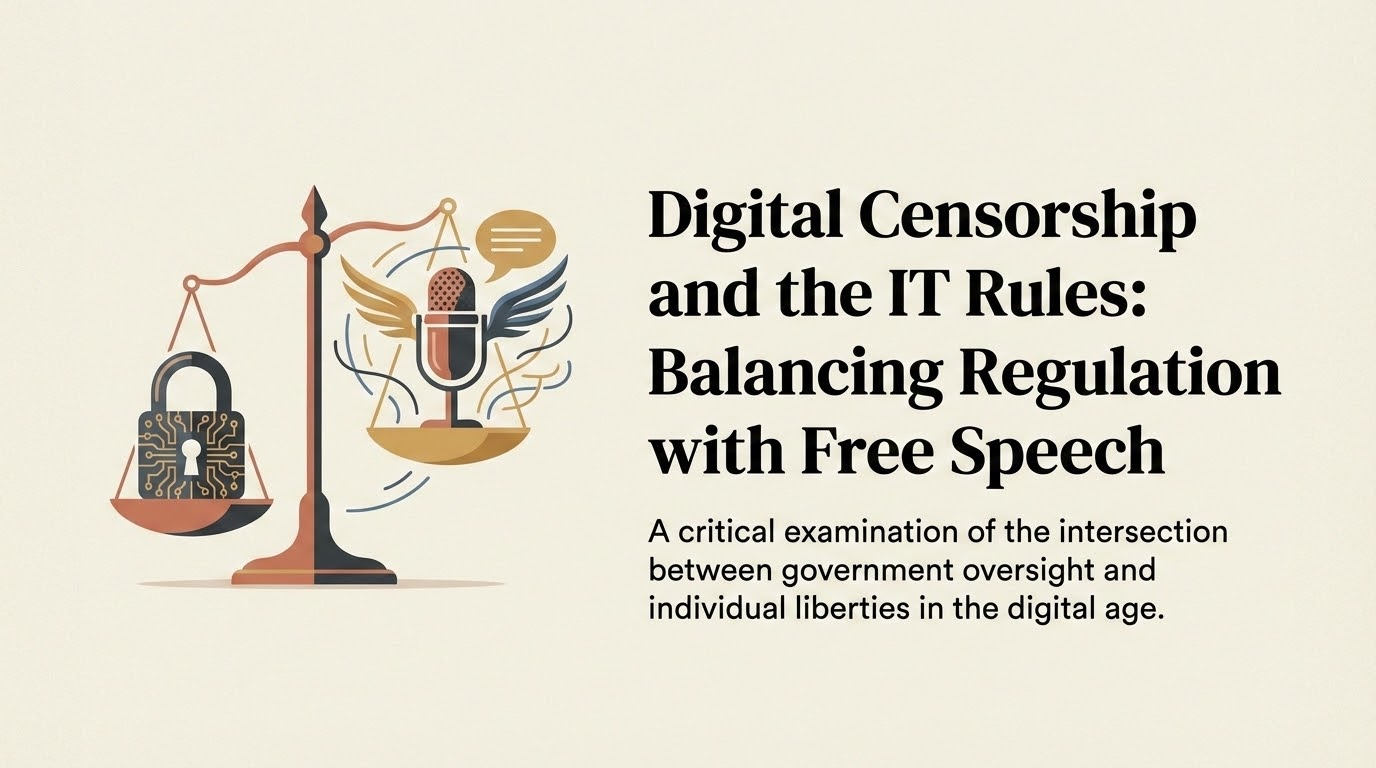
Recent actions by the Ministry of Electronics and Information Technology (MeitY) to block online content under the IT Act have intensified the debate on digital free speech, censorship, and executive overreach.
Key Developments and Proposed Amendments (2026)
Expansion of Oversight (Draft IT Rules, 2026): Extend blocking powers and Code of Ethics compliance to include ordinary users, content creators, and social media influencers, not just formal news publishers.
Legally Binding Advisories: Non-compliance could lead to intermediaries losing their "safe harbour" protection under Section 79 of the IT Act, making them directly liable for user content.
Shortened Takedown Timelines: Takedown windows have been reduced, platforms expected to act within three hours—and in some cases, one hour—of receiving certain government directions.
Decentralized Blocking Power: The government is considering allowing ministries such as Home Affairs, Defence, and Information and Broadcasting to issue direct content-blocking orders, bypassing the centralized MeitY mechanism.
Targeting Critical Content: Increase in takedown notices against social media accounts and journalists, often without public, reasoned orders.
Increasing Digital Connectivity in India
India’s digital revolution has driven broadband subscriptions past 1 billion as of early 2026, fueled by a data cost reduction to approximately ₹9-10 per GB from ₹269 in 2014.
What are the challenges with increasing connectivity?
Fake News & Disinformation: Weaponized to incite communal violence and sway elections.
Hate Speech: Online vitriol often spills into offline riots. Between June 2024 and June 2025 alone, India recorded 947 incidents of hate crime, with a significant portion fueled by online speech. (Source: APCR Hate Crime Report)
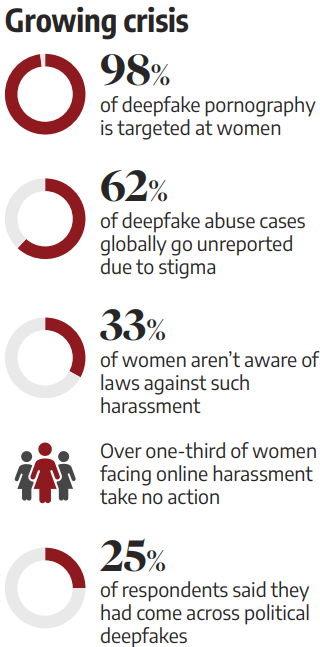
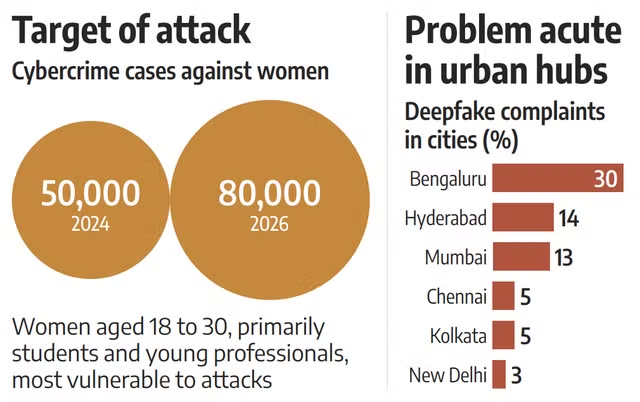
Deepfakes & AI Crimes: The use of Generative AI to create non-consensual sexual imagery or political deepfakes.
Cybercrime
 Government Intervention
The government notified the Information Technology (Intermediary Guidelines and Digital Media Ethics Code) Rules, 2021 to replace the 2011 guidelines, introducing a "soft-touch" oversight mechanism.
|
Provision |
Details |
Mandate for Intermediaries |
|
Takedown Rules |
Rule 3(1)(d): Content must be removed within 36 hours of a court order or govt notification. |
24 Hours: For sensitive content (nudity, impersonation) upon user complaint. |
|
Traceability |
Rule 4(2): "First Originator" identification. |
Significant Social Media Intermediaries (SSMIs) must identify who started a message chain (aimed at viral fake news). |
|
Grievance Redressal |
Rule 10: A 3-tier mechanism. |
1. Grievance Officer: (Company employee, resident in India). 2. Self-Regulatory Body: (Industry-led). 3. Oversight Mechanism: (Inter-departmental committee). |
|
Compliance Officers |
For SSMIs (>50 lakh users). |
Must appoint a Chief Compliance Officer, Nodal Contact Person, and Resident Grievance Officer (all must be Indian residents). |
|
OTT Regulation |
Code of Ethics. |
Age-based classification (U, U/A 7+, U/A 13+, U/A 16+, A). Parental locks required for U/A 13+ and above. |
Legal Basis: These rules were framed under Section 87 of the IT Act, 2000.
Challenges: Regulation vs Free Speech
The "Fact Check Unit" (FCU) Controversy
The Amendment: In 2023, the government amended the rules to establish a Fact Check Unit empowered to label any news related to the "business of the Central Government" as "fake, false, or misleading."
In 2024, the Bombay High Court struck down the FCU provision in Kunal Kamra vs Union of India.
Traceability vs Privacy
The Issue: WhatsApp and Signal use End-to-End Encryption (E2EE). They argue that identifying the "first originator" requires breaking encryption for everyone, violating the fundamental Right to Privacy (Puttaswamy Judgment).
State Stance: Privacy is not absolute; national security (terror funding, riots) takes precedence.
Executive Overreach
The Oversight Mechanism gives bureaucrats the power to order content blocking. Critics argue this bypasses the Section 69A procedure which at least had a review committee.
Way Forward
Proportionality & Judicial Oversight: As per the Puttaswamy test, any restriction on rights must be necessary and proportionate.
Statutory Backing for Regulators: Current rules are "subordinate legislation."
Strengthen Digital Literacy: Regulation treats the symptom; literacy treats the disease.
The "Co-Regulation" Model: Adopting the UNESCO Guidelines (2023) for digital platforms: A multi-stakeholder approach where the State, Civil Society, and Platforms co-create the Code of Ethics, ensuring diversity of views.
Conclusion
Balanced digital governance requires a shift from executive-led takedowns to a transparent, judicially-overseen framework that prioritizes the "Test of Proportionality" to ensure national security measures do not silence legitimate democratic dissent.
Source: INDIANEXPRESS
|
PRACTICE QUESTION Q. Consider the following statements regarding the regulation of digital content in India: 1. Section 69A of the IT Act 2000 empowers the Central Government to block public access to information in the interest of national security. 2. The Shreya Singhal vs Union of India case struck down Section 69A of the IT Act entirely. Which of the statements given above is/are correct? (a) 1 only (b) 2 only (c) Both 1 and 2 (d) Neither 1 nor 2 Answer: A Explanation: Statement 1 is correct: Section 69A of the Information Technology (IT) Act, 2000, grants the Central Government (or its authorized officers) the power to issue directions for blocking public access to any information through any computer resource. This can be done in the interest of India's sovereignty, integrity, defense, national security, friendly relations with foreign states, or public order. Statement 2 is incorrect: In the Shreya Singhal vs Union of India (2015) case, the Supreme Court upheld the constitutionality of Section 69A. The Court ruled that it was narrowly tailored with sufficient procedural safeguards. However, the Court struck down Section 66A of the IT Act entirely, as it was found to be vague and a violation of the right to freedom of speech (Article 19(1)(a)). |
The IT Rules 2021 are executive guidelines framed by MeitY to regulate social media intermediaries, OTT platforms, and digital news portals. Recent amendments mandate strict content takedown timelines, government fact-checking, and rapid removal of AI-generated misinformation.
In this judgement, the Supreme Court struck down Section 66A of the IT Act for being vague and violating free speech. However, it upheld Section 69A, emphasizing that content blocking must adhere to robust procedural safeguards, including providing recorded reasons and a right to be heard.
The government argues tighter rules are necessary to safeguard national security, prevent the spread of AI-generated deepfakes (which surged over 500% recently), curb financial cybercrimes, and ensure large multinational tech companies are accountable to sovereign Indian laws.


© 2026 iasgyan. All right reserved