Digital arrest is a cyber-extortion scam where syndicates use video calls to impersonate law enforcement. Countering this requires I4C-led coordination, AI telecom filters, and international cooperation against Southeast Asian fraud hubs.
The Union Government informed the Supreme Court that WhatsApp banned over 9,400 accounts linked to Digital Arrest scams following a dedicated probe.
|
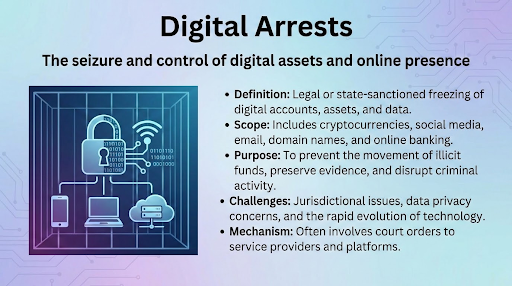
Read all about: Digital Arrest Scams l Digital Arrests |
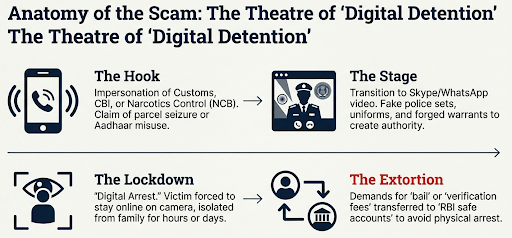
A "Digital Arrest" is a cyber-fraud where criminals impersonate law enforcement (CBI, Customs, or Police) to convince victims they are legally detained in their own homes via video call.
Note: Indian law or government agency does not recognize "Digital Arrest" as a legal procedure.
The scam follows a specific "Fear-Isolation-Extortion" playbook:
Rapid Digitalization: Internet access in 86% of Indian households has vastly increased potential targets. (Source: PIB)
Data Access: Breaches provide criminals easy access to personal details via the dark web.
Cross-Border Syndicates: Many operations run from "cyber-slavery" hubs in Cambodia, Laos, and Myanmar, making tracking difficult.
AI Technology: Fraudsters use AI Deepfakes to mimic the faces and voices of high-ranking officials to increase credibility.
Digital Literacy Gap: While internet usage has surged, awareness of cyber-security protocols has not kept pace.
Fear of Authority: Fraudsters exploit deference toward law enforcement to ensure immediate victim compliance.
Jurisdiction: Slow Mutual Legal Assistance Treaties (MLATs) processes complicate evidence gathering across international borders.
Enforcement: Specialized skills and forensic infrastructure are often lacking in local law enforcement.
Economic Loss: By early 2026, losses from digital arrests were estimated at approximately ₹3,000 crore. (Source: Supreme Court)
Psychological Trauma: Victims suffer from severe anxiety, Post-traumatic stress disorder (PTSD), and in extreme cases, cardiac issues due to prolonged interrogation and fear.
Institutional Distrust: These scams erode public confidence in legitimate law enforcement agencies.
Mule Accounts: Scammers use a network of "mule" accounts (rented from unsuspecting citizens) to quickly disperse and withdraw funds.
Jurisdictional Hurdles: Perpetrators operating from foreign soil are difficult to extradite or prosecute under Indian law.
Encryption: The use of end-to-end encrypted apps like WhatsApp and Skype makes it harder for agencies to monitor or intercept scam calls in real-time.
Indian Cyber Crime Coordination Centre (I4C): Ministry of Home Affairs established as Nodal agency for national cybercrime response coordination.
National Cyber Crime Reporting Portal (NCRP): Online platform (cybercrime.gov.in) for reporting fraud and other cybercrimes.
Helpline 1930: 24/7 support to report financial fraud and block transactions immediately.
Legislative Foundation:
Future Solutions: Proposals include a "transaction kill switch" for instant account freezing and fraud insurance to cover victim losses.
Digital Strikes: The government has blocked over 8.45 lakh fraudulent SIM cards and thousands of Skype/WhatsApp IDs linked to these gangs.
CBI Jurisdiction: The Supreme Court has granted the CBI pan-India jurisdiction to handle these cases without needing individual state consent.
Spoofing Filters: Department of Telecommunications has deployed systems to block international spoofed calls that display Indian (+91) numbers.
Real-time AI Monitoring: Banks should implement AI that flags and pauses high-value transfers from senior citizens to unknown accounts.
Global Cyber Alliances: India must lead a regional bloc with Southeast Asian nations to raid and dismantle scam compounds.
Mandatory KYC for Apps: Enforcing stricter KYC for communication platforms to eliminate anonymous scam accounts.
Legal Reforms: Amend the Information Technology Act, 2000, to penalize social engineering scams like digital arrest with stricter sanctions and expedited trials.
Law Enforcement: Modernize state cyber cells and provide specialized training for the police, prosecutors, and judiciary.
Strategic Collaboration: Promote real-time partnerships between law enforcement, financial institutions, and telecom providers to proactively block fraud.
Adopt Global Models: Implement systems like Singapore’s Anti-Scam Centre to enable immediate account freezing and fund recovery.
Education: Launch a nationwide digital literacy mission to help the public identify and report scams.
Digital arrest is social engineering-driven cyber extortion where syndicates use video calls to impersonate law enforcement and falsely accuse victims. Effectively dismantling these transnational hubs requires I4C coordination, AI anti-spoofing, and MLAT-based legal cooperation.
Source: THEHINDU
|
PRACTICE QUESTION Q. Evaluate the institutional responses by the Government of India and the Reserve Bank of India in countering the rising threat of cyber extortion. 150 words |
"Digital Arrest" is a fabricated term used by cybercriminals. Fraudsters impersonate law enforcement officials via video calls, falsely accuse victims of serious crimes, and demand money to avoid "arrest." Under Indian law, a legal arrest requires a physical warrant; digital arrests do not exist.
Scammers spoof official phone numbers, isolate victims on Skype or WhatsApp video calls, create fake police station or courtroom backgrounds, and present forged official warrants. They use psychological terror to extort money into fake "secret supervision accounts."
MuleHunter.ai is an artificial intelligence tool rolled out by the Reserve Bank of India (RBI) across major Indian banks. It actively monitors transactions to automatically flag and freeze suspected "mule accounts" used by criminals to instantly scatter stolen funds.

© 2026 iasgyan. All right reserved