The Armed Forces (Special Powers) Act (AFSPA) grants extraordinary powers and legal immunity to security forces in "disturbed areas." It permits arrests without warrants, searches, and the use of lethal force to maintain public order against insurgency and internal conflicts.
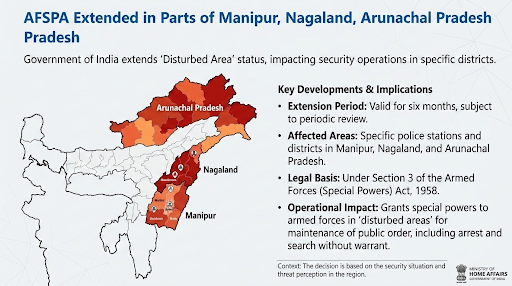
The Ministry of Home Affairs (MHA) has extended the Armed Forces (Special Powers) Act (AFSPA), 1958, in specified parts of Manipur, Nagaland, and Arunachal Pradesh for an additional six months.
The Armed Forces (Special Powers) Act (AFSPA) 1958 grants extraordinary powers to the Indian Armed Forces to maintain public order in designated "disturbed areas".
AFSPA was enacted primarily to address the growing insurgency in the Naga Hills district of Assam. Key reasons included:
Section 3 (Disturbed Area): The Governor, Administrator, or Central Government can declare a region as a "disturbed area" if they deem the situation dangerous enough to warrant armed forces involvement.
Section 4(a) (Lethal Force): Personnel may use force, including causing death, against anyone violating laws banning assembly or carrying weapons, following a warning.
Section 4(c) (Arrest): Security forces may arrest anyone without a warrant if they have committed a cognizable offense or are reasonably suspected of doing so.
Section 4(d) (Search & Seizure): Officers can enter and search premises without a warrant to arrest persons or recover arms/explosives.
Section 5 (Post-Arrest): Arrested individuals must be handed over to the nearest police station with "least possible delay".
Section 6 (Immunity): Legal proceedings against personnel for actions under this Act require prior sanction from the Central Government.
Counter-Insurgency Operation
In regions like Jammu & Kashmir and parts of the Northeast, security forces face sophisticated insurgent groups and cross-border terrorism that the local police are not equipped to handle.
Operational Freedom
Military commanders argue that without the legal protections of AFSPA, soldiers would be hesitant to take decisive action in high-stakes combat situations for fear of frivolous litigation.
National Security
The Act is seen as a tool to prevent the secession of territory and to maintain the "integrity and sovereignty of India" in areas where civil administration has effectively collapsed.
Deterrence
Presence of the armed forces with special powers acts as a deterrent against the regrouping of militant factions in sensitive border areas.
Violation of Fundamental Rights
Critics argue that Section 4, which allows for the use of lethal force and arrest without a warrant, violates the Right to Life (Article 21) and the Right against Arbitrary Arrest (Article 22).
Culture of Impunity
Section 6, which requires Central Government sanction to prosecute personnel, is cited as a "shield" that protects officers from accountability in cases of extrajudicial killings, torture, or disappearances.
Democratic Deficit
Prolonged imposition of AFSPA in certain regions for decades (some since 1958) is seen as a failure of democratic governance, as it normalises a state of exception and military presence in civilian life.
Alienation of Local Populations
Frequent search operations and the presence of armed personnel can lead to deep-seated resentment among locals, which paradoxically fuels the very insurgency the Act aims to suppress.
Misuse of Power
Investigative reports have documented instances where the "disturbed area" status was used to bypass standard criminal procedures, leading to "fake encounters".
Constitutional Validity (1997)
In Naga People's Movement of Human Rights vsUnion of India, the Supreme Court upheld AFSPA's constitutionality but ruled that a "disturbed area" declaration must be reviewed every six months.
Mandatory Guidelines
The 1997 judgment integrated the Army's "Do’s and Don’ts" into the law, requiring that any arrested person be handed over to the police within 24 hours.
No Absolute Immunity (2016)
In EEVFAM vs Union of India, the Court ruled that security forces do not enjoy absolute immunity from prosecution for using excessive or retaliatory force, even in disturbed areas.
Investigation of Encounters
The 2016 ruling mandated that every allegation of an extrajudicial killing by security forces must be investigated through an FIR and a criminal court, regardless of the victim's background.
Human Rights in Conflict
The Court emphasized that "democracy would be in grave danger" if the state is allowed to kill its own citizens without a proper investigation under the guise of maintaining order.
Persistent Security Threats
Insurgency Resurgence: While overall violence has decreased, specific areas in Manipur, Nagaland, and Arunachal Pradesh continue to face ethnic violence and insurgent activities.
Cross-Border Risks: Porous borders with Myanmar allow insurgent groups to find safe havens, making it difficult for security forces to operate effectively without the legal cover AFSPA provides.
Operational & Legal Hurdles
Troop Morale vs. Accountability: The military argues that without AFSPA's immunity (Section 6), soldiers would face a barrage of "frivolous" lawsuits, paralysing decision-making in combat zones.
Inadequate Police Capacity: State police forces in disturbed areas are often under-equipped to handle sophisticated weaponry and guerilla tactics used by insurgents.
Political & Social Tensions
Alienation of Locals: Prolonged military presence creates a "trust deficit" and feelings of alienation among the local population, which insurgent groups exploit for recruitment.
Human Rights Violations: Allegations of extrajudicial killings and lack of transparency in military courts fuel public anger and demand for repeal.
Phased Withdrawal ("Disturbed Area" Review)
The government should continue the policy of reducing the AFSPA footprint area-by-area as the security situation improves, as successfully done in parts of Assam, Nagaland, and Manipur (prior to 2023).
Regular reviews (every 6 months) of "disturbed area" status should be strictly enforced, ensuring the Act doesn't become permanent by default.
Legal & Institutional Reforms
Humanising the Law: Adopt recommendations from the Jeevan Reddy Committee (2005) and Second ARC, such as repealing AFSPA and incorporating its essential powers into the Unlawful Activities (Prevention) Act (UAPA) with better safeguards.
Independent Oversight: Establish independent grievance redressal bodies in each district where the Army is deployed to investigate complaints of misuse swiftly, as recommended by the Santosh Hegde Commission.
Capacity Building
Invest in training and equipping state police forces to take over internal security duties, allowing the Army to return to its primary role of external defense.
Political Solutions
Prioritise peace accords (like the Naga Peace Talks) and development projects to address the root causes of insurgency, rather than relying solely on military solutions.
The Armed Forces (Special Powers) Act (AFSPA) is a necessary but controversial security tool that effectively maintains national integrity in high-conflict zones but requires greater accountability and periodic review to balance state power with the fundamental human rights of citizens.
Source: MSN
|
PRACTICE QUESTION Q. With reference to the Armed Forces (Special Powers) Act (AFSPA), 1958, consider the following statements:
Which of the statements given above is/are correct? A) 1 and 2 only B) 3 only C) 2 and 3 only D) 1, 2, and 3 Answer: B Explanation: Statement 1 is Incorrect: Under Section 3 of the AFSPA, 1958, the power to declare an area as "disturbed" is vested in both the Central Government and the State Government (the Governor). The Central Government can unilaterally declare an area disturbed even if the State Government disagrees, as seen in various instances in the Northeast. Statement 2 is Incorrect: There is no statutory minimum period of one year mentioned in the Act. However, following the judgment in Naga People's Movement for Human Rights vs Union of India (1997), the Supreme Court ruled that the declaration of a "disturbed area" must be reviewed periodically, at least once every six months. Statement 3 is Correct: Under Section 4(c) of the Act, any commissioned officer, warrant officer, or non-commissioned officer may arrest, without warrant, any person who has committed a cognizable offence or against whom a "reasonable suspicion" exists that he has committed or is about to commit a cognizable offence. |
The Armed Forces (Special Powers) Act (AFSPA) was enacted by Parliament in 1958 initially to quell armed rebellion in the Naga Hills. It grants extraordinary powers to the armed forces to maintain public order in regions classified as "disturbed areas" where civil administration is deemed inadequate.
Under Section 3 of AFSPA, the Governor of a State, the Administrator of a Union Territory, or the Central Government possesses the authority to declare the whole or part of a state as a "disturbed area" through an official Gazette notification.a
The extension is primarily due to persistent internal security challenges. These include the unabated ethnic conflict and looted armouries in Manipur, prolonged insurgencies and extortion by shadow governments in Nagaland, and cross-border militancy and drug trafficking in Arunachal Pradesh's porous border districts.

© 2026 iasgyan. All right reserved