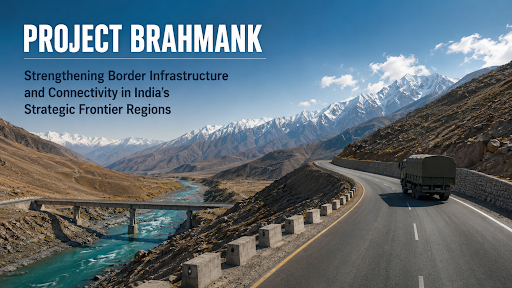
The Vibrant Villages Programme and VVP-II secure borders by transforming frontier outposts into prosperous hubs through connectivity and livelihood generation. This civilian-led "first line of defense" strategically counters external threats while empowering local communities.
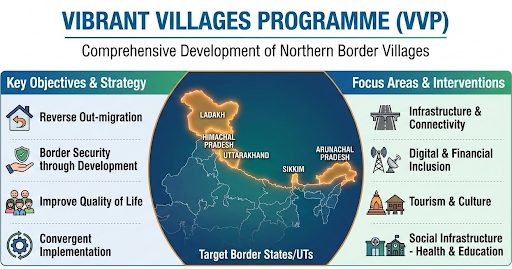
The Vibrant Villages Programme-II has been extended to six strategic border villages in Jammu & Kashmir's Kathua district.
It is a Centrally Sponsored Scheme announced in the Union Budget 2022-23 to develop villages along northern borders.
Objectives: Reverse out-migration: Improve border life quality to sustain a stable civilian presence that supports national security as vital "eyes and ears."
Budget: The Union Cabinet sanctioned ₹4,800 crore for 2022-26, including ₹2,500 crore dedicated to improving road connectivity.
The VVP is implemented through Vibrant Village Action Plans created by District Administrations in coordination with Gram Panchayats. The core components include:
National Security: Establishing a stable civilian presence creates a "human shield" and intelligence network along the Line of Actual Control (LAC).
Socio-Economic Growth: Initiatives like "One Village One Product" and Border Tourism turn stagnant hamlets into prosperous economic hubs.
Revitalizing "Ghost Villages": Reliable infrastructure curbs out-migration, incentivizing youth to return to ancestral lands.
Enhanced Connectivity: All-weather roads and digital networks integrate the Himalayan frontier with the Indian mainland.
Sustainability: Sustainable homestays and local cultivation preserve Himalayan biodiversity and indigenous cultures.
Harsh Terrain and Climate: Extreme weather and high altitudes hinder the costly development of all-weather roads and power grids.
Overlapping Jurisdictions: Lack of Coordination between the Ministry of Home Affairs, State Governments, and the Army/ITBP causes administrative approval delays.
Digital and Energy Issues: Sub-zero temperatures hinder high-speed internet and renewable energy reliability, causing frequent interruptions.
Environmental Risks: Infrastructure projects in the fragile Himalayan ecosystem can trigger disasters like the Joshimath subsidence, requiring careful ecological balancing.
Private Sector Investment: Despite subsidies, attracting investment to high-risk, sparsely populated border areas remains a challenge.
Decentralized Administration
Grant District Collectors and Gram Panchayats financial autonomy to customize projects for local needs (e.g., Ladakh yak husbandry or Sikkim cardamom) without awaiting central clearance.
Digital & Energy Infrastructure
Implement Low Earth Orbit (LEO) satellite connectivity for stable internet and solar micro-grids for resilient power, supporting tourism and surveillance.
Security Convergence
Establish a village-level Civil-Military Liaison Mechanism. Engage the ITBP/Army in development and train locals as first responders for intelligence and disasters.
Sustainable Livelihoods
Subsidize Border Tourism Circuits and homestays. Introduce high-altitude cash crops like sea buckthorn with state-guaranteed buy-backs.
Monitoring & Accountability
Use a GIS Monitoring Dashboard (via PM Gati Shakti) and Social Audits by village committees to ensure transparency and quality.
The Vibrant Villages Programme transforms border hamlets from "last villages" into "first villages," creating a strategic civilian buffer through a community-centric fusion of development and defense to ensure national security and regional resilience.
Source: THEHINDU
|
PRACTICE QUESTION Q. Consider the following statements regarding the Vibrant Villages Programme (VVP): 1. It is a Central Sector Scheme completely funded by the Union Government. 2. It aims to act as a strategic counter to China's 'Xiaokang' villages. 3. The programme focuses exclusively on physical border barriers and military fortification. Which of the statements given above is/are correct? a) 1 and 2 only b) 2 only c) 2 and 3 only d) 1, 2, and 3 Answer: b) Explanation: Statement 1 is incorrect: The Vibrant Villages Programme (VVP) is a Centrally Sponsored Scheme, not a Central Sector Scheme. This means it is jointly funded and implemented by both the Centre and the States/UTs. Statement 2 is correct: VVP is viewed as a response to the development of "Xiaokang" (well-off) villages by China along the Line of Actual Control (LAC) to establish civilian presence in border areas. Statement 3 is incorrect: The programme focuses on socio-economic development, livelihood generation, and civil infrastructure (like roads and digital connectivity) to prevent out-migration, rather than focusing exclusively on military fortifications. |
VVP is a Centrally Sponsored Scheme launched by the Government of India aimed at the comprehensive socio-economic development of border villages. Its goal is to provide essential amenities, reverse out-migration, and transform border regions into secure, thriving communities.
The programme was introduced to counter severe out-migration caused by geographical isolation and extreme poverty in border areas. Strategically, it erves as India's countermeasure against China’s rapid construction of militarized 'Xiaokang' (moderately prosperous) dual-use villages along the Line of Actual Control (LAC).
By empowering and retaining the local population, VVP creates an active network of human intelligence (HUMINT). Local residents, who are highly familiar with the challenging terrain, act as the "eyes and ears" for border guarding forces like the ITBP, allowing for faster detection of cross-border incursions.

© 2026 iasgyan. All right reserved