Agri-Photovoltaics resolves India's land-use conflicts by combining solar power with farming. By turning farmers into Urjadatas, this model boosts rural income and water security. Scaling through PM-KUSUM 2.0 and VGF is vital for achieving India’s 2030 clean energy and food targets.
Copyright infringement not intended
Picture Courtesy: THEHINDU
Why In News?
Experts recommend Agri-photovoltaics (agriPV) to resolve the conflict between energy and food by integrating solar panels directly onto active farmland.
What is Agri-Photovoltaics (AgriPV)?
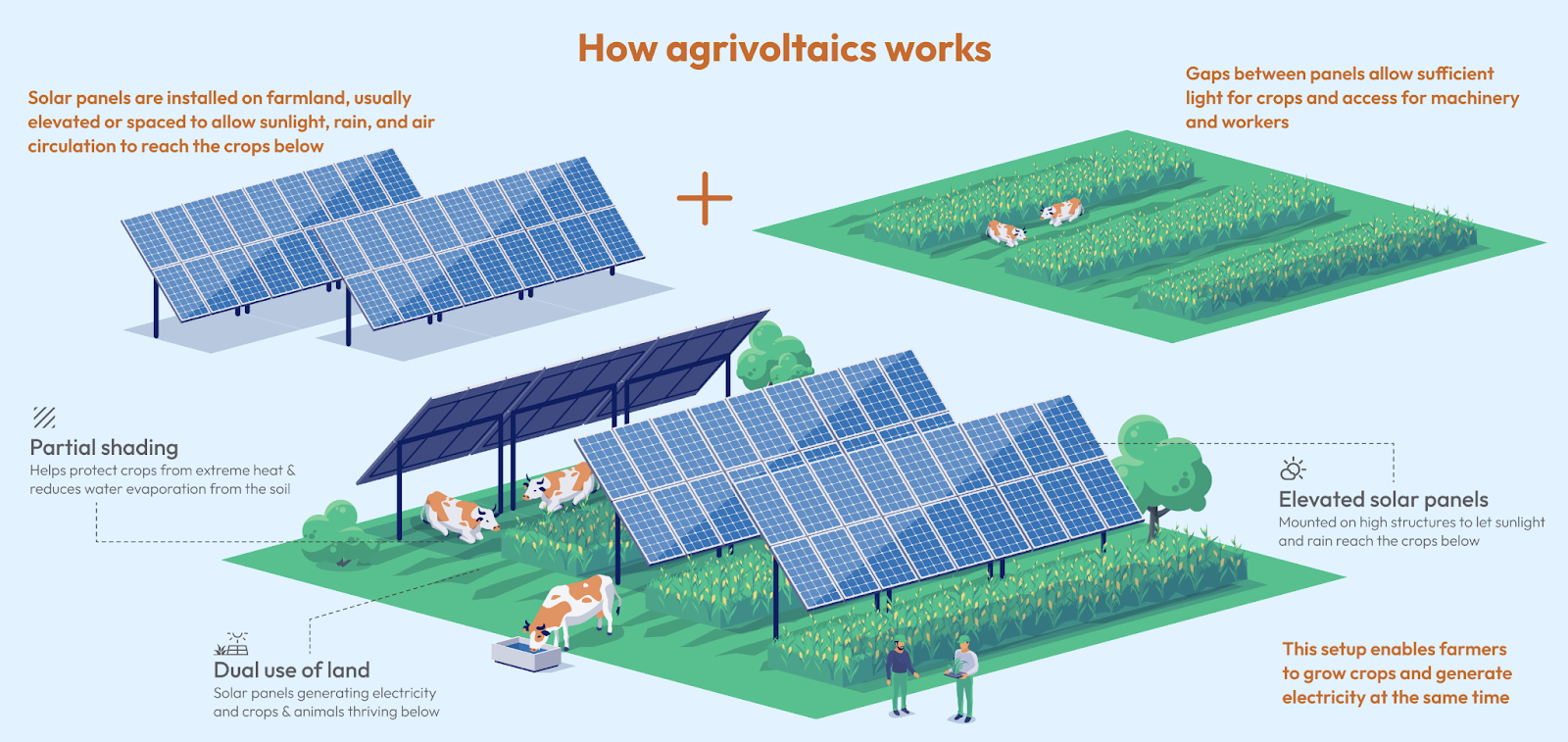
Agri-Photovoltaics (AgriPV), also known as Agrivoltaics, is a dual-use land management strategy where solar photovoltaic panels and agriculture coexist on the same piece of land.
How does it work?
Elevated Structure
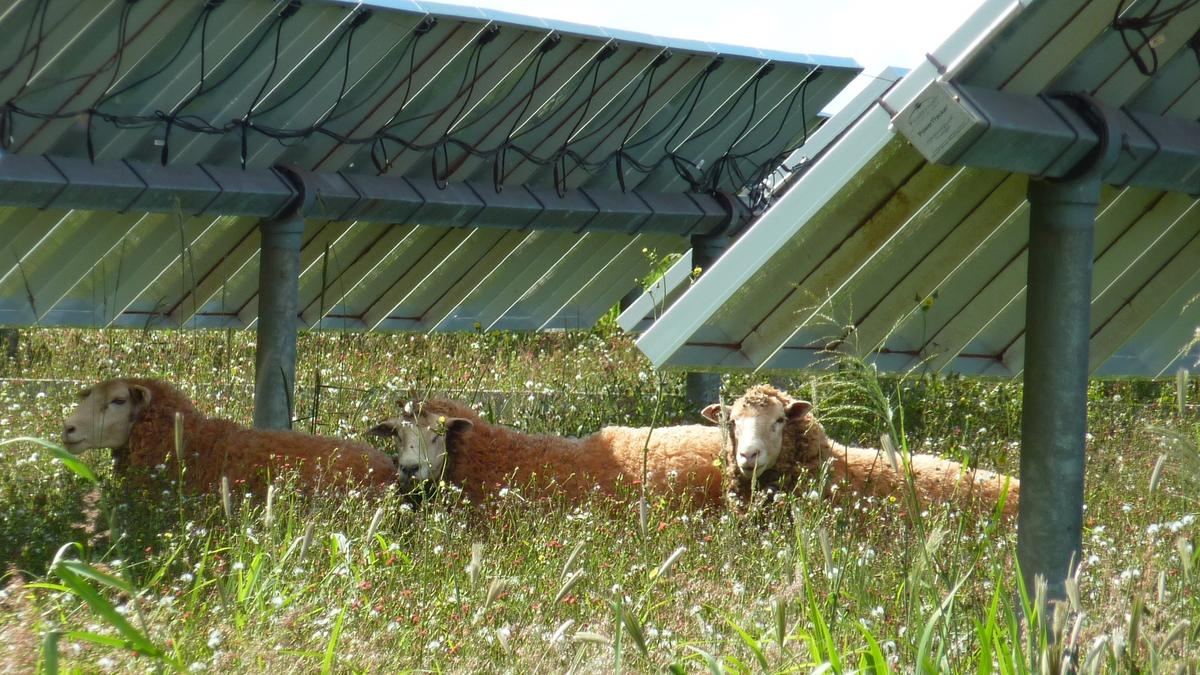
Solar panels are mounted at a height (2.5 to 4 metres) or spaced widely to allow enough sunlight to reach the crops below and provide space for agricultural machinery to move.
Symbiotic Relationship
The plants underneath cool the panels through transpiration, increasing solar efficiency, while the panels provide shade that reduces evapotranspiration (water loss) from the soil.
Key Benefits
Water Conservation: The shading effect can reduce the water required for irrigation by approximately 20% to 40%, making it ideal for arid regions like Rajasthan and Gujarat.
Increased Land Productivity: The Land Equivalent Ratio (LER) of AgriPV systems can be over 60% higher than separate solar and manual farming setups. (Source: Fraunhofer Institute)
Income Security: Farmers gain a "double income"—one from crop sales and another from generating solar power, which can be sold to the grid under schemes like PM-KUSUM.
Suitable Crops
Since the panels create partial shade, shade-tolerant crops perform best in this system:
Key Challenges to Scaling Up AgriPV
High Capital Expenditure (CAPEX)
Installing panels at a height of 2.5 to 4 metres to allow for tractor movement and crop growth requires robust mounting structures. This increases the installation cost by 20% to 30% compared to standard ground-mounted solar. (Source: MNRE Task Force)
Technical Constraints (The Dust Problem)
Agricultural activities like ploughing and harvesting generate significant dust. If panels are not cleaned frequently, dust accumulation can reduce electricity generation efficiency.
Regulatory & Land-Use Barriers
In many states, using agricultural land for solar power requires a "Non-Agricultural (NA)" conversion. This is a complex, bureaucratic process that can strip farmers of their "farmer status" and associated subsidies.
Biological Selection
Not all crops thrive under panels. The system is currently limited to shade-tolerant crops (like ginger, turmeric, and leafy greens), which may not align with the traditional cropping patterns of many regions.
Grid Connectivity
Many rural substations lack the infrastructure to "evacuate" or buy back power from small-scale (0.5 to 2 MW) AgriPV plants, leading to energy wastage .
Way Forward
Unified Policy Framework
States should introduce "Agri-Solar Dual-Use" land classifications that allow solar installation without requiring a full NA conversion, preserving the farmer's legal status and benefits.
Financial Incentives & Green Credit
Expanding the PM-KUSUM Scheme to include higher subsidies specifically for the "elevated structures" of AgriPV to offset the higher Capital Expenditure.
R&D for Crop-Specific Models
Developing region-specific "Shade Models" and identifying climate-resilient, shade-loving varieties of common crops (like certain pulses or fodder) to broaden the scope beyond ginger and turmeric.
Automated Cleaning Systems
Promoting the use of robotic dry-cleaning or water-efficient sprinkler systems integrated with the panels to manage dust without depleting the local water table.
Capacity Building
Training agricultural extension workers (KVKs) to advise farmers on the "Food-Energy-Water" management specific to Agrivoltaic micro-climates.
Conclusion
Agri-photovoltaics transforms farmers from food providers into energy producers, simultaneously securing India’s food and energy future through a synergistic, climate-resilient land-use model.
Source: THEHINDU
|
PRACTICE QUESTION Q. With reference to Agri-Photovoltaics (AgriPV) in India, consider the following statements: 1. It allows simultaneous crop cultivation and solar electricity generation on the same parcel of land. 2. It completely eliminates evapotranspiration, reducing the water required for irrigation to zero. 3. Shade-tolerant crops like ginger and turmeric are generally suitable for cultivation under these panels. Which of the statements given above is/are correct? a) 1 and 2 only b) 1 and 3 only c) 2 and 3 only d) 1, 2, and 3 Answer: b Explanation: Statement 1 is correct: Agri-Photovoltaics (AgriPV) or "Agrivoltaics" is a land-use model where solar panels are installed at a height or in a configuration that allows crops to be grown underneath or between the rows, enabling dual use of the same land for food and energy. Statement 2 is incorrect: While AgriPV creates a micro-climate that reduces evapotranspiration and conserves soil moisture, it does not completely eliminate it. Water is still required for plant growth and photosynthesis, and irrigation needs are reduced by roughly 20–40%, not to zero. Statement 3 is correct: Since solar panels partially block direct sunlight, shade-tolerant or shade-loving crops such as ginger, turmeric, leafy vegetables, and certain medicinal plants are highly suitable for cultivation in these systems. |
AgriPV is an innovative farming method that integrates solar photovoltaic (PV) power generation with agricultural crop production on the same parcel of land. This allows for the dual-use of space, ensuring both food production and clean energy generation.
Utility-scale solar farms require vast amounts of land, which often competes with arable agricultural land. AgriPV resolves this by allowing farmers to grow crops beneath or alongside elevated solar panels, preventing the displacement of agriculture while generating renewable energy.
Beyond generating clean energy, AgriPV panels provide partial shading that reduces evapotranspiration—helping soil retain moisture and improving water-use efficiency by up to 30% in arid regions. Some systems can also be integrated with rainwater harvesting modules.



© 2026 iasgyan. All right reserved