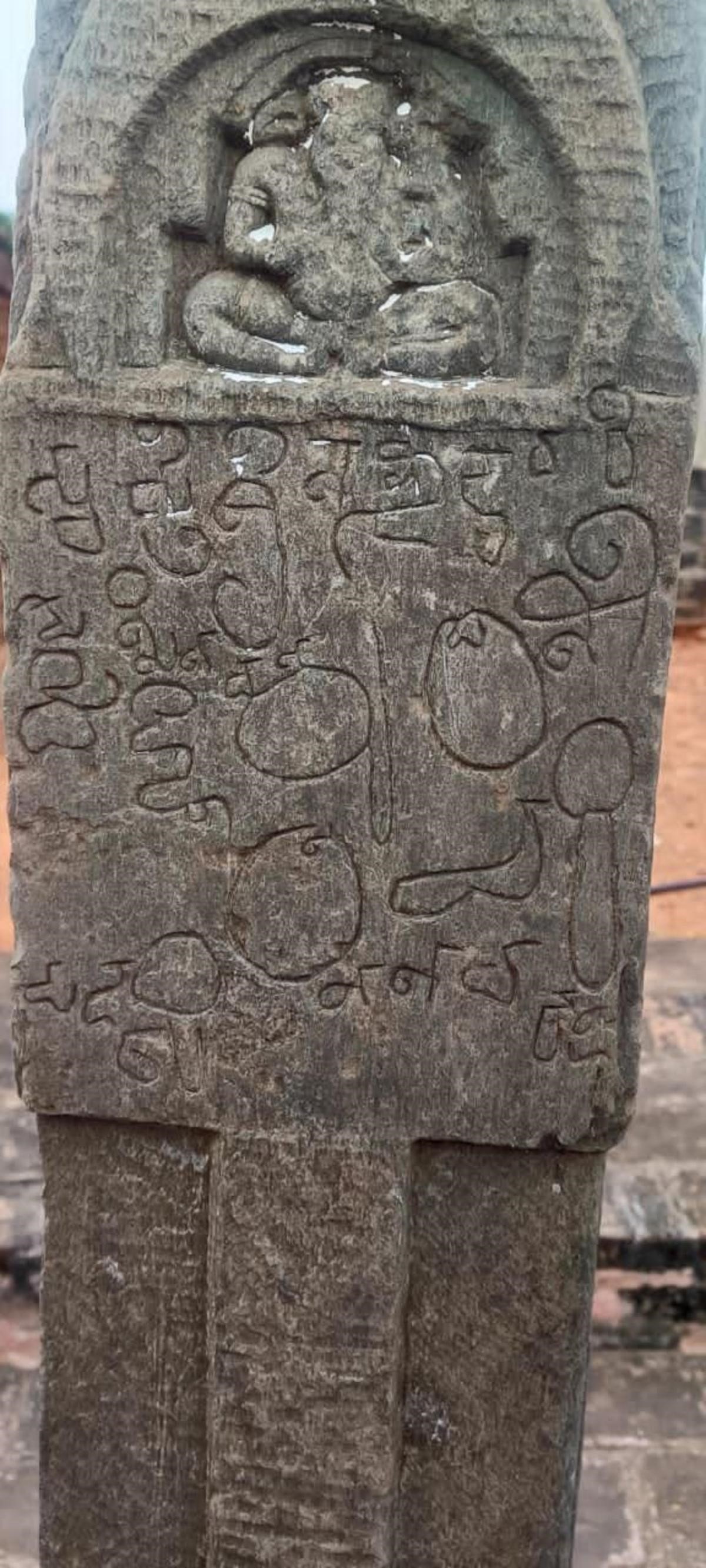
An early 8th-century Telugu inscription was discovered at Pitikayagulla village in Prakasam district, Andhra Pradesh, engraved on a stone slab near the historic Pitikesvara temple. Written in early Telugu script, the four-line record refers to the construction of a new embankment (nava katta), likely linked to irrigation. It mentions Pranimilli Achari, a craftsman, highlighting the role of artisans in public works. The inscription is significant for understanding the evolution of Telugu as a written administrative language, as well as providing insights into rural infrastructure, temple-centered settlements, and social organization in early medieval South India.
Copyright infringement not intended
Picture Courtesy: The Hindu
An early Telugu inscription dated to the 8th century CE has been unearthed at Pitikayagulla village in the Bestavaripeta (Besthavari Peta) mandal of Prakasam district, Andhra Pradesh. It is engraved on a stone slab placed in front of the historic Pitikesvara/Pithikesvara Swamy temple.
|
Must Read: Rare Renati Chola era inscription unearthed | |
Key highlights of the early 8th-century Telugu inscription:
Telegu Language:
Telugu belongs to the Dravidian language family, which is one of the oldest language families in India. It evolved from Proto-Dravidian, and later from Proto-South-Central Dravidian, along with languages like Gondi and Konda. Unlike Indo-Aryan languages, Telugu developed independently in the Deccan region, especially present-day Andhra Pradesh and Telangana.
Early Linguistic Phase: In its earliest phase, Telugu existed mainly as a spoken language used by common people, while Prakrit and Sanskrit dominated inscriptions and administration. Many early Telugu words appear in Prakrit inscriptions of the Satavahanas (2nd century BCE–2nd century CE)
Emergence in Inscriptions (6th–8th Century CE): Telugu began appearing clearly in written form around the 6th century CE, marking the start of its epigraphic history.
Influence of Sanskrit and Prakrit: As Telugu developed, it absorbed a large number of Sanskrit and Prakrit words, especially in areas like religion, governance, and literature. This led to a mixed vocabulary, where Native Dravidian words were used in daily life and sanskrit loanwords dominated literary, religious, and royal contexts
This blending gave Telugu a rich and flexible vocabulary, contributing to its later literary greatness.
Birth of Telugu Literature (11th Century CE): The real literary age of Telugu began in the 11th century CE under the Eastern Chalukyas.
Golden age of Telugu Literature (14th–16th Century): Telugu literature flourished under the Vijayanagara Empire.
Modern development (19th–20th Century): During the colonial period, Telugu underwent modernization and standardization.
Conclusion:
The Pitikayagulla inscription is an important piece of early medieval history that highlights the growing use of Telugu as a written administrative language by the 8th century CE. Its reference to the construction of a public irrigation structure shows the role of local communities and artisans in developmental activities. The record also reflects the transition of Telugu from a spoken vernacular to an epigraphic and functional language. Overall, the discovery enriches our understanding of language evolution, rural infrastructure, and social organization in early Andhra Pradesh.
Source: The Hindu
|
Practice Question Q. How do early regional language inscriptions, such as the 8th-century Telugu record from Andhra Pradesh, help historians reconstruct patterns of local governance and rural infrastructure in early medieval India? (150 words) |
The inscription was found at Pitikayagulla village in Bestavaripeta mandal of Prakasam district, Andhra Pradesh, engraved on a stone slab placed in front of the historic Pitikesvara temple.
It dates back to the early 8th century CE, making it one of the rare early Telugu inscriptions from that period.
The inscription is written in early Telugu language and script, showing the stage when Telugu was emerging as a written language for public records.


© 2026 iasgyan. All right reserved