Copyright infringement not intended
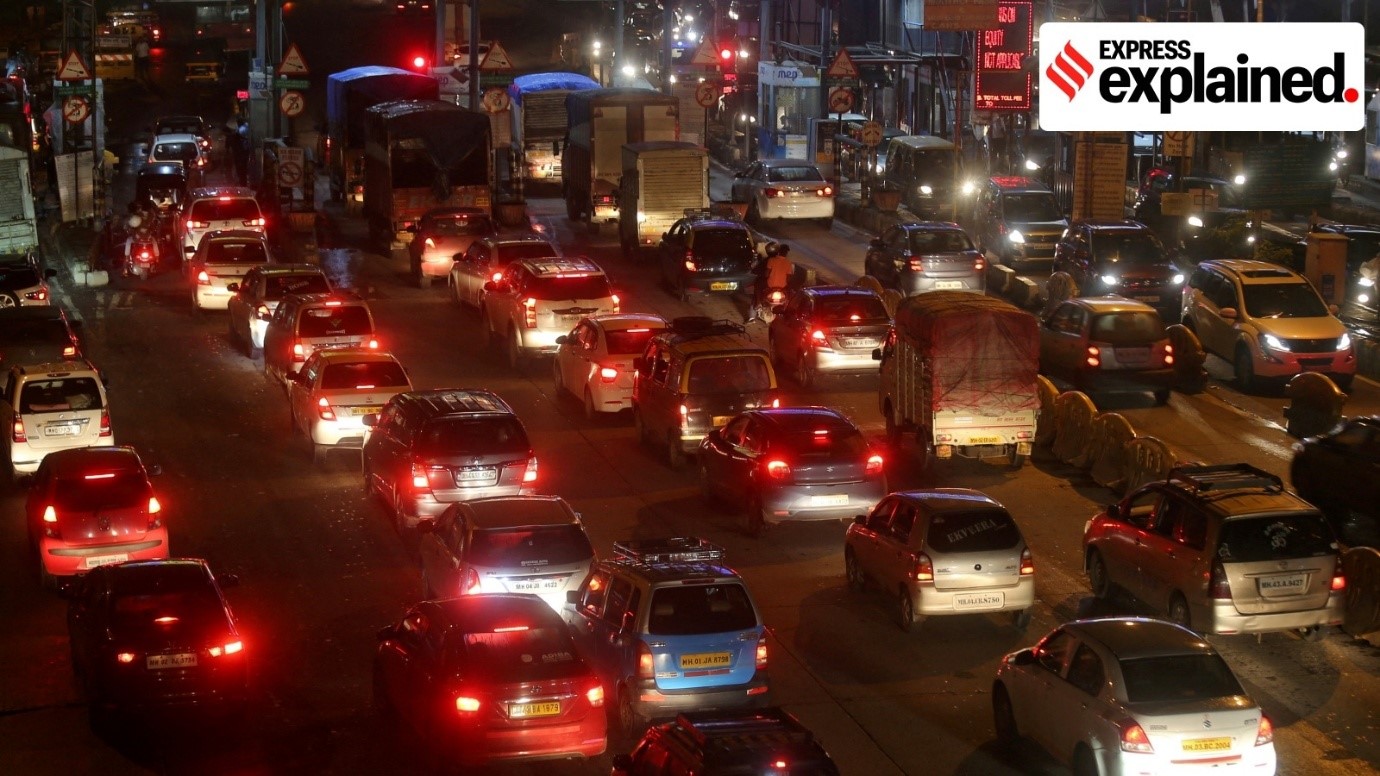
Picture Courtesy: Indian Express
Context:
The government is planning to launch Vehicle-to-Vehicle (V2V) safety technology to prevent road accident deaths and reduce traffic.
Current status of road accidents in India:
- India reported about 4.80 lakh road accidents which resulted in over 1.72 lakh deaths which marks a rise compared to previous years. (Source: PIB)
- UP reported a 2% increase in road accidents and a 12.8% rise in fatalities in 2025 compared to 2024.
- Delhi saw a year-on-year increase in fatalities in 2025, with 1,617 deaths reported, which is 4.2% more than 2024.
- Young adults and working-age adults (especially those aged 18–45) represent a disproportionately high share of victims.
What is V2V (Vehicle-to-Vehicle) Safety Technology?
Vehicle-to-Vehicle (V2V) communication is a wireless system in which vehicles continuously exchange information such as speed, location, direction, braking, and movement intentions with other nearby vehicles around them without relying on the driver’s line of sight or mobile network connectivity.
Working mechanism:
- Onboard Communication Units (OBUs): Each vehicle is equipped with a small device that broadcasts and receives safety data (like speed, braking, position).
- Wireless signals: Vehicles communicate using dedicated wireless technologies (such as DSRC or Cellular V2X) over short distances (typically up to 300 metres).
- Real-time data exchange: Vehicles send and receive this safety info several times per second to maintain an up-to-date picture of nearby traffic.
- Driver alerts (and automation): If a nearby vehicle suddenly brakes or changes direction, alerts can be sent to drivers or even trigger automatic vehicle safety systems to help avoid collisions.
Significance of Vehicle-to-Vehicle (V2V) safety technology:
- Enhances road safety through early collision warnings: V2V technology allows vehicles to exchange real-time information about speed, position, and braking, enabling drivers to receive alerts about potential collisions before they become visible, which significantly reduces the risk of rear-end crashes and sudden pile-ups.
- Extends driver awareness beyond line of sight: By communicating with nearby vehicles, V2V systems can warn drivers about hidden dangers such as vehicles around blind curves, at obstructed intersections, or in blind spots, thereby overcoming the natural limitations of human vision and conventional mirrors.
- Reduces accidents caused by human reaction delays: Since many crashes occur due to delayed braking or poor judgment, V2V technology provides instant automated alerts that give drivers extra reaction time, helping to prevent accidents that result from human error.
- Improves traffic flow and reduces congestion: Continuous data sharing between vehicles allows smoother speed adjustments and coordinated movement, which reduces abrupt braking, minimizes traffic waves, and leads to more efficient and safer traffic flow, especially in densely populated urban areas.
- Supports safer driving in adverse conditions: V2V systems are particularly valuable in poor visibility conditions such as fog, heavy rain, or nighttime driving, where drivers may not be able to see hazards clearly but can still receive timely warnings through vehicle communication.
Challenges of Vehicle-to-Vehicle (V2V) safety technology:
- Rolling out V2V requires widespread adoption: Although the Indian government plans to mandate V2V communication devices in all new vehicles by the end of 2026, the system will take many years to reach most cars and trucks on the road, which limits how quickly it can reduce crashes nationwide.
- High upfront implementation cost: Each vehicle needs an onboard communication unit (OBU), which costs an estimated ₹5,000–₹7,000 per vehicle, and this cost along with installation and standardization places a financial burden on manufacturers and buyers in a price-sensitive market.
- Dependency on mass penetration of technology: V2V technology is most effective when many vehicles share data, but until a large proportion of the vehicle fleet is equipped with these devices, the full safety benefits, especially in mixed traffic conditions with many old vehicles — may not materialize immediately.
- Cybersecurity and data privacy risks: Because V2V systems continuously exchange real-time data such as speed, location, and movement patterns, there are serious concerns about how this information may be protected from misuse, hacking, or unauthorized tracking without robust data protection regulations.
- Potential wireless communication limitations: V2V relies on dedicated short-range wireless signals that must remain reliable in congested urban environments; interference or signal loss could reduce the effectiveness of safety warnings in critical situations.
Global level adoption of V2V Technology:
Japan’s commercial rollouts
Japan was among the first countries where automakers deployed V2X technology commercially: in 2016, Toyota introduced vehicles equipped with Dedicated Short-Range Communication (DSRC)-based V2X communication.
China’s rapid expansion in connected vehicles
China has integrated connectivity technologies into its automotive ecosystem under national industrial strategies like Made in China 2025, promoting the development of connected vehicle applications including V2V and broader V2X systems.
Way Forward:
- Enable nationwide rollout and mandate adoption: To maximise road safety benefits, V2V systems should be mandated in all new vehicles through regulatory policy. India plans to roll out V2V communication technology nationwide by the end of 2026, with new vehicles initially required to have onboard units that share real-time safety data like speed, location, and braking without reliance on mobile networks.
- Establish clear technical standards and spectrum allocation: A dedicated spectrum band (e.g., 5.875-5.905 GHz) should be consistently managed and regulated so all vehicles, manufacturers, and communication systems can communicate reliably. Allocation of this spectrum and setting uniform standards reduces fragmentation and ensures interoperability across different vehicle brands and regions.
- Build robust cybersecurity and data privacy frameworks: Since V2V systems exchange real-time location and movement data, governments must develop strong data protection and cybersecurity protocols to shield against hacking, misuse, or unauthorized tracking, making the technology trustworthy for users.
- Integrate V2V with Intelligent Transport Systems (ITS): V2V must be aligned with broader Intelligent Transportation Systems (ITS), including Vehicle-to-Infrastructure (V2I) integration, adaptive traffic signals, and cloud-based traffic analytics, to enhance overall traffic management, mobility, and safety.
Conclusion:
Vehicle-to-Vehicle (V2V) technology represents a transformative step toward safer and smarter roads by enabling real-time communication between vehicles to prevent collisions before they occur. While it cannot replace the need for better road infrastructure, strict enforcement, and responsible driving behaviour, it adds a powerful preventive safety layer that can significantly reduce accidents caused by human error and delayed reaction. With strong standards, cybersecurity safeguards, and widespread adoption, V2V can become a key pillar of future intelligent transport systems, especially in countries like India where road fatalities remain a major public safety challenge.
Source: Indian Express
|
Practice Question
Q. “Vehicle-to-Vehicle (V2V) communication technology can significantly improve road safety but faces multiple implementation challenges.” Discuss. (250 words)
|
Frequently Asked Questions (FAQs)
V2V is a wireless communication system that allows vehicles to share real-time information such as speed, position, and braking with nearby vehicles to improve road safety.
It provides early warnings about potential hazards like sudden braking, vehicles in blind spots, or traffic at intersections giving drivers more time to react and avoid collisions.
Vehicles exchange safety-related data such as speed, direction, acceleration, braking status, and location not personal information about drivers.