The Ministry of Tribal Affairs is driving inclusive development by promoting community-led tribal homestays through schemes like DAJGUA and PM-JANMAN. By addressing infrastructure gaps and regulatory hurdles, this model aims to preserve culture, curb migration, and create self-sustaining economic engines.
Copyright infringement not intended
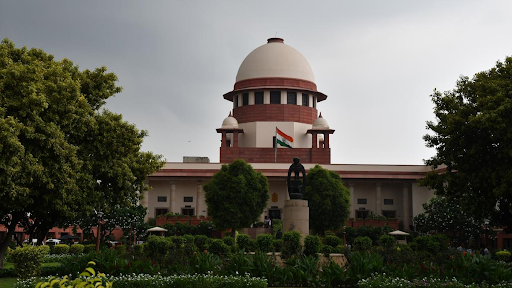
Picture Courtesy: NEWSONAIR
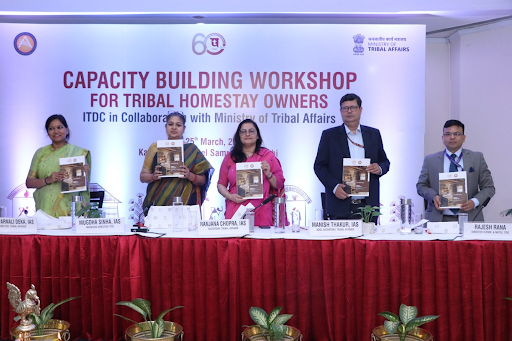
The Ministry of Tribal Affairs organised a Capacity Building Workshop for Tribal Homestay Owners in New Delhi.
|
Read all about: Homestay Tourism in India Explained l Tribal Homestays Scheme Explain |
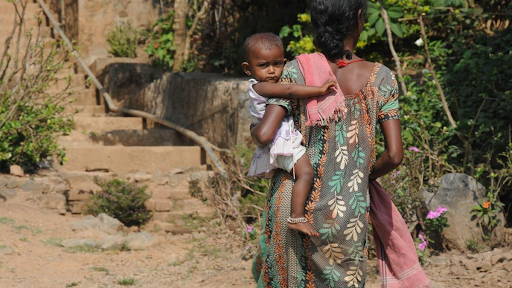
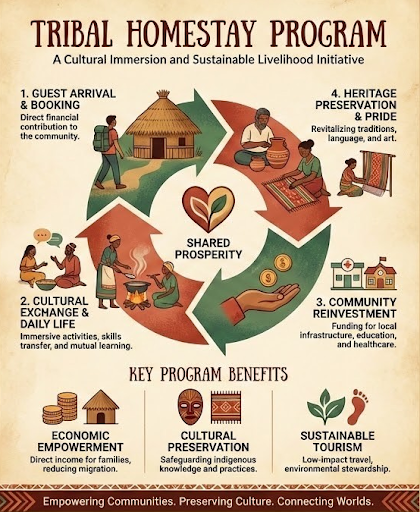
Tribal homestays are a form of community-led sustainable tourism where travelers stay in the homes of indigenous tribal families to experience their authentic culture, traditions, and lifestyle firsthand.
Unlike standard commercial lodging, these homestays are deeply rooted in the local heritage, offering visitors a chance to engage with traditional architecture, indigenous cuisine, and ancestral customs.
Significance of Tribal Homestays
Authentic Cultural Immersion
Guests live with hosts, participating in daily routines such as forest walks, traditional farming, or learning local crafts like basket weaving.
Socio-Economic Empowerment
By keeping tourism revenue circulating locally, this model creates a sustainable rural economy that provides families with a viable alternative to migrating to cities for work.
Cultural Preservation
They turn cultural heritage into a primary livelihood, creating a direct financial incentive for communities to protect their unique traditions, languages, and arts from fading away.
Environmental Sustainability
They promote low-impact eco-tourism by using local materials and traditional methods, preventing the environmental damage caused by large-scale infrastructure.
PM-JANMAN (Pradhan Mantri Janjati Adivasi Nyaya Maha Abhiyan)
A ₹79,156 crore package targeting 75 Particularly Vulnerable Tribal Groups (PVTGs). Provides financial aid directly to tribal households: ₹5 lakh for new homestays and ₹3 lakh for renovation of existing ones.
DAJGUA (Dharti Aaba Janjatiya Gram Utkarsh Abhiyan)
An umbrella program aiming for saturation of welfare schemes in 63,843 tribal-majority villages. Focuses on building critical infrastructure like all-weather roads and electricity, which are essential for tourism development.
Adi Karmayogi Abhiyan
A grassroots leadership program to train 20 lakh change-makers for last-mile delivery of schemes. These trained leaders (Adi Karmayogis, Sahyogis, Saathis) mentor tribal entrepreneurs in establishing homestays and navigating regulations.
Infrastructure Gaps: Many remote tribal areas lack basic all-weather roads and, critically, digital connectivity.
Capacity and Skilling Deficits: Running a successful homestay requires training in hospitality, hygiene, and communication.
Regulatory Bottlenecks: Tribal entrepreneurs often face complex compliance hurdles from multiple departments (forest, tourism, local panchayats).
Implement Single-Window Clearance
States should create unified digital portals in vernacular languages to streamline the approval process for homestays, reducing bureaucratic delays.
Drive Digital Onboarding
Leverage the network of the Adi Karmayogi Abhiyan to train local youth as digital facilitators. They can help homestay owners list their properties on platforms like Airbnb and MakeMyTrip for global visibility.
Enforce Carrying Capacity Assessments
The Ministry of Environment, Forest and Climate Change (MoEFCC) must conduct scientific assessments to set and enforce strict visitor limits in ecologically sensitive tribal areas to prevent over-tourism.
Ensure Seamless Scheme Convergence
District administrations should act as nodal agencies to effectively converge funds and objectives from schemes like PM-JANMAN (housing), DAJGUA (connectivity), and Swadesh Darshan (promotion) to ensure holistic development.
Learnings from Successful Case Studies
Domestic Examples
International Best Practice
New Zealand integrated its indigenous Maori culture into its core national tourism brand, "100% Pure New Zealand." The government supported Maori-owned eco-lodges and cultural tours, transforming it into a multi-billion dollar sector. (Source: UN Tourism Report)
Promoting tribal homestays enables an empowerment-driven model that combines livelihood generation, cultural preservation, and sustainable tourism to support inclusive and self-reliant tribal development.
Source: NEWSONAIR
|
PRACTICE QUESTION Q. "Community-led sustainable tourism has the potential to transform tribal hinterlands from marginalized regions into engines of inclusive economic growth." Discuss. 150 words |
The primary objective is to promote community-led sustainable tourism, providing tribal communities with alternative socio-economic empowerment, reducing distress migration, and incentivizing the preservation of indigenous culture and ecology.
PM-JANMAN (Pradhan Mantri Janjati Adivasi Nyaya Maha Abhiyan) is a ₹79,156 crore mega-package for PVTGs. Its Swadesh Darshan component provides ₹5 lakh for building new homestays and ₹3 lakh for renovating existing ones for tribal households.
DAJGUA is an umbrella program aimed at saturating welfare schemes across 63,843 tribal-majority villages. It works by converging 25 interventions across 17 ministries to build critical physical infrastructure like roads and electrification


© 2026 iasgyan. All right reserved