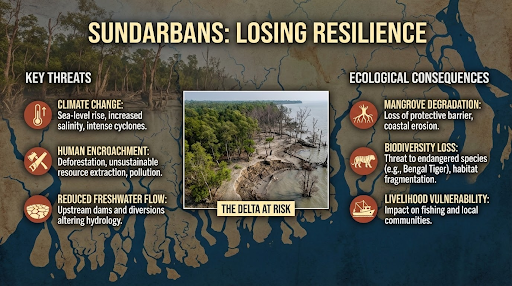
The Sundarbans faces an existential threat as resilience declines due to cyclones and salinity. This degradation risks turning the forest into a carbon source. Recovery requires implementing the MISHTI scheme, transboundary cooperation, and community-led stewardship to prevent collapse.
Why In News?
A study in the journal Communications Earth & Environment, reveals that 10–15% of the Sundarbans has lost its resilience since 2000, signaling a Critical Slowing Down.
What is Critical Slowing Down?
Critical Slowing Down (CSD) is a statistical phenomenon used as an early warning signal that an ecosystem is approaching a "tipping point" or a critical transition toward a total collapse.
It is characterized by:
Key Drivers of Degradation
Climate Change and Extreme Weather
High-Intensity Cyclones: Frequent and severe cyclones have permanently damaged the forest structure, downgrading vast tracts from resilient to weakly resilient categories.
Hydrological Imbalance: Rising temperatures and erratic rainfall disrupt the freshwater balance. This increases salinity stress, forcing mangrove trees to expend more energy on survival (osmoregulation) rather than growth.
Global Trend: This loss of resilience is not isolated; similar trends are being observed in other critical biomes like the Amazon rainforest, indicating a global crisis.
Anthropogenic Pressures
Freshwater Starvation: Upstream dams and barrages restrict freshwater flow, which increases salinity in the delta.
Chemical Pollution: Runoff containing excess phosphorus creates hypoxic (oxygen-deficient) soil conditions, which damages the mangrove root systems.
Land-Use Changes: Encroachment, expansion of commercial shrimp farming, and illegal logging are severely degrading the forest's complexity and health.
Consequences of Ecosystem Degradation
Loss of Structural Complexity: Diverse stands of fast-growing (e.g., Avicennia officinalis) and slow-growing (e.g., Heritiera fomes) species are becoming uniform.
Economic Loss from "Top-Dying" Disease: Decline of the Sundari tree due to salinity-induced disease results in an estimated annual loss of $16.72 million in timber value and ecosystem services.
Carbon Sink to Source Transition: Degraded forest patches are losing their ability to sequester carbon.
Livelihood Collapse: Traditional Resource Users (TRUs), like fishers and honey collectors, face catastrophic income losses.
Increased Coastal Vulnerability: As the mangrove "bio-shield" thins, inland human settlements are directly exposed to storm surges, leading to increased saltwater intrusion into agricultural lands.
Mitigation and Conservation Strategies
MISHTI Scheme (India): The Mangrove Initiative for Shoreline Habitats & Tangible Incomes aims to restore 540 sq. km of mangroves by 2028. It integrates funds from CAMPA and MGNREGS.
Transboundary Cooperation: India and Bangladesh are negotiating the renewal of the Ganges Water Treaty to ensure a minimum freshwater flow to the delta, which is critical for reducing salinity stress.
Community-Led Management: Programs under the Satoyama Initiative promote sustainable livelihoods, such as traditionally dried shrimp packaging, to reduce absolute dependence on fragile forest resources while increasing local income.
"Bio-Shield" Legal Status: Parliamentary Standing Committee Recommended to designate mangroves as critical "bio-shields," backed by a dedicated Coastal Protection Fund to incentivize local conservation efforts.
Technological Monitoring: Utilization of satellite-based monitoring tools to track the "recovery time" of forest patches, allowing for targeted intervention in "Critical Slowing Down" hotspots.
Way Forward
Transboundary Cooperation: India and Bangladesh must collaborate to ensure freshwater flow and conduct joint anti-poaching patrols.
Scientific Management: Integrate climate impact assessments into local policy and scientifically manage sediment flow to support mangrove health.
Community Participation: Aggressively scale up community-led frameworks like MISHTI to ensure conservation efforts are sustainable and equitable.
Learn from Global Best Practices
Conclusion
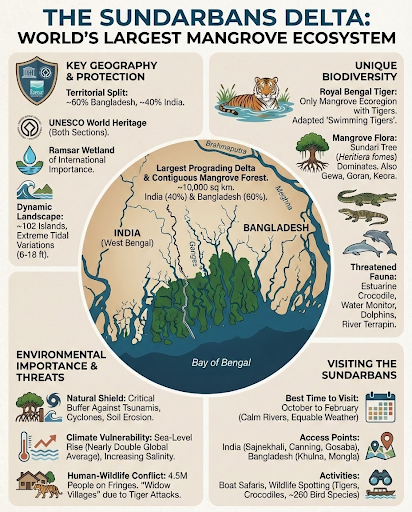
Protecting the Sundarbans is crucial not only for preserving biodiversity but also for securing the climate resilience and socio-economic future of millions in the Bengal delta.
Source: DOWNTOEARTH
|
PRACTICE QUESTION Q. Effective mangrove conservation requires a paradigm shift from reactive disaster management to proactive ecosystem stewardship. Elaborate. 150 words |
It is an ecological phenomenon where the Sundarbans mangrove ecosystem is losing its resilience. It takes progressively longer to recover from environmental shocks like cyclones, experiences fluctuating productivity, and becomes fundamentally unstable.
Human-induced pressures include freshwater starvation caused by upstream dams and barrages, chemical pollution from agricultural runoff, illegal logging, and land-use changes like the expansion of commercial shrimp farming.
MISHTI (Mangrove Initiative for Shoreline Habitats & Tangible Incomes) is a Government of India initiative launched to restore 540 sq km of mangroves across nine coastal states between 2023 and 2028 by converging funds from CAMPA and MGNREGS.



© 2026 iasgyan. All right reserved