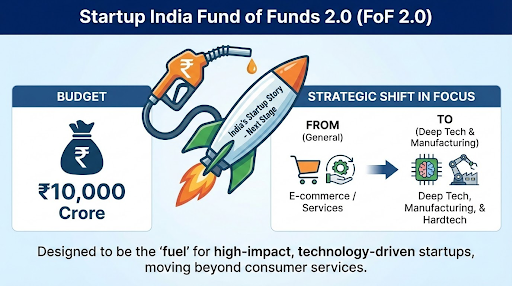
The ₹10,000 crore Startup India Fund of Funds 2.0 shifts focus from e-commerce to Deep Tech, AI, and Robotics. This strategic pivot aims to catalyze high-tech manufacturing and innovation, driving the next phase of India’s economic growth and resilience.
Why In News?
The Union Government notified the Startup India Fund of Funds 2.0 (FoF 2.0) with a ₹10,000 crore corpus to mobilize venture capital, building on the 2016 FFS 1.0 initiative.
What is Startup India Fund of Funds 2.0?
It is a new scheme designed to inject ₹10,000 crore into the Indian startup ecosystem. Operating as a "Fund of Funds," it functions as a capital "wholesaler" rather than investing in companies directly.
What is the "Fund of Funds" Model?
The government does not invest directly in startups.
Key Features of FoF 2.0
The "Four-Pillar" Segmentation
Evolution: FFS 1.0 vs. FoF 2.0
|
Feature |
Fund of Funds for Startups (FFS 1.0) |
Startup India Fund of Funds 2.0 (FoF 2.0) |
|
Launch Year |
2016 |
2026 |
|
Primary Goal |
Ecosystem Building: Creating the initial wave of startups (mostly digital/consumer tech). |
Strategic Capability: Creating global champions in Deep Tech and Manufacturing. |
|
Focus Areas |
Broad and Sector-Agnostic. |
Targeted: Deep Tech, Hardware, and Tier-2/3 inclusivity. |
|
Impact |
Catalyzed ₹25,500+ Cr investment in 1,300+ startups. |
Aimed at ensuring Technological Sovereignty and industrial self-reliance. |
Strategic Significance
Bridging the "Valley of Death": Deep tech startups often fail not because of bad technology, but because they run out of cash before commercialization. FoF 2.0 provides "Patient Capital" (long-term investment) which private VCs often avoid.
Countering "Flipping": Many Indian startups domicile abroad (flip) to access easier capital. A robust domestic capital pool encourages high-value startups to remain headquartered in India.
Regional Inclusivity: By incentivizing investments in Tier-2 and Tier-3 cities, the scheme aims to decentralize the startup boom beyond Bengaluru, Delhi, and Mumbai.
Complementing PLI Schemes: While PLI (Production Linked Incentive) supports large established manufacturers, FoF 2.0 supports the innovative startups that will become the suppliers or disruptors for those industries.
Source: PIB
|
PRACTICE QUESTION Q. With reference to the Startup India Fund of Funds 2.0 (FoF 2.0), consider the following statements: 1. Under this mechanism, the government directly invests capital into deep tech startups to prevent market distortion. 2. The Department for Promotion of Industry and Internal Trade (DPIIT) is the nodal agency, while SIDBI manages the fund deployment. Which of the statements given above is/are correct? a) 1 only b) 2 only c) Both 1 and 2 d) Neither 1 nor 2 Answer: b) Explanation: Statement 1 is incorrect: The government does not directly invest capital into deep tech startups. Instead, the Fund of Funds (FoF) operates by investing in SEBI-registered Alternative Investment Funds (AIFs), which then deploy capital into startups. Statement 2 is correct. The Department for Promotion of Industry and Internal Trade (DPIIT), under the Ministry of Commerce and Industry, is the nodal agency for the Startup India initiative, and the Small Industries Development Bank of India (SIDBI) is the designated agency managing the fund deployment (operating agency) for FFS 1.0 and FoF 2.0. |
FoF 2.0 is a ₹10,000 crore government scheme designed to provide capital to Indian startups. Instead of investing directly, the government channels funds through SEBI-registered Alternative Investment Funds (AIFs) to focus on Deep Tech and Tech-Driven Manufacturing.
Patient capital refers to investments made with a long-term horizon (typically 7 to 10 years) without the expectation of immediate commercial returns. It is crucial for deep tech and R&D startups to survive the "Valley of Death"—the phase where they need extensive capital for testing and development before achieving market viability.
The Department for Promotion of Industry and Internal Trade (DPIIT) is the nodal policy agency, while the Small Industries Development Bank of India (SIDBI) is responsible for the actual management and disbursement of the funds to AIFs (Daughter Funds).



© 2026 iasgyan. All right reserved