The Employees' State Insurance Corporation launched SPREE 2025 to formalise the unorganised workforce by offering one-time amnesty on past dues. It expands ESI coverage and benefits, but success depends on awareness, administrative capacity, and employer compliance, making it a key step toward universal social security.
Copyright infringement not intended
Picture Courtesy: PIB
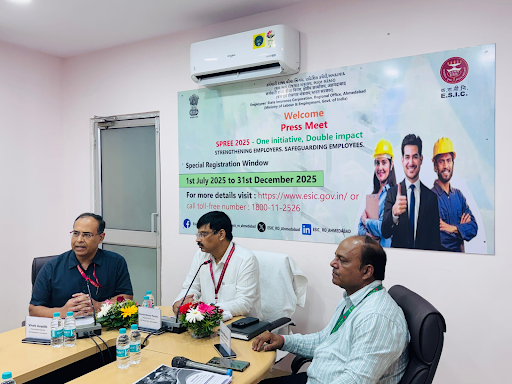
The Employees' State Insurance Corporation (ESIC) launched the SPREE 2025, initially set for July 1, 2025, to December 31, 2025, but extended until January 31, 2026, to maximize its reach.
The Scheme for Promotion of Registration of Employers and Employees (SPREE) 2025 is an initiative by the Employees' State Insurance Corporation (ESIC) to bring more workers under the formal social security framework.
It is a time-bound opportunity for employers to voluntarily register their establishments and employees under the ESI Act, 1948, without facing penalties for past non-compliance.
Scheme Duration
Originally from July 1, 2025, to December 31, 2025. It has been extended for one month until January 31, 2026, due to representations from employers and state governments.
'Amnesty' Clause
Provides a one-time opportunity for registration with full immunity from past liabilities.
No Retrospective Action
Digital Registration
Employers can register easily through multiple online portals: ESIC Portal, Shram Suvidha Portal, and the MCA Portal.
Effective Date of Coverage
Registration is considered valid from the date declared by the employer, ensuring immediate access to benefits for newly registered employees from that date.
It is a statutory body under the Ministry of Labour and Employment, established under the ESI Act of 1948.
It manages the Employees' State Insurance (ESI) scheme, a self-financing social security and health insurance program designed to provide socio-economic protection to Indian workers.
Key Features
Core Benefits
As per Section 46 of the ESI Act, insured persons (IPs) and their families are entitled to several benefits:
Source: PIB
|
PRACTICE QUESTION Q. With reference to the SPREE 2025 scheme, which of the following statements is/are correct? 1. It is an initiative of the Ministry of Finance to expand the tax base. 2. It offers retrospective benefits to employees from the date their employment began. 3. A key feature is the amnesty offered to employers on past dues and penalties. Select the correct answer using the code given below: (a) 1 and 2 only (b) 3 only (c) 2 and 3 only (d) 1, 2 and 3 Answer: b Explanation: Statement 1 is incorrect: The SPREE 2025 (Scheme for Promotion of Registration of Employers and Employees) is an initiative of the Ministry of Labour and Employment, implemented by the Employees' State Insurance Corporation (ESIC), not the Ministry of Finance. Statement 2 is incorrect: The scheme explicitly states that no contribution or benefit will apply for any period prior to registration. Registration is valid from the date declared by the employer (or date of registration), meaning there are no retrospective benefits for employees for the time they were unregistered. Statement 3 is correct: A key feature of SPREE 2025 is the amnesty offered to employers on past dues and penalties. Employers registering under the scheme are protected from inspections, demands for past contributions, interest, and penalties related to the period before their registration date. |
SPREE stands for Scheme for Promotion of Registration of Employers and Employees. It was launched by the Employees' State Insurance Corporation (ESIC), which operates under the Ministry of Labour & Employment, Government of India.
By bringing their employer into the formal system, employees gain access to comprehensive social security benefits provided by ESIC, including medical care, sickness benefits, maternity leave benefits, and disability coverage.
Formalization is crucial as it provides social security and legal protection to workers, increases the government's tax revenue, improves businesses' access to credit, and allows for better data-driven policymaking, ultimately boosting overall GDP.




© 2026 iasgyan. All right reserved