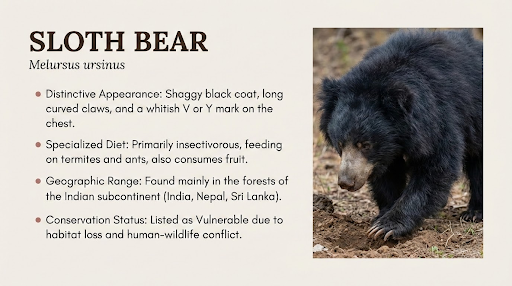
The Sloth Bear (Melursus ursinus) is a shaggy, myrmecophagous (insect-eating) mammal endemic to the Indian subcontinent. Protected under Schedule I of the Wildlife Protection Act, it is classified as Vulnerable due to habitat loss.
Why In News
A recent operation by the Karnataka Forest Department to capture a sloth bear near the Shivamogga airport has highlighted the human-wildlife Conflict.
About Sloth Bear
The Sloth Bear (Melursus ursinus) is one of the eight bear species globally and is uniquely adapted to the Indian subcontinent.
Biological Profile & Unique Adaptations
Myrmecophagous Diet: They are specialized insectivores, primarily consuming ants and termites.
Physical Traits: They possess shaggy black fur and a distinctive V-shaped white chest mark.
Behavior: Primarily nocturnal, they forage at night and rest in secluded boulders or tall grasslands during the day.
Habitat
Range: Sloth bears are endemic to the Indian subcontinent, found in India, Nepal, Sri Lanka, and potentially Bhutan.
Ecosystems: They thrive in diverse environments, from dry and moist deciduous forests to scrublands and grasslands where rocky outcrops provide essential shelter.
Conservation & Legal Status
Due to habitat loss and poaching, the sloth bear is a high-priority species for conservation:
Source: THEHINDU
|
PRACTICE QUESTION Which of the following best describes the term 'Myrmecophagous', often used in relation to Sloth Bears? (a) An animal that feeds primarily on aquatic plants. (b) An animal that feeds exclusively on fruits and honey. (c) An animal that finds bugs and termites to be its primary meal. (d) An animal that migrates seasonally across high altitudes. Answer: c Explanation: The term 'Myrmecophagous' (from Greek myrmex "ant" and phagein "to eat") refers to an animal that feeds primarily on ants and termites. |
The Sloth Bear (Melursus ursinus) is classified as "Vulnerable" on the International Union for Conservation of Nature (IUCN) Red List.
A myrmecophagous diet refers to a specialized insectivorous diet that relies heavily on ants and termites. Sloth bears utilize their specially adapted long lower lip and palate as a "biological vacuum" to extract these insects from mounds.
Sloth Bears are endemic to the Indian subcontinent. Their populations reside mainly in India, Nepal, Sri Lanka, and potentially Bhutan, where they thrive in diverse zones like dry and moist deciduous forests, scrublands, and grasslands.



© 2026 iasgyan. All right reserved