The 2026 Plastic Waste Rules ease compliance by deferring EPR penalties but risk "greenwashing" by redefining incineration as recycling. To ensure true accountability, India must replace self-reporting with unannounced audits, integrate informal workers, and prioritize material recovery over burning plastic.
Why In News?
The Ministry of Environment, Forest and Climate Change (MoEFCC) notified the Plastic Waste Management (Amendment) Rules 2026.
What are Plastic Waste Management Rules 2026?
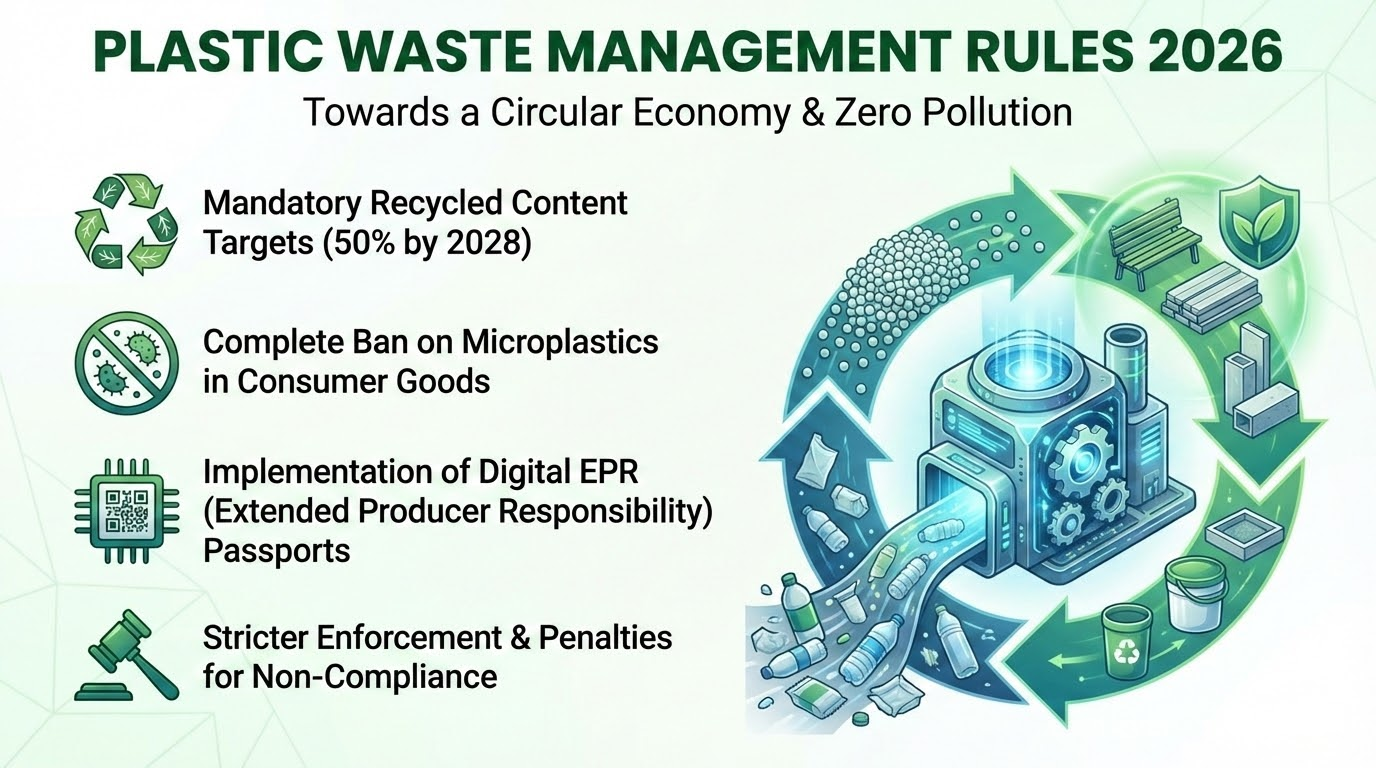
It amends the 2016 framework to introduce flexibility for producers while enforcing stricter "circular economy" obligations like mandatory recycled content and reuse targets.
Key Features of the 2026 Rules
Mandatory Recycled Content Targets: Producers, Importers, and Brand Owners (PIBOs) must incorporate a minimum percentage of recycled plastic in their packaging.
Carry-Forward Provision: Companies that fail to meet their recycling targets in a specific year can "carry forward" the deficit for up to three years, provided they clear at least one-third of the shortfall annually.
Tradable Extended Producer Responsibility (EPR) Certificates: A market mechanism where companies exceeding their recycling targets can sell surplus certificates to non-compliant firms to meet their obligations.
Reuse Obligations: Specific mandates for reusing rigid plastic packaging have been introduced to reduce virgin plastic consumption. For example, beverage bottles must meet increasing reuse percentages annually.
Exemptions for Food & Pharma: Packaging for food and pharmaceutical products is currently exempt from recycled content mandates due to safety regulations by the FSSAI and other bodies.
What are the Key Challenges in Implementation?
Data Integrity & Fraud
The system relies heavily on self-reporting. A CPCB audit in 2023 revealed over 600,000 fake EPR certificates generated by recyclers in Gujarat, Maharashtra, and Karnataka, exposing deep flaws in the digital portal. (Source: Central Pollution Control Board)
Collection vs Recycling Gap
While the government mandated 100% collection of plastic waste by 2024-25, independent assessments indicate actual collection rates hover between 50-60%, creating a massive enforcement gap. (Source: Centre for Science and Environment)
Informal Sector Marginalization
India’s 1.5 to 4 million waste pickers, who form the backbone of the recycling ecosystem, are largely excluded from the formal EPR framework, leading to livelihood loss and untracked waste flows. (Source: International Labour Organization)
Infrastructure Deficit
India generates approximately 4.13 million tonnes of plastic waste annually, yet recycling capacity remains concentrated in a few states like Gujarat and Maharashtra, leaving other regions with high logistical costs. (Source: CPCB)
What Should be the Way Forward?
Strengthening Monitoring and Verification: To curb the generation of fake EPR certificates, the government must move from a self-declaration model to mandatory third-party audits of all registered recyclers and producers.
Formalizing the Informal Sector: State governments and Urban Local Bodies (ULBs) should provide occupational identity cards to waste pickers and integrate them into official Material Recovery Facilities (MRFs) to ensure social security and better waste tracking.
Adoption of Blockchain for Traceability: Implementing a blockchain-enabled EPR portal would create a tamper-proof digital trail, ensuring that every tonne of plastic recycled is only claimed once by a single producer.
Investing in Alternative Technologies: Increasing funding for Chemical Recycling (pyrolysis), which can break down complex Multi-Layered Plastics (MLP) into fuel or new plastic feedstock, is essential where mechanical recycling fails.
Standardizing "Eco-Design" for Packaging: Government should mandate monomaterial packaging (using only one type of plastic instead of multiple layers) to make the recycling process technically simpler and more cost-effective.
Learn from Best from Global Practices
Conclusion
The Plastic Waste Management (Amendment) Rules, 2026, transition India toward a market-driven circular economy through mandatory recycled content and tradable EPR certificates, yet their ultimate success depends on rigorous enforcement against data fraud and the formal integration of the informal waste-picking sector.
Source: LIVELAW
|
PRACTICE QUESTION Q. Regarding the "Circular Economy" model for plastic, which of the following actions aligns most closely with its core objectives? A) Increasing the capacity of waste-to-energy plants for mass incineration. B) Shifting from a "take-make-dispose" model to a closed-loop system of resource recovery. C) Exporting plastic waste to countries with lower environmental standards. D) Encouraging the use of virgin plastic to ensure higher product durability. Answer: c Explanation: The fundamental principle of a Circular Economy is to transition away from the traditional linear "take-make-dispose" model. It focuses on keeping materials and products in use for as long as possible through a closed-loop system that emphasizes reuse, repair, refurbishment, remanufacturing, and recycling. |
The 2026 Amendment Rules are updated regulations by the Ministry of Environment, Forest and Climate Change (MoEFCC) designed to ease compliance norms for companies under the Extended Producer Responsibility (EPR) framework, defer penalties, and introduce new definitions and reuse mandates for plastic waste.
The 2026 amendment controversially expands the definition of "Recycling" to include the "generation of energy." This legally recognizes the processing of low-value plastics in Waste-to-Energy plants as a form of recycling, which environmentalists argue causes toxic air pollution.
For Category I (Rigid Plastics like PET/HDPE), companies are mandated to use at least 30% recycled material in their packaging in the financial year 2025–26. This target will progressively increase to 60% by the year 2028–29.

© 2026 iasgyan. All right reserved