One Nation One Election proposes synchronising Lok Sabha and State Assembly elections to be held simultaneously every five years. This aims to reduce election costs, prevent governance disruptions from frequent polls, and streamline the administrative process nationwide.
Copyright infringement not intended
Picture Courtesy: NEWSONAIR
Lok Sabha extended the tenure of the Joint Parliamentary Committee (JPC) on the “One Nation, One Election” Bills till Monsoon Session 2026.
|
Read all about: ONE NATION ONE ELECTION l SIMULTANEOUS ELECTIONS IN INDIA l KOVIND COMMITTEE ON ONE NATION, ONE ELECTION |
The concept of ONOE proposes synchronizing the elections for the Lok Sabha and all State Legislative Assemblies to be held simultaneously, either on a single day or within a specific timeframe.
This idea aims to reform the electoral process by reducing costs, minimizing policy paralysis, and improving governance efficiency.
The first four general elections from 1951 to 1967 were held simultaneously for the Lok Sabha and State Assemblies.
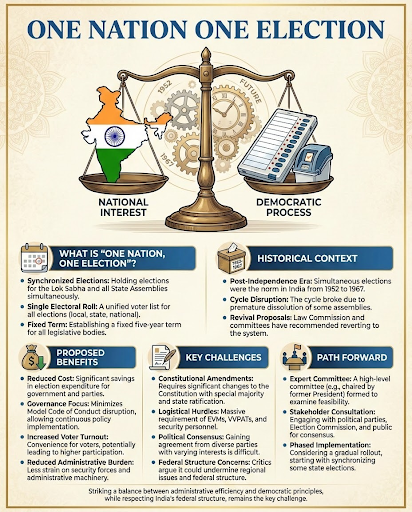
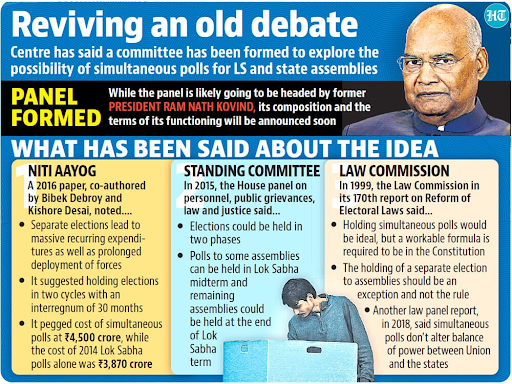
The Constitution (129th Amendment) Bill, 2024, which proposes simultaneous elections based on the Kovind Committee recommendations, is currently under review by a JPC.
Reduces Massive Expenditure
Frequent elections place a huge financial burden on the public exchequer.
Prevents Governance Paralysis
The repeated imposition of the Model Code of Conduct (MCC) halts developmental projects and policy decisions.
Efficient Use of Security and Administrative Staff
Elections require the deployment of Central Armed Police Forces (CAPF) and polling personnel, diverting them from their primary duties.
Threat to Federalism
Critics argue that ONOE undermines India's federal structure, a 'Basic Structure' of the Constitution.
Erosion of Accountability
The provision for a "remainder term" government could weaken democratic accountability. A government elected for a short term may lack the incentive to implement long-term policies.
Major Logistical Hurdles
Implementing ONOE requires a massive number of Electronic Voting Machines (EVMs) and VVPATs. The ECI estimated a need for ₹10,000 crore just for procuring additional EVMs every 15 years.
Impact on Voter Behaviour
An analysis of election data from 1999 to 2014 indicates a 77% probability that voters choose the same party for both State Assembly and Lok Sabha elections when they are held simultaneously.
Constitutional Compliance
The 129th Constitutional Amendment Bill must be passed with a special majority in both Houses of Parliament and be ratified by at least 50% of State Legislatures, as it directly alters the federal relationship between the Centre and States under Article 368.
Political Consensus Building
A broad-based dialogue must be initiated with regional political parties to address fears that local issues might be overshadowed by national narratives, ensuring the reform respects multi-party democracy.
Ensuring Legislative Stability
India should adopt a "Constructive Vote of No-Confidence"—a system where a government can only be ousted if an alternative majority is ready—to prevent premature dissolution of houses and keep the five-year cycle intact.
Institutionalizing a Common Electoral Roll
Parliament should enact a law under Article 325 to create a single, unified electoral roll for all three tiers (Centre, State, and Local), eliminating the current administrative redundancy and voter confusion.
Protecting Regional Narrative
To prevent national issues from drowning out local ones, the Election Commission could mandate separate campaign windows or dedicated media slots for State and Local body issues during the synchronised polling period.
Legal Framework for Hung Assemblies
Clear constitutional guidelines must be established to handle a "Hung Assembly" situation, prioritising the formation of a coalition government or an all-party "Unity Government" before considering a mid-term election.
'One Nation, One Election' can drive administrative efficiency and economic stability, provided it secures political consensus and protects federal diversity through legal safeguards
Source: NEWSONAIR
|
PRACTICE QUESTION Q. "While the idea of 'One Nation, One Election' promises macroeconomic stability and reduced governance downtime, it poses structural challenges to the federal fabric of India." Critically analyze 150 words |
It is a legislative bill aimed at implementing "One Nation, One Election" in India by synchronizing the electoral cycles of the Lok Sabha, State Legislative Assemblies, and local bodies.
The High-Level Committee (HLC) chaired by former President Ram Nath Kovind submitted the report and recommendations that form the basis of the new electoral reform bill.
Major challenges include the potential dilution of regional issues in favor of national narratives (which structurally disadvantages regional parties), the democratic implications of truncated mandates leading to short-term populism, and the massive logistical burden of procuring enough EVMs and VVPATs.




© 2026 iasgyan. All right reserved