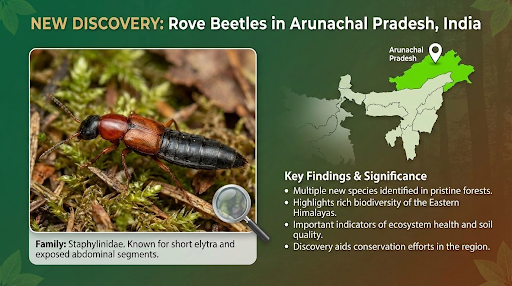
Researchers from Rajiv Gandhi University and Germany’s University of Tübingen recently discovered three new rove beetle species in Arunachal Pradesh: Megalopinus arunachalensis, M. mithun, and M. micros. Found in leaf litter, these tiny predators highlight the region’s vast, underexplored biodiversity.
Why In News?
A collaborative team of researchers from India and Germany discovered three new species of Rove Beetles in Arunachal Pradesh.
About the Discovery
A team from Rajiv Gandhi University (RGU), Arunachal Pradesh, and the University of Tübingen, Germany, documented three previously unknown species under the genus Megalopinus.
Locations of Discovery: The specimens were collected from ecologically vital areas including Eaglenest Wildlife Sanctuary, Pakke Tiger Reserve, Mechukha Valley, and the Aalo Forest Division.
About Rove Beetles
Physical Characteristics
Unique Structure: Unlike most beetles, rove beetles have very short, leathery wing covers called elytra.
Flight Capability: Despite their short covers, most species have fully functional wings folded intricately underneath, allowing them to be strong fliers.
Size: They range from tiny (less than 1 mm) to large species like the 'Devil’s Coach Horse,' which can reach 25–30 mm.
Habitat and Behavior
Moisture-Loving: They are mostly found in moist micro-habitats such as leaf litter, decaying wood, compost, dung, and fungi. They are highly sensitive to desiccation (drying out).
Diet: Most rove beetles are predatory, feeding on smaller insects, mites, and soil-dwelling larvae. Some species are specialized "mycetophages" (fungus-eaters).
Defense Mechanism: When threatened, they often curl their abdomen upward, mimicking a scorpion to deter predators.
Ecological and Economic Importance
Natural Pest Control: In agriculture, they are vital biological control agents. They consume the eggs and larvae of root maggots, aphids, and other crop pests.
Decomposition: By breaking down organic matter on the forest floor, they play a critical role in nutrient cycling and soil health.
Forensic Indicators: Certain species are used in forensic entomology to help estimate the time of death (post-mortem interval) as they are among the first insects to arrive at decaying organic matter.
Source: EASTMOJO
|
PRACTICE QUESTION Q. Recently, in April 2026, researchers discovered three new species of Rove Beetles. In which biodiversity hotspot were these discoveries made? (a) Western Ghats (b) Arunachal Pradesh (c) Nicobar Islands (d) Eastern Himalayas Answer: b Explanation: The three new species of rove beetles—Megalopinus arunachalensis, Megalopinus mithun, and Megalopinus micros—were discovered in the state of Arunachal Pradesh |
Rove Beetles are small insects belonging to the family Staphylinidae, known for their uniquely short wing covers (elytra).
A "Lazarus event" refers to the rediscovery of a species that was missing for a long time and presumed to be locally extinct.
Rove Beetles act as apex predators in micro-habitats. They aggressively consume mites, roundworms, and eggs of destructive agricultural pests. For example, ICAR-NBAIR successfully deployed Dalotia coriaria to suppress fungus gnats in greenhouses, reducing the need for toxic chemical pesticides.



© 2026 iasgyan. All right reserved