The MPLADS continues as a Central Sector Scheme administered by district authorities, despite ongoing debates about its constitutionality, recent controversy over inter-state allocations, and persistent concerns. While judicial validation exists, discussions about its utilization and potential reforms are ongoing. A practical way forward is to enhance transparency through social audits.
Copyright infringement not intended
Picture Courtesy: THE HINDU
Context
The MPLADS scheme, while promoting local development, is criticized for its constitutional legitimacy, fund management, accountability, and recent non-traditional constituency allocations.
|
Read all about: MPLADS SCHEME |
What is MPLADS?
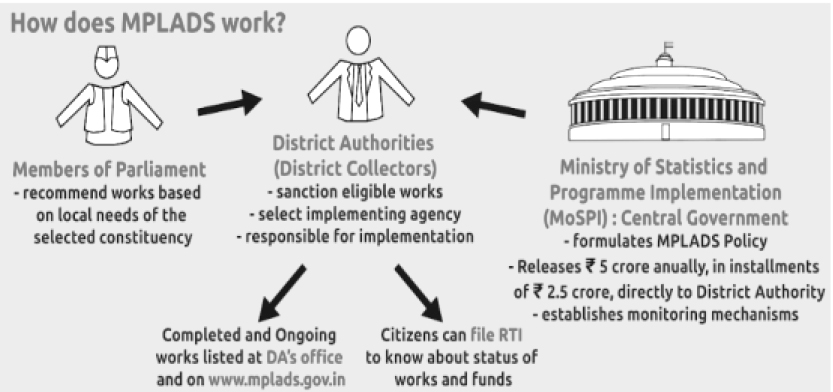
The Member of Parliament Local Area Development Scheme (MPLADS) is a Central Sector Scheme launched in 1993.
Objective: Empowers Members of Parliament (MPs) to recommend development works in their constituencies, with a focus on creating durable community assets based on locally felt needs (e.g. education, public health, sanitation, and roads.)
Funding: Each MP is allocated ₹5 crore per annum. The funds are non-lapsable, meaning unspent money can be carried forward to the next year.
Role of MP: The MP's role is purely recommendatory. They identify and suggest projects based on constituency needs.
Implementation: The scheme is implemented by the respective District Authorities (like the District Collector/Magistrate), who are responsible for project sanctioning, execution, and monitoring.
Performance and Utilization Status
14th Lok Sabha (2004–2009): Efficient fund management resulted in only 0.99% of allocated funds remaining unspent.
15th Lok Sabha (2009–2014): The unspent balance remained relatively low at 3.47%.
16th Lok Sabha (2014–2019): Unspent funds rose to 8.7%.
17th Lok Sabha (2019–2024): Share of unspent money reached to 16%.
18th Lok Sabha (2024–Present): Data from the eSAKSHI portal indicates a current utilization rate of roughly 32.4% for the new term.
Key Factors Affecting Utilization
COVID-19 Impact: The scheme was non-operational for the 2020-21 and part of the 2021-22 fiscal years, with funds diverted to health infrastructure.
New Digital Monitoring: Implementation of the eSAKSHI Portal in 2023 changed the fund-flow procedure from physical bank accounts to online authorizations, aiming to reduce delays in submitting utilization certificates.
Non-Lapsable Nature: MPLADS funds are non-lapsable, meaning unspent balances are carried forward to subsequent years, which sometimes lead to a buildup of available but unutilized funds.
Arguments For and Against MPLADS
Arguments in Favour (Pros)
Decentralized Development: MPs can address specific, small-scale local needs that are often missed by larger, top-down government schemes.
Bridging Infrastructure Gaps: Effectively fills gaps in local infrastructure, directly improving the quality of life for constituents.
Strengthens Accountability: Creates a direct and visible link between the MP and their constituents, making the representative more responsive to local demands.
Flexibility and Responsiveness: The scheme's flexible nature allows for tailored solutions to diverse and unforeseen local problems across the country.
Arguments Against (Cons)
Violation of Separation of Powers: It blurs the line between the Legislature (MP's recommendatory role) and the Executive (implementation by District Authority), infringing on the executive's domain.
Corruption and Patronage: The scheme has faced allegations of being used for political patronage to favour specific groups or contractors, leading to misuse of funds.
Implementation Inefficiency: Can lead to the creation of poor-quality assets, duplication of projects already covered by other schemes, and uneven development within a constituency.
Lack of Technical Expertise: MPs, being legislators, may not possess the necessary technical expertise for sound project identification, planning, and oversight.
Way Forward
The solution lies not in discontinuing a vital development tool but in reforming it to enhance efficiency, transparency, and accountability.
Procedural and Structural Reforms
Clearer Guidelines: Develop unambiguous rules to prevent disputes and misinterpretations, especially regarding inter-constituency allocations.
Robust Monitoring: Strengthen oversight through mandatory social audits, independent third-party monitoring, and periodic reviews by parliamentary committees.
Streamlined Processes: Simplify administrative procedures to ensure faster release of funds and timely execution of projects, reducing bureaucratic delays.
Leveraging Technology for Transparency
Real-time Dashboards: Enhance the official MPLADS portal with features like geo-tagging of assets, real-time photo and video updates of project progress, and data on fund utilization.
Citizen Feedback Mechanism: Integrate platforms for public feedback and online grievance redressal to make the implementation process more accountable to the public.
Capacity Building and Collaboration
MP Training: Conduct workshops and provide resources for MPs and their staff on effective project planning, financial management, and impact assessment.
Participatory Approach: Institutionalize collaboration between MPs, Panchayati Raj Institutions (PRIs), Urban Local Bodies, and civil society for better project identification, planning, and monitoring.
Conclusion
MPLADS should be reformed through strategic measures like enhancing accountability, leveraging technology, and improving implementation to make it a more transparent and effective tool for inclusive governance.
Source: THE HINDU
|
PRACTICE QUESTION Q. Consider the following statements about the Member of Parliament Local Area Development Scheme (MPLADS): 1. It is a Central Sector Scheme fully funded by the Government of India. 2. The funds allocated under this scheme are non-lapsable. 3. The Ministry of Rural Development is the nodal ministry for its implementation. Which of the statements given above is/are correct? a) 1 only b) 1 and 2 only c) 2 and 3 only d) 1, 2 and 3 Answer: b) Explanation: Statement 1 is correct: The Member of Parliament Local Area Development Scheme (MPLADS) is a Central Sector Scheme that is fully funded by the Government of India. Statement 2 is correct: The funds allocated under this scheme are non-lapsable at both the Central and District levels. This means unspent funds do not expire at the end of a financial year and are carried forward for future use. Statement 3 is incorrect: While the scheme was initially under the Ministry of Rural Development at its launch in 1993, it was transferred to the Ministry of Statistics and Programme Implementation (MoSPI) in 1994, which remains the nodal ministry today. |
The objective is to enable MPs to recommend developmental works of a capital nature with an emphasis on creating durable community assets (like water, education, and health facilities) in their constituencies.
The Ministry of Statistics and Programme Implementation (MoSPI) acts as the nodal ministry responsible for policy formulation, release of funds, and monitoring of the scheme.
The 2nd ARC recommended abolition because it believed the scheme encroaches upon the domain of local self-governing bodies (Panchayats and Municipalities) and violates the separation of powers.



© 2026 iasgyan. All right reserved