The Ministry of Home Affairs revised Look Out Circulars guidelines, requiring statutory bodies like National Human Rights Commission and National Commission for Women to route law-enforcement agencies, preventing misuse and protecting the Article 21-based right to travel abroad.requests through
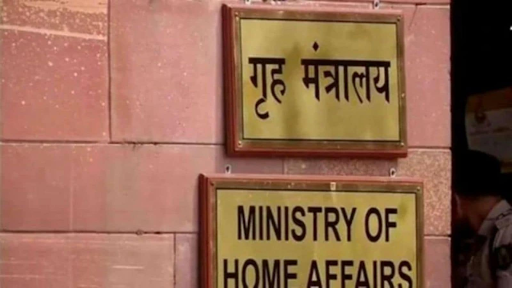
Copyright infringement not intended
Picture Courtesy: INDIANEXPRESS
Context
The government clarified that statutory bodies cannot directly issue Look Out Circulars (LOC) and must route requests through the Ministry of Home Affairs.
What is Look Out Circulars (LOCs)
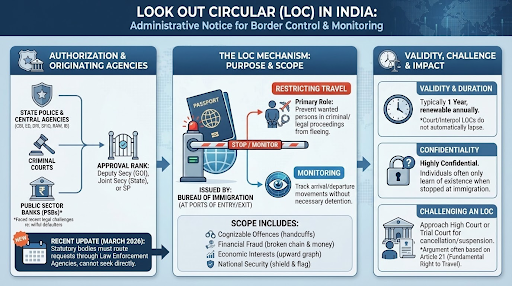
It is an administrative notice issued by the Bureau of Immigration (under the Ministry of Home Affairs) at the request of law enforcement agencies.
Purpose and Function
Restricting Travel: Its primary role is to prevent persons wanted in connection with criminal investigations or legal proceedings from fleeing the country.
Monitoring: It can also be used to simply track the arrival or departure of individuals without necessarily detaining them.
Scope: While for cognizable offences, it extends to cases of financial fraud, economic interests, and national security.
Who Can Authorize an LOC?
Requests for an LOC must come from designated "originating agencies" and be approved by an officer not below Deputy Secretary to the GOI, Joint Secretary in a State Government, or Superintendent of Police (SP).
Authorized agencies include:
Validity and Revocation
Duration: Most LOCs are valid for one year and must be renewed by the requesting agency annually. However, LOCs issued by courts or Interpol do not automatically lapse.
Confidentiality: LOCs are confidential; individuals often only learn of their existence when stopped at an immigration counter.
Challenging an LOC: An individual can approach the High Court or the trial court concerned to seek the cancellation or suspension of an LOC, often arguing it violates their fundamental right to travel under Article 21.
Legal Framework Governing LOCs in India
In India, LOCs lack a specific Act of Parliament, drawing their legal basis from MHA executive orders and judicial interpretations.
|
Case Name |
Details |
|
Satwant Singh Sawhney vs D. Ramarathnam 1967 |
Established that the right to travel abroad is a part of 'personal liberty' under Article 21. |
|
Maneka Gandhi v.s Union of India 1978 |
Cemented the 'right to travel abroad' as a fundamental right and mandated that any restriction must follow a "procedure established by law" that is fair and reasonable. |
|
Sumer Singh Salkan vs Asst. Director & Ors, 2010 |
The Delhi High Court laid down guidelines stating LOCs should be used in cognizable offences where the accused is deliberately evading arrest or trial. This judgment became a cornerstone for MHA guidelines. |
Way Forward
Enact a Statutory Framework
The reliance on executive memorandums is a legal weakness. A dedicated Act of Parliament is needed to provide a solid legal foundation for LOCs, defining their scope, grounds for issuance, and the authorities empowered to use them.
Strengthen Judicial Oversight
Introducing a mechanism for pre-issuance judicial scrutiny in non-urgent cases could prevent arbitrary restrictions on liberty before they occur.
Improve the Redressal Mechanism
A transparent system is needed where individuals can check for an LOC against them. An expedited and time-bound review and appeal process is essential to uphold the principles of natural justice.
Conclusion
The new guidelines balance state security interests with the fundamental right to travel, establishing a robust legal framework where LOCs are legitimate law enforcement tools, not instruments of harassment.
Source: INDIANEXPRESS
|
PRACTICE QUESTION Q. What is the primary purpose of a Look Out Circular (LOC)? A) To track the location of missing persons B) To stop authorized personnel from entering India C) To restrict a person from leaving or entering the country D) To issue travel visas for foreign nationals Answer: C Explanation: A Look Out Circular (LOC) is an administrative measure used by law enforcement agencies in India to monitor and restrict the movement of individuals. |
A Look Out Circular is a directive issued by Indian authorities to immigration officials to monitor the arrival or departure of an individual who is wanted by a law enforcement agency or a court. It is used to prevent individuals from leaving the country if they are required for an investigation or legal proceedings.
The main changes include barring statutory bodies without criminal jurisdiction (like NHRC, NCW) from directly requesting LOCs, mandating that all such requests be routed through a law enforcement agency, standardizing the LOC proforma, and setting clear timelines for taking custody of a detained person.
An LOC directly curtails the 'right to travel abroad,' which the Supreme Court, in the Maneka Gandhi case, has interpreted as a fundamental right under Article 21 (Right to Life and Personal Liberty). The new guidelines aim to ensure that this restriction is imposed through a procedure that is fair, just, and not arbitrary.



© 2026 iasgyan. All right reserved