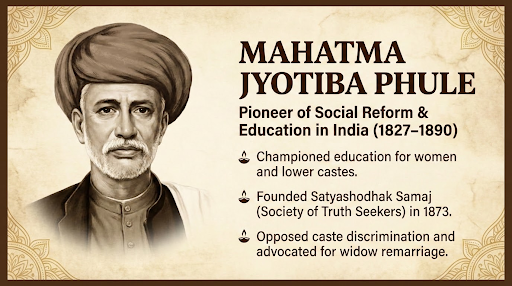
Mahatma Jyotiba Phule was a social reformer, he founded the Satyashodhak Samaj (1873) and India’s first girls' school (1848). Through works like Gulamgiri, he fought caste and gender inequality, laying the foundation for modern social justice and educational rights.
Why In News?
The President of India paid floral tributes to Jyotiba Phule at Prerna Sthal in the Parliament House complex.
Who was Jyotirao Phule?
Jyotirao Govindrao Phule (1827–1890), regarded as the "Father of the Indian Social Revolution," worked against caste discrimination, untouchability, and gender inequality.
Early Life and Influences
Born: On April 11, 1827, in Pune, belonged to the Mali (gardener) community.
Education: Though he initially dropped out, he later completed his education at the Scottish Mission High School
Intellectual Awakening: He was influenced by Thomas Paine’s book The Rights of Man, which shaped his belief that the only solution to combat social evils was the enlightenment of women and lower caste members.
Turning Point: In 1848 Phule was insulted and thrown out of a Brahmin friend’s wedding procession because of his "lower" caste. This personal humiliation ignited his lifelong crusade against the caste system.
Role in Educational Revolution
Phule viewed education as the "trinetra" (third eye) for liberating the oppressed. He identified lack of education as the primary cause of misery for the Shudras.
First Girls' School: In 1848, Jyotiba, along with his wife Savitribai Phule, opened the first school for girls in India at Bhidewada, Pune.
Teaching the Untouchables: He opened the first school for children of the Mahar and Mang castes (then considered untouchables) in 1851.
Night Schools: Recognizing the economic constraints of the working class, he started night schools for agriculturists and laborers in 1855.
Free Education: In 1882, Phule appeared before the Hunter Commission on Education and demanded free and compulsory primary education for all children up to age 12.
Founded Satyashodhak Samaj (1873)
Primary Goal: To liberate the Shudras and Ati-Shudras from the exploitation of the priestly class and to establish a society based on human equality.
Rationalism: The Samaj rejected the need for intermediaries (priests) to connect with God.
Motto: "All human beings are the children of one God (Nirmik), so there is no need for an intermediary".
Major Social Reforms
Widow Remarriage & Infanticide Prevention: In 1863, he established a "Home for the Prevention of Infanticide" (Balhatya Pratibandhak Griha) in his own house to help pregnant widows.
Water for All: In 1868, he opened his private household water tank to the "untouchables," a revolutionary act of defying pollution norms of that era.
Barbers' Strike: He organized a strike of barbers in Pune to oppose the practice of shaving the heads of widows, a ritual that stripped women of their dignity.
Literary Contributions
Phule used literature as a weapon for social change. His writing style was direct, employing the "khandyacha" (colloquial) Marathi to reach the masses.
|
Book/Work |
Year |
Theme/Subject |
|
Tritiya Ratna |
1855 |
A play exposing the exploitation of peasants by the Brahmin-British alliance. |
|
Gulamgiri (Slavery) |
1873 |
Dedicated to the people of the USA for abolishing slavery; linked the condition of Indian Dalits to American slaves. |
|
Shetkaryacha Asud |
1881 |
(The Cultivator's Whipcord) detailed the exploitation of farmers by moneylenders and bureaucracy. |
|
Sarvajanik Satya Dharma |
1891 |
Published posthumously; outlined his vision of a universal humanistic religion. |
Legacy and Recognition
The Title "Mahatma": He was given the title "Mahatma" in 1888, by social activist Vithalrao Krishnaji Vandekar at a public gathering in Mumbai.
Influence on Dr. Ambedkar: Dr. B.R. Ambedkar formally acknowledged Phule as one of his three Gurus (the other two being Buddha and Kabir), crediting Phule for laying the foundation of the anti-caste movement.
Precursor to the Right to Education (RTE) Act: In his testimony before the Hunter Commission on Education in 1882, Phule demanded free and compulsory primary education for all children.
Source: NEWSONAI
|
PRACTICE QUESTION Q. Mahatma Jyotiba Phule dedicated his famous book 'Gulamgiri' to: A) The Dalit activists of the Mahad Satyagraha. B) The people of the United States who fought to abolish slavery. C) The women of India struggling for educational rights. D) The peasant revolutionaries of the Deccan Riots. Answer: B Explanation: Mahatma Jyotiba Phule dedicated his famous 1873 book Gulamgiri (Slavery) to the people of the United States who fought to abolish slavery. He made this dedication to link the struggle against the caste system in India to the American fight for freedom, inspired by the Civil War ending slavery ten years prior. |
Mahatma Jyotiba Phule is recognized as the father of India's social revolution due to his foundational efforts to eradicate the caste system, untouchability, and his pioneering crusade for women's education and rights.
Jyotiba Phule founded the Satyashodhak Samaj (Society of Truth Seekers) on September 24, 1873. Its primary goal was to forge a united front of Shudras, Ati-Shudras, and women to fight against orthodox social exploitation and secure their equal human rights.
Phule viewed education as the "third eye" of rationality. Along with his wife Savitribai Phule, he established India's first school for girls in Pune in 1848. He also opened schools for "untouchable" communities in 1851 and started adult night schools for laborers in 1855.



© 2026 iasgyan. All right reserved