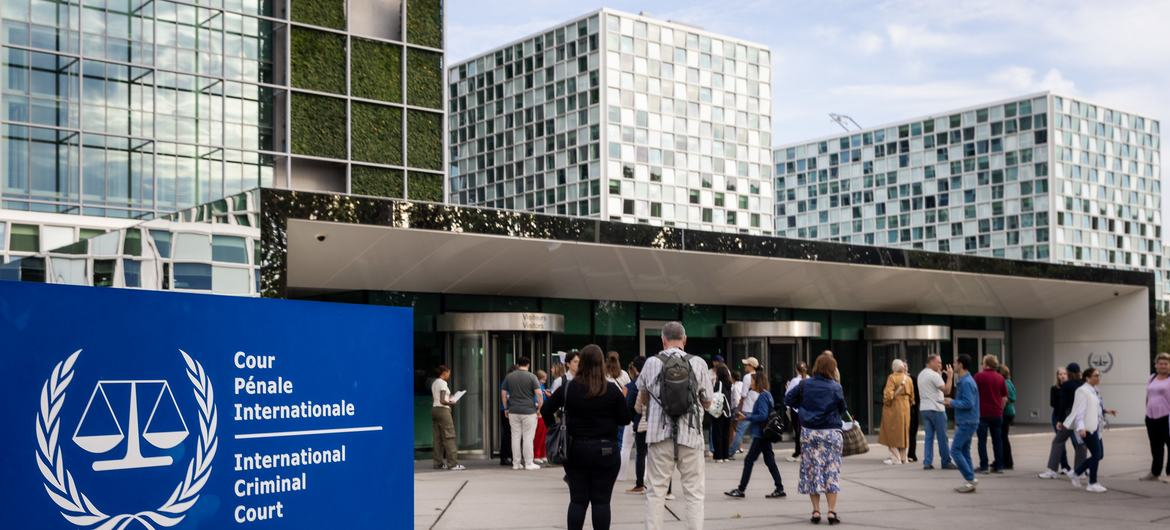
The International Criminal Court (ICC) is a permanent global court established by the Rome Statute in 2002. Based in The Hague, it prosecutes individuals for genocide, war crimes, crimes against humanity, and aggression when national courts fail to act. It aims to end impunity for serious international crimes.
Copyright infringement not intended
Picture Courtesy: UN
Context
Rodrigo Duterte, the former President of the Philippines, is currently at the International Criminal Court (ICC) in The Hague for a "Confirmation of Charges" hearing.
What is the Case Against Rodrigo Duterte?
The case centers on the state-sanctioned extrajudicial killings under Duterte's anti-narcotics campaign.
What is the International Criminal Court (ICC)?
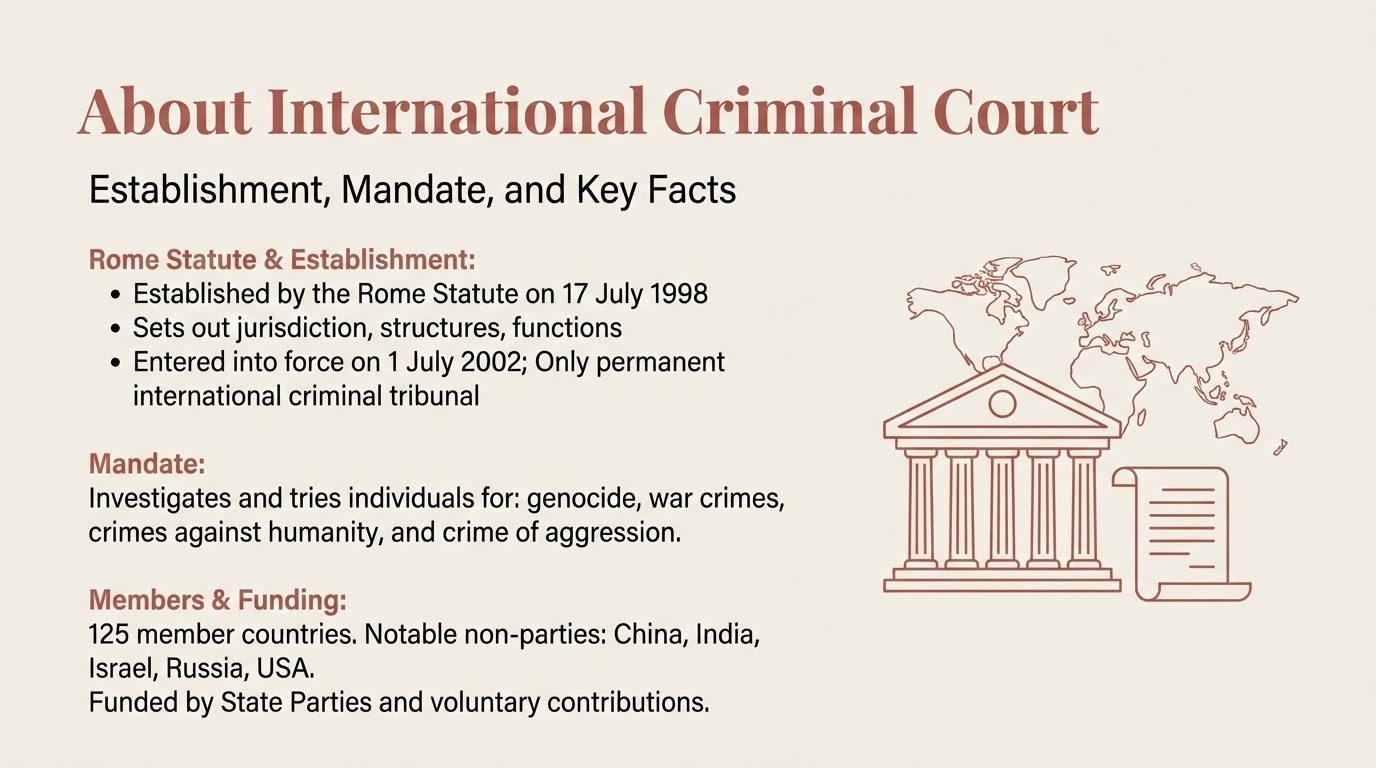
It is the world's first permanent international court established to investigate and prosecute individuals for the most serious international crimes.
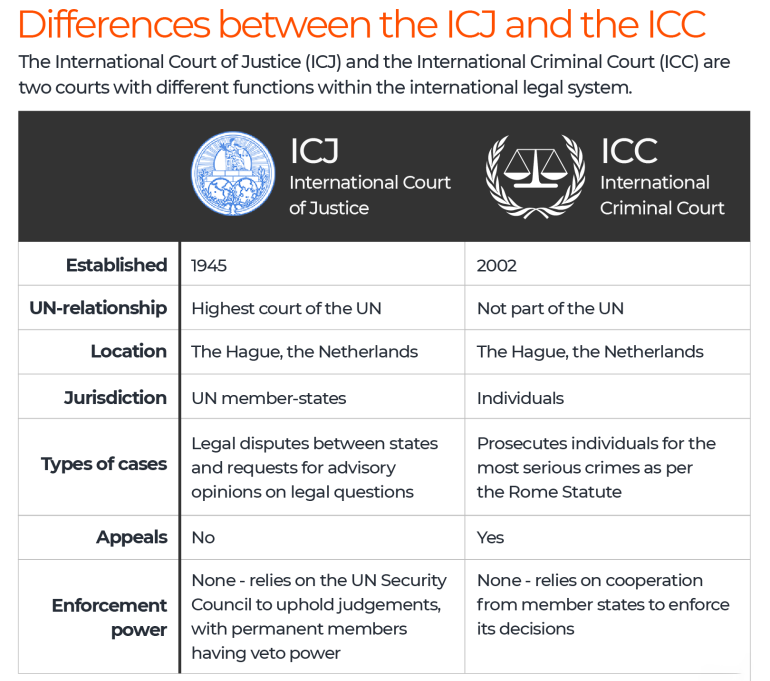
It is an independent organization, not part of the United Nations system.
Establishment: Founded by the Rome Statute, adopted in 1998. It officially began operations on July 1, 2002.
Headquarters: The Hague, Netherlands.
Mandate: The Court prosecutes individuals (not states) for four core international crimes:
Membership: It comprises 125 State Parties to the Rome Statute. Ukraine became the latest member in January 2025.
Key Non-Members: Major global powers including India, China, Russia, the United States, and Israel have not joined the ICC.
How Does the ICC Function?
The ICC operates on the Principle of Complementarity => Only steps in when a country's own judicial system is unwilling or genuinely unable to investigate or prosecute the grave crimes. It complements, rather than replaces, national courts.
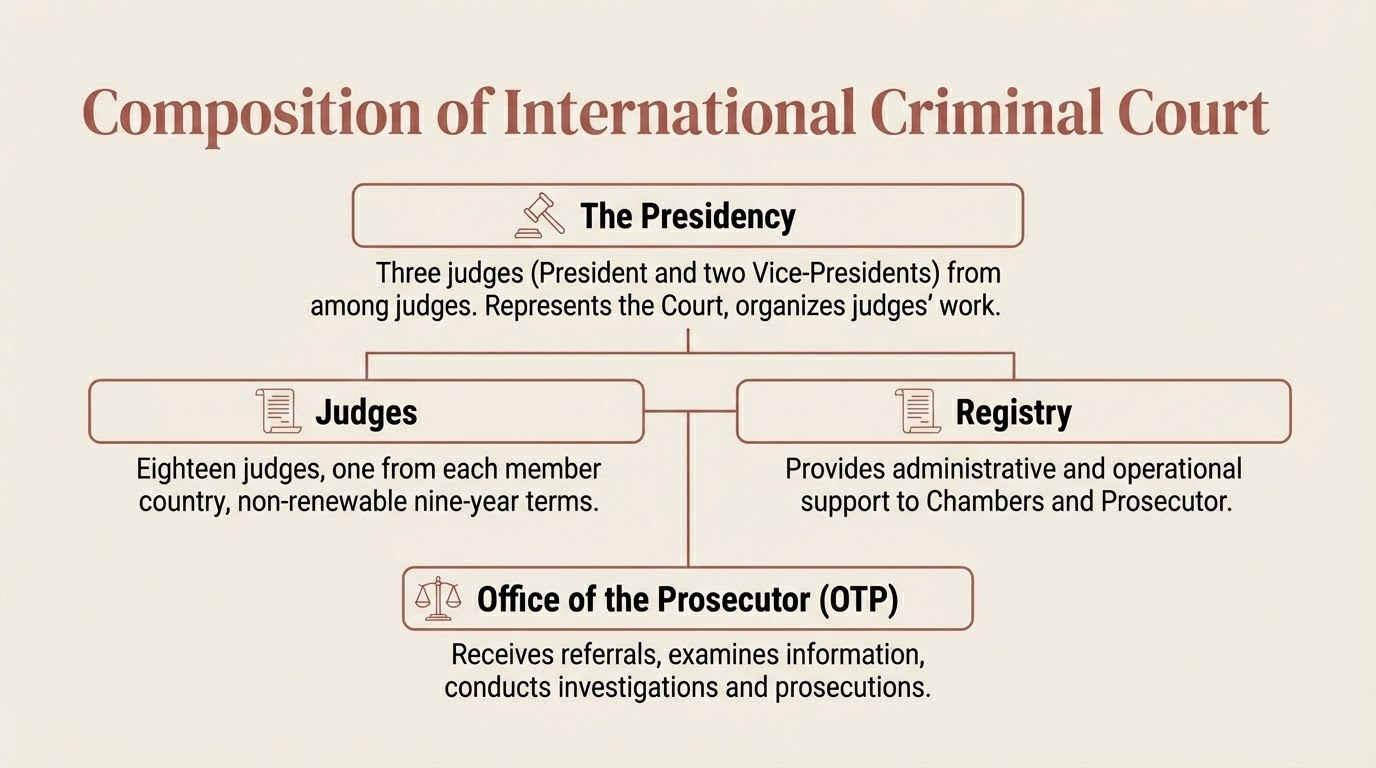
Composition of International Criminal Court
Why India Not Joined the ICC?
India has refused to sign the Rome Statute due to fundamental objections regarding sovereignty, jurisdiction, and procedural fairness
Threat to National Sovereignty
India believes the ICC's power to decide if a nation is "unwilling or unable" to prosecute is an unacceptable infringement on the sovereignty of its domestic judicial system.
Politicization by the UN Security Council (UNSC)
India contends that Article 16 of the ICC Statute allows the UNSC to defer an investigation, giving the P5 a political means to shield themselves or allies from prosecution, thus compromising the Court's impartiality.
Inadequate Definition of Crimes
India's proposals to include "cross-border terrorism" and the "use of nuclear weapons" as prosecutable crimes were not accepted during the drafting of the Rome Statute.
Focus on State Actors
The ICC effectively targets state actors but struggles against non-state actors like state-sponsored terrorist groups, which pose a major security threat to India.
Key Challenges to the ICC's Credibility
Lack of Enforcement Power
The ICC lacks its own police force and relies on member states for arrests. National interests often override international obligations, leading to failures in executing warrants.
Opposition from Major Powers
The US opposes the Court, the American Service-Members' Protection Act (2002) ("Hague Invasion Act"), authorizes force to free US personnel. In 2024, the US also enacted H.R. 8282 to sanction ICC officials investigating its allies.
Perception of Bias
Historically criticized for an Africa-centric focus, a "Global North" bias still exists among many in the "Global South," although recent cases in Ukraine and Palestine have widened its purview.
Way Forward
The ICC needs structural reform—insulating compliance from state politics and the UNSC veto—to ensure impartial and enforceable international justice.
Source: bbc
|
PRACTICE QUESTION Q. Consider the following statements regarding the International Criminal Court (ICC): 1. It is the official judicial organ of the United Nations. 2. It investigates and tries individuals, not states. 3. India and the United States are members of the Rome Statute. 4. The Principle of Complementarity allows the ICC to intervene only when national legal systems are unable or unwilling to act. Which of the statements given above are correct? A) 1 and 3 only B) 2 and 4 only C) 2, 3 and 4 only D) 1, 2 and 4 only Answer: B Explanation: Statement 1 is incorrect: The International Court of Justice (ICJ) is the official judicial organ of the UN. The ICC is an independent international organization established by the Rome Statute; while it cooperates with the UN, it is not a part of the UN system. Statement 2 is correct: Unlike the International Court of Justice (ICJ), which deals with disputes between states, the ICC investigates and prosecutes individuals for serious international crimes such as genocide, war crimes, and crimes against humanity. Statement 3 is incorrect: Neither India nor the United States are members of the Rome Statute. While the U.S. initially signed the treaty, it never ratified it and later withdrew its signature; India has never signed or ratified it. Statement 4 is correct: The Principle of Complementarity is a core functional rule. It dictates that the ICC acts as a "court of last resort," intervening only when a national legal system is genuinely unable or unwilling to carry out the investigation or prosecution itself. |
The International Court of Justice (ICJ) settles disputes between countries (States) and is an official organ of the UN. The International Criminal Court (ICC) prosecutes individuals for crimes like genocide and is an independent body established by the Rome Statute.
India is not a member of the ICC. India has neither signed nor ratified the Rome Statute due to concerns regarding sovereignty, the definition of crimes, and the role of the UN Security Council.
It is a fundamental principle of the Rome Statute which states that the ICC is a "court of last resort." It can only intervene and prosecute crimes if the national judicial system of the relevant country is either unwilling or unable to genuinely carry out the proceedings.



© 2026 iasgyan. All right reserved