India accounts for eleven percent of global road fatalities, causing severe socio-economic burdens. This comprehensive guide covers the structural causes of road accidents, the Motor Vehicles Amendment Act 2019, the Brasilia Declaration, Bharat NCAP, and essential global best practices.
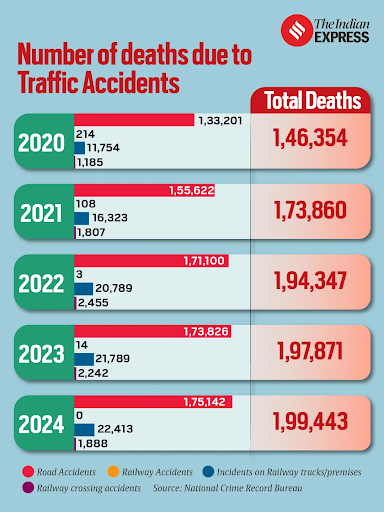
According to the National Crime Records Bureau (NCRB), 2024 traffic accidents in India resulted in 1.99 lakh deaths, with over-speeding causing 58% of these fatalities.
|
Read all about: India's Road Accident Crisis l Road Accidents in India |
Road accidents are traffic-related incidents involving motor vehicles, pedestrians, or cyclists that convert routine travel into a high-risk activity, leading to injuries, fatalities, and property damage.
Traffic accidents act as an umbrella term that includes road crashes, railway accidents, and incidents at railway crossings, which have immense public health and socio-economic repercussions.
Highest global fatalities: India records the highest number of road accident deaths globally, accounting for 11% of all road crash deaths despite having only 1% of the world's vehicles. (Source: Ministry of Road Transport)
Rising death toll: In 2024, 1.99 lakh people died in traffic accidents, with road accidents accounting for 1.75 lakh (88%) of those fatalities. (Source: NCRB)
Disproportionate impact on the youth and workforce: Young adults (18-45 years) accounting for 72.1% of victims and the 18-60 age group making up 87.2% of total fatalities. (Source: Ministry of Road Transport)
Severe economic loss: Socio-economic costs of road crashes amounting to an estimated 3.14% of India's GDP. (Source: PIB)
High geographic concentration: 100 districts representing over 25% of national road deaths. About 63% of the fatalities occur on non-National Highways, including State Highways and local roads. (Source: Save Life Foundation)
Structural and engineering defects: 59% of all road accident fatalities do not involve any traffic violation, highlighting the impact of absent crash barriers, unsafe junctions, and poor street lighting. (Source: SaveLIFE Foundation)
Speeding and reckless driving: Speeding causing 58% of total road deaths, followed by dangerous driving and overtaking. (Source: NCRB)
Delayed emergency response: Only about 20% of victims utilize government 108 ambulance services, and in 55% of cases, ambulances fail to arrive within 15 minutes, causing delays in trauma care. (Source: SaveLIFE Foundation)
Poor vehicular safety standards: Old, unfit vehicles prone to breakdowns and a lack of built-in safety features like airbags or anti-lock braking systems.
Visibility and environmental risks: 53% of deaths occurring between 6 PM and midnight, exacerbated by straight, open roads where vehicle speeds tend to be dangerously high. (Source: SaveLIFE Foundation)
Motor Vehicles (Amendment) Act, 2019: Increase penalties for traffic violations, mandate automated vehicle fitness testing, and implement the recall of defective vehicles.
Cashless treatment during the Golden Hour: Cashless emergency treatment scheme covering up to ₹1.5 lakh in medical expenses for the first seven days following an accident.
Bharat NCAP Launch: Bharat New Car Assessment Programme (NCAP) to award 'Star Ratings' to automobiles based on crash test performance.
Bystander Protection: Established Guidelines and Standard Operating Procedures (SOPs) to shield Good Samaritans from police or hospital harassment when assisting crash victims.
Centralized Data & Safety: Systems like Electronic Detailed Accident Report (e-DAR) and Integrated Road Accident Database (iRAD) identify and fix high-risk "blackspots" on National Highways.
Vulnerable Road Users (VRUs) Support: States must create Annual Action Plans for VRU-friendly infrastructure like safe crossings, especially in high-fatality rural areas.
Cashless Care Access: Implement the Pradhan Mantri Jan Arogya Yojana to reduce out-of-pocket expenses for poor households.
Interim Compensation: Establish Motor Accidents Mediation Authorities (MAMA) to transfer fixed compensation directly to Aadhaar-linked accounts, avoiding legal delays.
Report Standardization: Enforce Motor Accident Claims Tribunal Agreed Procedure (MCTAP) and use CCTNS for swift Detailed Accident Reports (DAR) sharing among police, hospitals, and insurers.
Strengthen financial safety nets: Provide unconditional cash transfers and loans to female-headed households affected by crashes, ensuring gender-responsive support.
Learn from global best practices: Adopt a holistic "systems approach" by combining safer infrastructure, vehicle standards, and universal trauma care—emulating nations like Japan and Thailand—to achieve global fatality reduction targets.
|
Brasilia Declaration on Road Safety (2015) Adopted in 2015 during the 2nd Global High-Level Conference on Road Safety, this is the most widely cited "Brasilia Declaration." India is a key signatory to this agreement.
|
Conclusion
To curb the road fatality crisis, India must move from driver-blame to systemic engineering, universal trauma care, and rapid financial safety nets for all victims.
Source: INDIANEXPRESS
|
PRACTICE QUESTION Q. With reference to the Brasilia Declaration, consider the following statements:
Which of the statements given above is/are correct? A) 1 only B) 2 only C) Both 1 and 2 D) Neither 1 nor 2 Answer: B Explanation: Statement 1 is Incorrect: The Brasilia Declaration on Road Safety (2015) is not a legally binding international treaty. Statement 2 is Correct: India is a signatory to the Brasilia Declaration. By signing this, India committed to the global goal of reducing road accident fatalities. Originally, the target was a 50% reduction by 2020, which has since been extended to 2030 in line with the UN Decade of Action for Road Safety. |
Speeding remains the biggest factor, accounting for 58% of total road deaths, followed by poor road engineering, as 59% of fatalities occur without any traffic violation.
Road crashes amount to an estimated socio-economic cost of 3.14% of India's GDP, disproportionately affecting Low-Income Households and pushing them into a vicious cycle of debt.
It is a global commitment adopted in 2015 by over 110 countries, including India, to reduce road traffic deaths and injuries, aligning with the Sustainable Development Goal 3.6.



© 2026 iasgyan. All right reserved