February 2026’s 2.3% core growth reveals a divergence: infrastructure-led expansion in steel and cement versus contractions in hydrocarbons. Achieving stable growth requires addressing energy vulnerabilities, sustaining capital expenditure, and integrating green hydrogen to align industrial output with Net-Zero targets.
Copyright infringement not intended
Picture Courtesy: newsonair
Why In News?
The combined Index of Eight Core Industries (ICI) increased by 2.3 % in February, 2026 as compared to the Index in February, 2025
What is the Index of Eight Core Industries (ICI)?
It is a monthly production index that measures the collective and individual performance of eight "infrastructure" sectors in India.
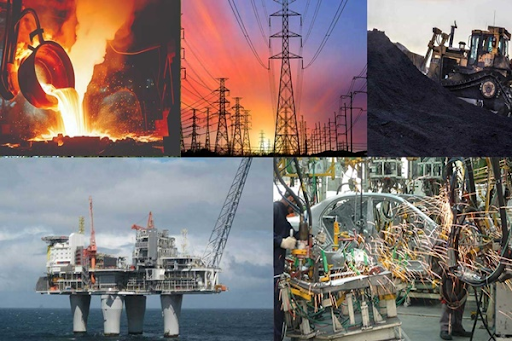
The Eight Core Industries : These sectors are considered "core" because they act as the primary inputs for almost all other industrial activities. They are:
Key Technical Details
Key Highlights & Trends (February 2026)
Overall Growth: The combined ICI recorded a provisional growth of 2.3% in February 2026, slower than the 4.7% recorded in January 2026, indicating a moderation in industrial activity.
Sectoral Divergence: Infrastructure-linked sectors like Steel and Cement are booming, while energy-extraction sectors like Crude Oil and Natural Gas are contracting.
|
Trend |
Performing Sectors (Infrastructure-Led Boom) |
Underperforming Sectors (Hydrocarbon Slump) |
|
Sectors & Growth |
|
|
|
Driving Factors / Reasons |
|
|
Way Forward
Address Hydrocarbon Sector Issues: Invest in Enhanced Oil Recovery (EOR) technologies to maximize output from existing oil fields.
Decarbonize Hard-to-Abate Sectors: Align with India's "Panchamrit" commitment to achieve Net-Zero by 2070.
Sustain Capital Expenditure: Focus on infrastructure-led growth to maintain domestic demand for steel, cement, and other core products.
Conclusion
The February 2026 core sector data reveals a 2.3% growth led by robust performance in cement and steel, yet is significantly hindered by contractions in crude oil, natural gas, and refinery products.
Source: PIB
|
PRACTICE QUESTION Q. Consider the following statements about the Index of Eight Core Industries (ICI) in India: 1. It constitutes over 50% of the total weight in the Index of Industrial Production (IIP). 2. Cement and Steel are among the eight core industries. 3. The base year for the ICI is 2011-12. Which of the statements given above is/are correct? a) 1 and 2 only b) 2 and 3 only c) 1 and 3 only d) 1, 2, and 3 Answer: b Explanation: Statement 1 is incorrect: The combined weight of the eight core industries in the IIP is approximately 40.27%. It does not exceed the 50% threshold. Statement 2 is correct: The eight core industries consist of Coal, Crude Oil, Natural Gas, Refinery Products, Fertilizers, Steel, Cement, and Electricity. Statement 3 is correct: The base year for both the ICI and the IIP was revised from 2004-05 to 2011-12 to better reflect the current industrial structure. |
The ICI is a macroeconomic indicator that measures the combined and individual performance of eight fundamental industrial sectors in India: Coal, Crude Oil, Natural Gas, Refinery Products, Fertilizers, Steel, Cement, and Electricity.
The eight core industries form the foundational bedrock of the industrial economy and comprise 40.27% of the total weight in the Index of Industrial Production (IIP). Therefore, their performance heavily dictates the overall manufacturing output trends.
The decline in domestic Crude Oil and Natural Gas extraction is largely due to maturing and aging offshore fields (such as Mumbai High) experiencing pressure drops, high geological risks deterring private investments, and complex environmental clearance protocols.



© 2026 iasgyan. All right reserved