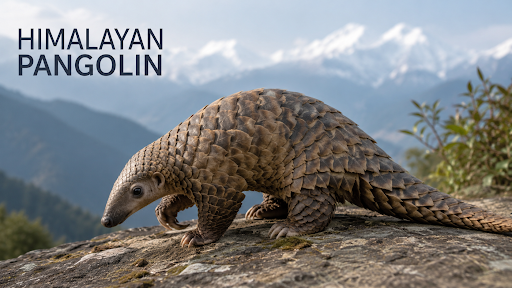
The Himalayan Pangolin (Manis aurita) is newly recognized as a distinct species from the Chinese Pangolin utilizing genomic data. This reclassification strengthens anti-trafficking forensic efforts, mandates specific CITES protections, and highlights urgent conservation needs against severe poaching threats.
Why In News?
Recent genomic and morphological studies confirm the Himalayan Pangolin (Manis aurita) as a distinct species, separated from the Chinese Pangolin over 1.2 million years ago
What is Himalayan Pangolin?
The Himalayan Pangolin (Manis aurita) is a newly-revalidated pangolin species native to the Himalayan region, genetically and morphologically distinct from the Chinese Pangolin.
Distribution
Key Features of the Himalayan Pangolin
Nocturnal and Solitary Nature: The mammal operates primarily at night and exhibits elusive, solitary behavior, making wild populations exceedingly difficult to study.
Protective Keratin Scales: Overlapping protective keratin scales cover the body. The animal employs volvation—rolling into an impenetrable ball—as its primary defense mechanism, which tragically makes it an easy target for human poachers.
Specialized Insectivorous Diet: Lacking teeth, the species relies on an enlarged olfactory bulb to forage exclusively for ants and termites.
Strong Burrowing Adaptations: It possesses strong, moderately curved claws, with the third (middle) claw on each forefoot being the longest and highly specialized for digging burrows and tearing into termite mounds.
Distinct Morphological Characteristics: Genetically and morphologically, the species boasts a larger average body length of 95.2 cm compared to the 71.2 cm of the Chinese Pangolin, alongside a longer tail, smaller ears, and a broader, shorter nasal bone.
The IUCN currently classifies the Indian Pangolin as Endangered and the Chinese Pangolin as Critically Endangered. Manis aurita now requires an independent, urgent threat assessment.
Source: DOWNTOEARTH
|
PRACTICE QUESTION Q. Consider the following statements regarding the newly revalidated Himalayan Pangolin: 1. It is found in the arid regions of Northwestern India. 2. It exhibits distinct morphological traits, including smaller ears and a larger body size compared to the Chinese Pangolin. 3. Like all other pangolin species in India, it receives the highest level of legal protection under Schedule I of the Wildlife (Protection) Act, 1972. Which of the statements given above are correct? A) 1 and 2 only B) 2 and 3 only C) 1 and 3 only D) 1, 2, and 3 Answer: B Explanation: Statement 1 is incorrect: The newly revalidated Himalayan Pangolin (Manis aurita or Manis indoburmanica) is found in the foothills of the Himalayas and northern/northeastern India. It is the Indian Pangolin (Manis crassicaudata) that is widely distributed across the country but specifically absent from the arid regions, high Himalayas, and Northeast. Statement 2 is correct: Recent genomic and morphometric research confirms that the Himalayan Pangolin exhibits distinct morphological traits. It is larger in body size, has a longer tail, and smaller ears when compared to the Chinese Pangolin. Statement 3 is correct: All pangolins, including both the Chinese Pangolin and the recently confirmed Himalayan Pangolin (formerly classified under the Chinese Pangolin), receive the highest level of legal protection in India. They are all listed under Schedule I of the Wildlife (Protection) Act, 1972, which prohibits hunting, poaching, or any form of commercial trade. |



© 2026 iasgyan. All right reserved