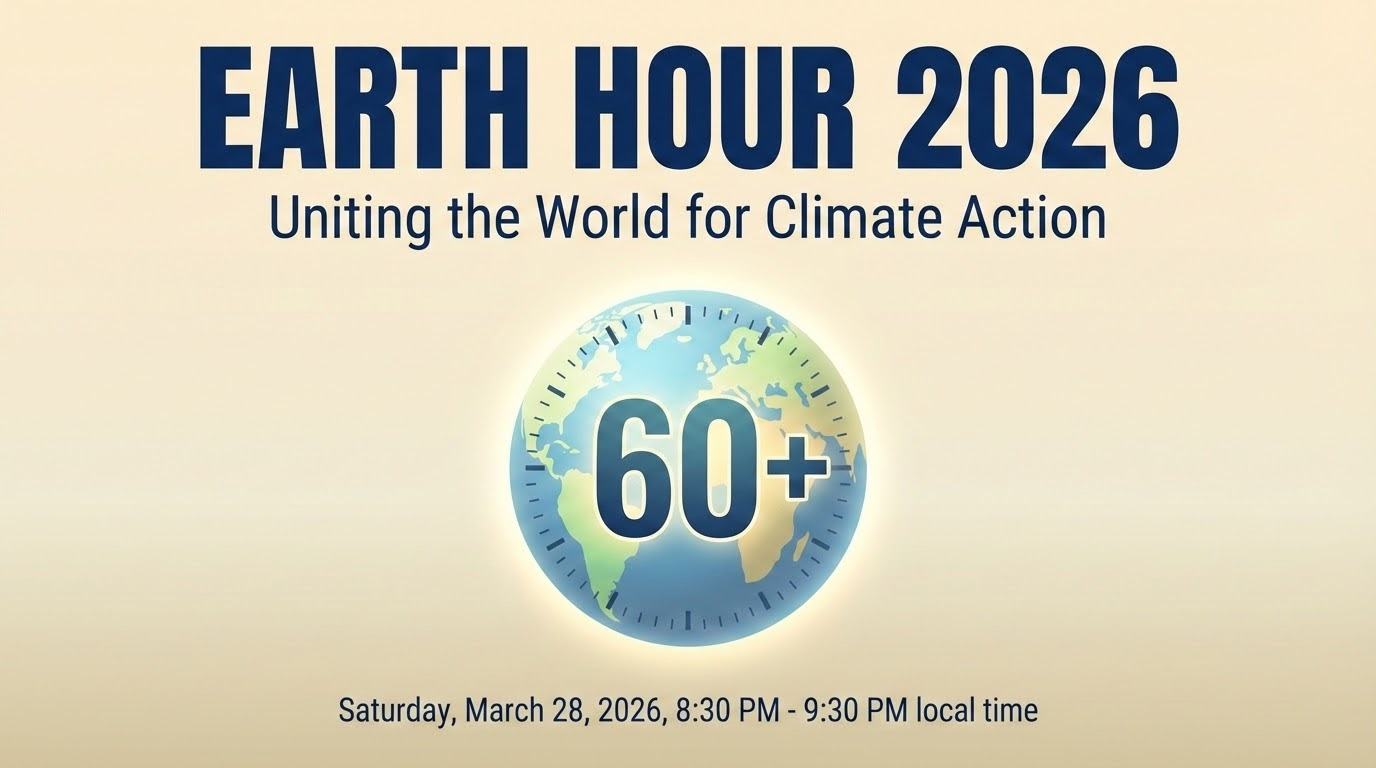
Earth Hour 2026 takes place on Saturday, March 28, from 8:30 PM to 9:30 PM local time. This global event marks the 20th anniversary of the movement, encouraging millions to switch off non-essential lights to support our planet.
Why In News?
On March 28, 2026, people across 190+ countries and territories observed Earth Hour from 8:30 PM to 9:30 PM local time.
What is Earth Hour?
Definition: A global environmental movement that encourages individuals, communities, and businesses to turn off non-essential electric lights for one hour.
Organizer: World Wide Fund for Nature (WWF).
Origin: Started as a lights-off event in Sydney, Australia, in 2007.
Timing: Held annually on the last Saturday of March.
Objective: To raise awareness about climate change, nature loss, and the urgent need to protect our planet.
|
Earth Hour vs Earth Day |
||
|
Feature |
Earth Hour |
Earth Day |
|
Date |
Last Saturday of March |
April 22 |
|
Organizer |
World Wildlife Fund (WWF) |
EARTHDAY.ORG (formerly Earth Day Network) |
|
Primary Act |
Switching off lights (Symbolic) |
Rallies, tree planting, policy advocacy (Action-oriented) |
|
Focus |
Climate Change & Energy Loss |
General Environmental Protection (Pollution, Plastic, etc.) |
Theme 2026: "Give an Hour for Earth"
While the core act remains switching off lights, the movement has rebranded its focus to "The Biggest Hour for Earth."
About World Wildlife Fund (WWF)
Key Reports & Indices
Living Planet Report (LPR)
Living Planet Index (LPI)
Major Global Initiatives
Earth Hour
Debt-for-Nature Swaps
WWF India
Source: TIMESNOWNEWS
|
PRACTICE QUESTION Q. Consider the following statements regarding 'Earth Hour': 1. It is an initiative of the United Nations Environment Programme (UNEP). 2. It is a movement in which participants switch off the lights for one hour on a certain day every year. 3. The movement began in Sydney, Australia, in 2007. Which of the statements given above is/are correct? A) 1 and 2 only B) 2 and 3 only C) 1 and 3 only D) 1, 2, and 3 Answer: B Explanation: Statement 1 is incorrect: Earth Hour is an initiative of the World Wide Fund for Nature (WWF), not the United Nations Environment Programme (UNEP). Statement 2 is correct: It is a global movement where participants are encouraged to switch off non-essential electric lights for one hour—from 8:30 PM to 9:30 PM local time—as a symbolic gesture of commitment to the planet. Statement 3 is correct: The movement originated as a "lights-off" event in Sydney, Australia, on March 31, 2007. |
Earth Hour is a global grassroots environmental movement organized by the World Wildlife Fund (WWF). It encourages individuals, businesses, and landmarks to switch off non-essential lights for one hour to demonstrate global solidarity for planetary health and energy conservation.
In 2024 judgment (M.K. Ranjitsinh vs Union of India), the Supreme Court of India officially recognized the "right to be free from the adverse effects of climate change" as a fundamental right flowing directly from Articles 14 and 21 of the Constitution.
As of January 2026, India's total installed power capacity reached 520.5 GW, with a significant 52% (approximately 272 GW) originating from non-fossil generation sources, heavily driven by record-breaking solar energy growth.



© 2026 iasgyan. All right reserved