Babu Jagjivan Ram was a veteran freedom fighter, India’s first Labour Minister, and a Dalit icon. As Defence Minister in 1971, he led India to victory. His birth anniversary (5th April) is celebrated as Samta Diwas, honouring his crusade for equality.
The Prime Minister pays tribute to Babu Jagjivan Ram on his 119th birth anniversary.
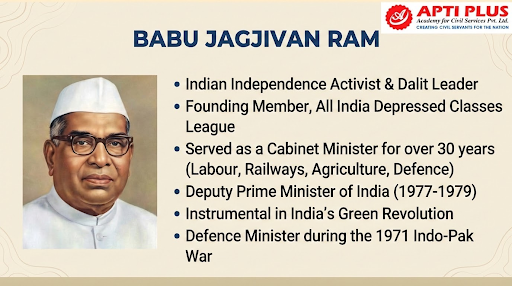
Babu Jagjivan Ram, affectionately known as "Babuji," was a Dalit icon who rose to become the Deputy Prime Minister of India, he holds the world record for being a parliamentarian for 50 uninterrupted years (1936–1986).
His birth anniversary (5th April) is celebrated across India as Samta Diwas (Equality Day), reflecting his lifelong fight for a casteless, egalitarian society.
Early Life & The Fight Against Untouchability
Roots: Born on April 5, 1908, in Chandwa, Bihar.
Life lesson: As a student in Arrah and later at Banaras Hindu University (BHU), he faced severe discrimination (e.g., being denied water from common pots).
Organization: In 1935, he founded the All India Depressed Classes League, an organization dedicated to attaining equality for untouchables and integrating them into the nationalist movement.
Role in Freedom Struggle
Babuji was a staunch Gandhian who believed that political freedom was incomplete without social equality.
The Administrator: Key Ministries & Contributions
Labour Minister (1946–1952)
As the youngest minister in Nehru’s Interim Government, he laid the bedrock of India’s labour laws.
Agriculture Minister (1967–1970)
He took charge when India was facing a "ship-to-mouth" existence and severe droughts.
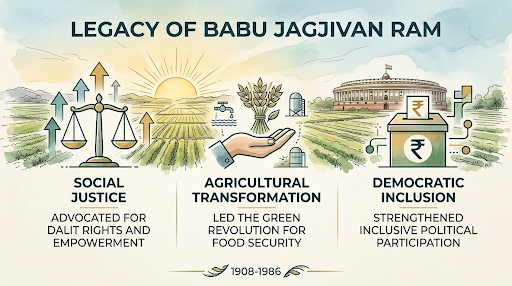
The Green Revolution: While scientists like M.S. Swaminathan provided the research, Babuji provided the political will. He pushed for the import of HYV seeds despite criticism and strengthened the Public Distribution System (PDS) to avert famine.
Outcome: India moved towards food self-sufficiency, a strategic asset that reduced dependence on US aid (PL-480).
Defence Minister (1970–1974)
His finest hour came as the Defence Minister during the 1971 Indo-Pak War.
Strategic Leadership: He is credited with giving the Armed Forces the freedom to plan their operations while ensuring seamless coordination between the Army, Navy, and Air Force.
Liberation of Bangladesh: His leadership was pivotal in the surrender of 93,000 Pakistani soldiers and the creation of Bangladesh.
Role in the Constitution & Emergency
Constituent Assembly: As a member, he ensured that Article 17 (Abolition of Untouchability) and reservation provisions for SC/STs were enshrined in the Constitution.
The 1977 Revolt: He quit the Congress party and the government during the Emergency to form the Congress for Democracy (CFD).
Legacy and Tributes
Samta Sthal: His cremation site near Raj Ghat in New Delhi is a dedicated national memorial.
Postal Stamps: The Department of Posts issued a commemorative stamp in 1991 to honour his contribution to the freedom struggle and nation-building.
Jagjivan Ram Abhinav Kisan Puruskar: Instituted by the ICAR (Indian Council of Agricultural Research) to recognise innovative farmers who introduce new technologies in agriculture.
Babu Jagjivan Ram National Foundation Schemes: This foundation provides scholarships and funding for Dalit literature and social activities.
Source: NEWSONAIR
|
PRACTICE QUESTION Q. Consider the following statements regarding Babu Jagjivan Ram: 1. He founded the All India Depressed Classes League in 1935. 2. He served as the Defence Minister of India during the 1962 Sino-Indian War. 3. His birth anniversary is observed nationwide as Samta Diwas. Which of the statements given above is/are correct? a) 1 and 2 only b) 2 and 3 only c) 1 and 3 only d) 1, 2, and 3 Answer: c Explanation: Statement 1 is correct: He was instrumental in the foundation of the All India Depressed Classes League in 1935, an organization dedicated to attaining equality for the depressed classes (Dalits) and drawing them into the nationalist movement. Statement 2 is incorrect: He was not the Defence Minister during the 1962 Sino-Indian War. The Defence Minister at that time was V.K. Krishna Menon (followed by Y.B. Chavan) Babu Jagjivan Ram served as the Defence Minister later, notably during the 1971 Indo-Pak War. Statement 3 is correct: His birth anniversary (5th April) is observed nationwide as Samta Diwas (Equality Day) to honor his contribution to social justice and equality. |
His birth anniversary on April 5th is celebrated as Samta Diwas (Equality Day) to commemorate his lifelong struggle and political dedication towards establishing a casteless, egalitarian society in India.
He worked to integrate marginalized classes into the mainstream nationalist movement by founding the All India Depressed Classes League in 1935. He also successfully secured voting rights for Dalits during the Hammond Commission, preventing British attempts to alienate these groups from the freedom struggle.
Serving as India's first Labour Minister, he piloted foundational laws such as the Industrial Disputes Act (1947), the Minimum Wages Act (1948), and the Employees’ Provident Fund (EPF) Act (1952). These laws provided mandatory financial safety nets and conflict resolution mechanisms for workers.


© 2026 iasgyan. All right reserved