India’s ambition to emerge as a global arbitration hub remains stalled as the Centre has not constituted the Arbitration Council of India six years after the 2019 amendment. This delay blocks the shift to institutional arbitration, weakens investor confidence, and undermines contract enforcement and Ease of Doing Business goals.

Copyright infringement not intended
Picture Courtesy: THEHINDU
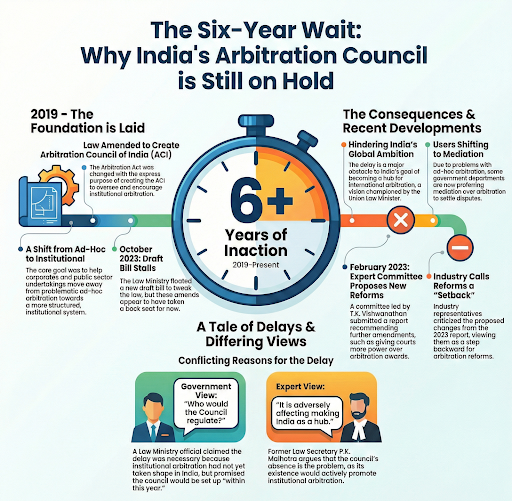
The Arbitration and Conciliation (Amendment) Act of 2019 aimed to make India an arbitration hub by creating the Arbitration Council of India (ACI), but the ACI has not been constituted as of early 2026.
|
Read all about: Arbitration and Mediation l Arbitration and Mediation in India l Reviving Indian Arbitration System |
It is an independent statutory body established under Part 1A of the Arbitration and Conciliation (Amendment) Act, 2019.
Its primary purpose is to promote and standardize institutional arbitration, mediation, and other alternative dispute resolution (ADR) mechanisms in India.
|
What is Arbitration?
|
Key Objectives and Functions of the ACI
Grading Arbitral Institutions: To frame policies and criteria for grading institutions based on infrastructure, quality of arbitrators, and performance.
Accrediting Arbitrators: To establish uniform professional standards and accredit arbitrators, ensuring a pool of qualified professionals.
Promoting ADR: To take all necessary measures to promote various forms of Alternative Dispute Resolution (ADR), including arbitration, mediation, and conciliation.
Maintaining a Depository: To create and maintain an electronic depository of all arbitral awards made in India, enhancing transparency and analysis.
Minimizing Judicial Intervention: A key goal was to reduce the burden on courts by empowering ACI-graded institutions to handle the appointment of arbitrators.
Proposed Composition of the ACI
Chairperson: Appointed by the Central Government in consultation with the Chief Justice of India.
Full-Time Members: Includes an eminent arbitration practitioner and an esteemed academic researcher with expertise in ADR.
Ex-officio Members: Includes the Secretary of the Department of Legal Affairs, the Secretary of the Department of Expenditure, and the Chief Executive Officer (CEO) of the ACI.
Part-Time Member: A representative from a recognized chamber of commerce or industry nominated on a rotational basis.
Administrative Inertia: Procedural delays in finalizing appointments, allocating resources, and establishing the necessary infrastructure.
Lack of Political Urgency: The initial legislative push has not been matched by sustained executive action to operationalize the Council.
Shift in Focus: Some government departments have reportedly started preferring mediation over arbitration for certain disputes, shifting the focus away from institutional arbitration reforms.
Lack of Clarity: Some officials have suggested a "chicken-and-egg" problem, where the council's role is to regulate institutional arbitration, but institutional arbitration itself has not yet fully matured in India.
Impact of Non-Constitution
Damages 'Ease of Doing Business' Perception
Effective contract enforcement is a critical parameter for investors. India has historically performed poorly on this sub-index, ranking 163rd out of 190 countries in the last World Bank Doing Business Report.
Burdens the Judiciary
Indian judiciary is already strained, with over 4.8 crore cases pending across all courts (Source: National Judicial Data Grid (NJDG)). The ACI was designed to alleviate this by streamlining commercial dispute resolution.
Reduces Investor Confidence
Foreign investors seek predictable, efficient, and neutral dispute resolution mechanisms. The absence of a robust regulatory body makes India a less attractive seat for international arbitration compared to global hubs.
India Loses Out to Global Hubs
Indian parties frequently use the Singapore International Arbitration Centre (SIAC) for India-related business disputes; loss of business and prestige for India.
Immediate Steps Required
Expedite Appointments: The central government must prioritize the appointment of the ACI's Chairperson and members to make the body functional at the earliest.
Allocate Resources: Provide necessary funds and infrastructure to support the ACI's operations and secretariat.
Notify All Provisions: Ensure all remaining provisions of the 2019 Amendment Act related to the ACI are officially notified and brought into force.
Comprehensive Reforms for a Pro-Arbitration Culture
Learn from Global Best Practices: Singapore's success is built on strong government commitment, pro-arbitration legislation, and a supportive, non-interventionist judiciary. India can adopt similar principles.
Build Capacity: Invest in training a new generation of skilled arbitrators and ADR professionals to meet international standards.
Embrace Technology: e-Arbitration Platform should be integrated with the ACI's functions for case management and maintaining a digital repository of awards.
For an economy aspiring to reach $32 trillion by 2047, a swift, predictable, and credible commercial dispute resolution mechanism is not a luxury but a necessity.
Source: THEHINDU
|
PRACTICE QUESTION Q. "The delay in constituting the Arbitration Council of India (ACI) undermines India’s ambition to become a global hub for international arbitration." Critically analyze. (250 words) |





© 2026 iasgyan. All right reserved