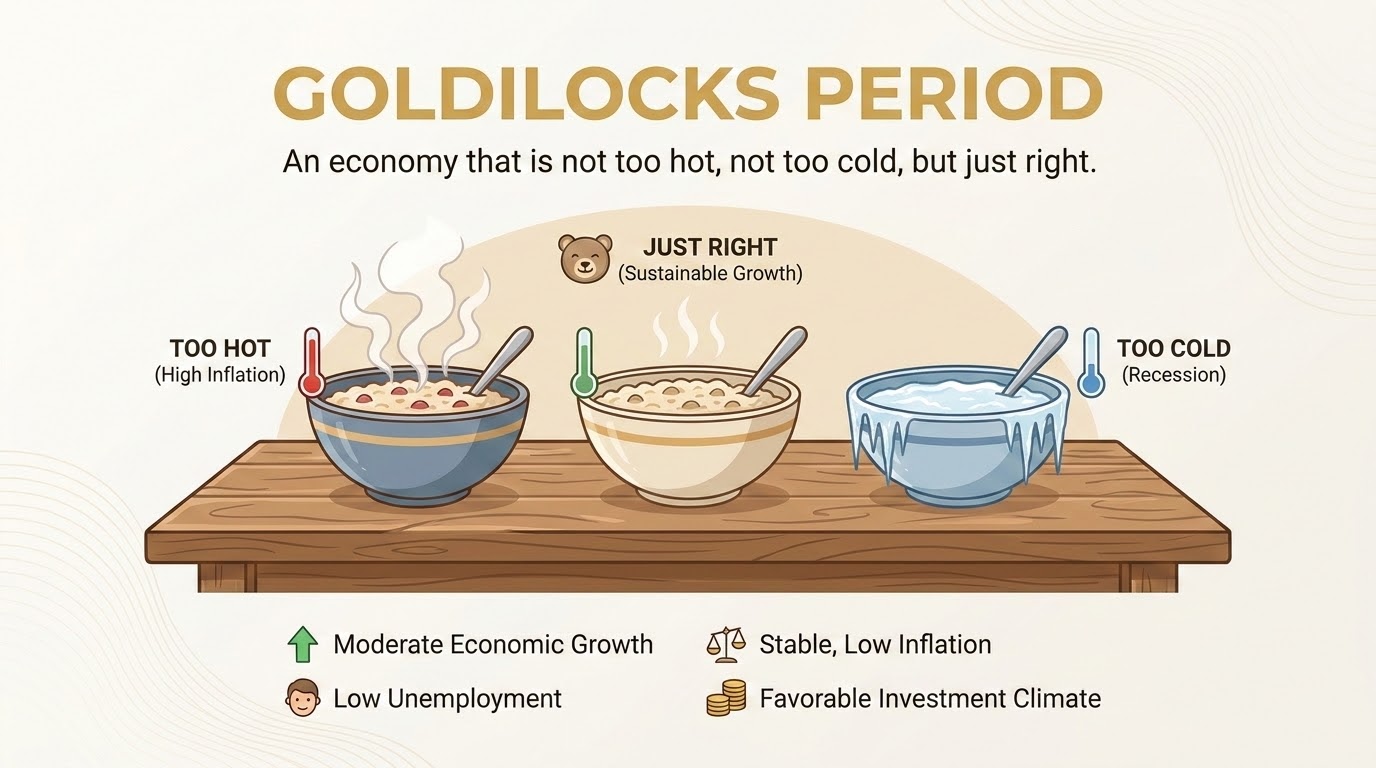
A Goldilocks Economy describes an ideal state where growth is robust enough to prevent recession but not so fast that it triggers high inflation. This "just right" balance allows for stable interest rates and sustainable long-term economic expansion.
A structural slowdown is currently challenging the Indian economy's "Goldilocks" era, characterized by strong growth and low inflation.
The "Goldilocks Period" in economics refers to an ideal state of the business cycle where the economy is performing "just right"—balanced perfectly between a recession and an inflationary boom.
According to the Reserve Bank of India (RBI) and the Ministry of Finance, India was described as being in this "sweet spot" during late 2025 and early 2026, characterized by high growth and falling inflation.
Key Features of a Goldilocks Economy
Sustained Economic Growth: GDP growth remains robust and steady. Growth rate of approx. 7% to 8%, keeping India the fastest-growing major economy.
Low to Moderate Inflation: Prices remain stable, allowing consumers to maintain purchasing power. Headline inflation dropped 0.3% in Oct 2025; staying well within the RBI's comfort zone.
Low Interest Rates: Since inflation is under control, the Central Bank can keep interest rates low. This encourages businesses to borrow and invest. For example, the RBI cut the repo rate to 5.25% in Dec 2025 to sustain this phase.
Low Unemployment: Strong growth creates enough jobs to keep unemployment rates low without causing the "wage-price spiral" that leads to high inflation.
Asset Appreciation: Stability leads to a surge in stock markets and real estate values, as investor confidence is at its peak.
Predictable Stability: Business and consumers can plan for the long term because prices are stable and growth is steady. This reduces the "risk premium" in investments.
Optimal Employment: High growth ensures that the labor market remains tight (low unemployment), which leads to rising household incomes without the immediate threat of a recession.
Fiscal Strength: For the government, a Goldilocks economy boosts tax buoyancy (higher GST and Income Tax collections) while reducing the need for expensive stimulus spending, helping in Fiscal Consolidation.
"Wealth Effect": Stable low interest rates drive up the value of stocks and real estate, making households feel wealthier and encouraging further consumption.
Proactive Monetary Policy: The RBI balances growth and inflation by adjusting interest rates, exemplified by the December 2025 cut to 5.25%.
Supply-Side Reforms: Infrastructure and digital upgrades (Gati Shakti, UPI/GST) boost efficiency, maintaining high growth with low prices.
Soft Commodity Prices: Lower global costs for oil and fertilizer reduce domestic inflation, benefiting import-dependent India.
Clean Balance Sheets: Low debt across banks and corporations facilitates smooth credit flow, driving investment-led economic expansion.
What are the Risks of a Goldilocks Phase?
According to the RBI's Financial Stability Reports and the IMF, a prolonged "just right" state can lead to several dangers:
Supply-Side Resilience: Investing in climate-resilient agriculture and cold-chain logistics helps stabilize "Goldilocks" conditions against monsoon shocks.
Private Capex Revival: A supportive RBI stance is needed for the private sector to lead capital expenditure beyond government infrastructure efforts.
Fiscal Prudence: Following the Fiscal Consolidation roadmap (deficit below 4.5% by FY26) prevents "crowding out" of private credit.
Incentivizing Manufacturing: Expanding PLI schemes to labor-intensive sectors can fix the "K-shaped" recovery through mass employment.
Energy Decoupling: Adopting Green Hydrogen and Renewables protects inflation and the Rupee from global oil shocks.
India's "Goldilocks" phase offers a brief window for structural reform. Achieving a $5 trillion economy requires building domestic resilience to ensure stability through internal strength rather than external luck.
Source: INDIAN EXPRESS
|
PRACTICE QUESTION Q. With reference to the "Goldilocks Economy", consider the following statements: 1. It is characterized by exceptionally high inflation and stagnation in employment. 2. It represents a state where economic growth is robust but does not trigger runaway inflation. 3. Aggressive interest rate hikes by the Central Bank are a defining feature of this phase. Which of the statements given above is/are correct? a) 1 and 2 only b) 2 only c) 2 and 3 only d) 1, 2, and 3 Answer: b Explanation: A "Goldilocks Economy" describes an ideal state where the economy is "just right"—neither overheating with high inflation nor stalling in a recession. Statement 1 is incorrect: It is characterized by low inflation and low unemployment (high employment). High inflation and stagnation are characteristics of stagflation, which is the opposite of a Goldilocks economy. Statement 2 is correct: It represents a state where economic growth is robust (steady/stable) but does not trigger runaway inflation. Statement 3 is incorrect: A defining feature is actually stable or low interest rates that are supportive of growth, rather than aggressive hikes. Aggressive hikes are usually a sign that the Goldilocks phase is ending. |
Goldilocks Economy refers to an ideal macroeconomic state where economic growth is steady and robust, but not so fast that it causes high inflation, nor so slow that it leads to a recession. Borrowed from the children's tale, it describes an economy that is "just right."
The primary features include steady GDP growth driven by domestic consumption, moderate and controlled inflation, high employment rates without wage-inflation spirals, and accommodative or neutral interest rates set by the central bank.
Predictable inflation and stable interest rates lower borrowing costs and provide long-term market certainty. This encourages the private sector to confidently invest in long-term infrastructure and expand capacity without the fear of sudden monetary shocks.


© 2026 iasgyan. All right reserved