TRAI’s Draft 13th Amendment (2026) mandates telecom providers to offer "Voice and SMS-only" packs mirroring the validity of data-bundled plans. It ensures affordable, proportional pricing for non-data users, protecting rural and elderly consumers' interests.
Why In News?
The Telecom Regulatory Authority of India (TRAI) released the Draft Telecom Consumer Protection (Thirteenth Amendment) Regulation 2026 to reform the tariff structure for mobile services.
|
Read all about: INDIAN TELECOM SECTOR: GROWTH, CHALLENGES, WAY FORWARD |
Background: Why was this Amendment Introduced?
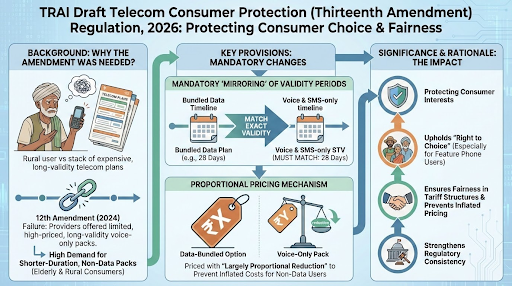
The 2024 regulation forced telcos to offer at least one voice-only pack, however, service providers followed the "letter of the law" but ignored its spirit.
Strategic "Oversight" by Telcos: After the 2024 mandate, providers introduced voice-only packs but often restricted them to expensive, long-term validities (e.g., 365 days).
Protecting Non-Data Users: Most affordable short-term packs (e.g., 28 days) remained bundled with data. Feature phone users—who cannot use data—were effectively paying a "data tax" for services they didn't need.
Financial Inclusion: Mobile numbers are essential for the digital welfare system. Services like Direct Benefit Transfer (DBT) rely on One Time Passwords (OTPs) and SMS alerts.
Key Provisions of the 2026 Draft Regulation
Mandatory Standalone Vouchers: For every bundled plan (Voice + SMS + Data) offered, telecom service providers (TSPs) must offer a corresponding standalone "Voice and SMS-only" voucher.
Same Validity: This standalone voucher must have the exact same validity period as its bundled counterpart.
Proportionate Pricing: The price of the "Voice and SMS-only" plan must be proportionately reduced, ensuring consumers do not pay for data services they cannot or do not use.
Significance
This amendment upholds consumer "Right to Choice," particularly for rural users relying on feature phones.
It aims to ensure fairness in tariff structures by preventing inflated pricing on non-data packs, thus strengthening regulatory consistency and protecting consumer interests.
Source: PIB
|
PRACTICE QUESTION Q. The term "Digital Bharat Nidhi", frequently seen in the news, is most closely associated with which of the following? (a) A scheme for funding digital literacy programs in primary schools (b) A sovereign wealth fund for domestic semiconductor manufacturing (c) A fund to subsidize telecommunication connectivity in rural and underserved areas (d) A government platform for issuing Central Bank Digital Currencies Answer: (c) Explanation: The term "Digital Bharat Nidhi", formerly known as the Universal Service Obligation Fund (USOF), is a fund established under the Telecommunications Act, 2023, specifically designed to finance projects that improve telecommunication services, internet connectivity, and digital infrastructure in rural, remote, and underserved areas. |
It is a draft regulation by the Telecom Regulatory Authority of India (TRAI) mandating telecom operators to offer standalone "Voice and SMS-only" plans at proportionately lower prices alongside their bundled data plans, ensuring affordability for non-data users.
Tariff forbearance is a regulatory policy where authorities like TRAI refrain from fixing prices. Instead, they allow free-market forces and competition among telecom service providers to determine the cost of telecom services for consumers.
Formerly known as the Universal Service Obligation Fund (USOF), the Digital Bharat Nidhi is a government fund managed by the Department of Telecommunications designed to subsidize and improve telecom connectivity and infrastructure for rural, remote, and Below Poverty Line (BPL) populations

© 2026 iasgyan. All right reserved