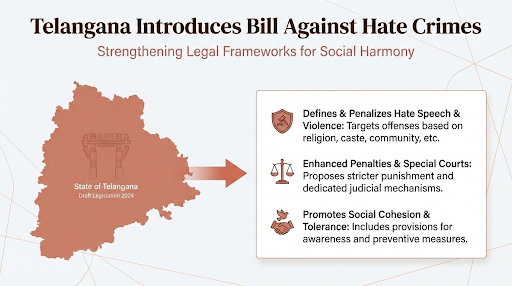
The Telangana Hate Speech and Hate Crimes (Prevention) Bill, 2026, establishes a stringent legal framework for cognizable and non-bailable offences, carrying penalties of up to 10 years imprisonment for repeat offenders
Why In News?
The Telangana government introduced the Telangana Hate Speech and Hate Crimes (Prevention) Bill 2026 to address hate speech and hate-motivated crimes.
What are the Key Provisions of the Bill?
Definitions
Hate Speech: Defined broadly to include any communication (spoken, written, signs, or digital) made with the intention to cause injury, disharmony, or feelings of enmity/hatred against a person or community.
Hate Crime: Covers acts of violence or hostility motivated by prejudice against a group based on religion, race, caste, community, sex, gender, sexual orientation, place of birth, language, or disability
Stringent Penalties
Institutional Accountability
Organisational Guilt: If an organization or institution is found promoting hate crimes, the persons in charge (directors, managers) can be held liable and punished.
Digital Platform Regulation
Takedown Mechanism: The Bill empowers a "Designated Officer" to issue directives for the removal of hateful content from electronic platforms (social media, websites) to prevent further circulation.
Victim Compensation
The courts are empowered to award compensation to victims, calculated based on the gravity of the physical or mental injury caused.
What is Hate Speech?
There is no specific legal definition of "Hate Speech" in the Indian Law.
Constitutional & Statutory Framework
In the absence of a dedicated "Hate Speech Act," various sections of the Bharatiya Nyaya Sanhita (BNS)—which replaced the IPC—are used:
Judicial Intervention
Pravasi Bhalai Sangathan vs Union of India (2014): The Supreme Court observed that hate speech is an effort to marginalize individuals based on their membership in a group and asked the Law Commission to suggest measures.
Amish Devgan vs Union of India (2020): The SC distinguished between "Free Speech" and "Hate Speech," stating that the latter targets the dignity of an individual and "identity-based" groups.
Tehseen Poonawalla Case (2018): The SC condemned "mobocracy" and hate crimes, directing Parliament to create a special law. The Telangana Bill can be seen as a response to this directive.
Kaushal Kishore vs State of UP (2023): The SC ruled that no additional restrictions, other than those mentioned in Article 19(2), can be imposed on the free speech of public functionaries.
Challenges in Curbing Hate Speech
Lack of a Statutory Definition
There is no specific definition of "Hate Speech" in the Bharatiya Nyaya Sanhita (BNS) or any other central law, leading to subjective interpretations by law enforcement.
The "Digital Virality" Gap
Hate speech on social media spreads via algorithms designed for engagement, outpacing the legal "takedown" process provided under the IT Rules, 2021
Subjectivity and Misuse
Terms like "disharmony" or "ill-will" are broad, raising concerns that hate speech laws could be weaponized to suppress legitimate political dissent or "offensive" but legal speech.
Anonymity and Jurisdictional Hurdles
Perpetrators use VPNs or fake profiles, and since major tech platforms are headquartered outside India, gathering evidence involves slow Mutual Legal Assistance Treaties (MLATs).
The "Chilling Effect"
Over-regulation can lead to self-censorship, where citizens fear expressing controversial opinions, thus weakening the "marketplace of ideas" essential for democracy.
Way Forward
Legal Codification
Parliament should enact a dedicated "Hate Speech Act" or insert specific sections into the BNS, as recommended by the T.K. Viswanathan Committee, to clearly define the threshold for "incitement to violence".
Adopting the "Six-Pronged Test"
India should adopt international standards like the Rabat Plan of Action, which considers the speaker's intent, the reach of the speech, and the "imminence" of violence before criminalizing it.
Algorithmic Accountability
Social media intermediaries must be held liable for "active promotion" of hateful content through their recommendation engines, moving beyond mere "safe harbor" protection.
Institutional Safeguards
To prevent political misuse, the power to sanction an FIR for hate speech should rest with a high-level committee or the Director General of Police (DGP), as suggested by the Supreme Court in the Tehseen Poonawalla Case.
Community Policing & Monitoring
Establishing "Peace Committees" at the district level to monitor communal tensions and counter-speech strategies can neutralize hate before it turns into violence.
Conclusion
The Telangana Hate Speech and Hate Crimes (Prevention) Bill 2026 upholds the Preamble's goal of "fraternity" through cognizable and non-bailable penalties, but its democratic legitimacy depends on impartial implementation and procedural safeguards to prevent the potential "chilling effect" on free speech.
Source: INDIANEXPRESS
|
PRACTICE QUESTION Q. The rapid evolution of cyber-amplified communal violence necessitates algorithmic accountability rather than mere reactive censorship. Discuss. 150 words |
Existing central laws, including the new Bharatiya Nyaya Sanhita (BNS), do not explicitly define "hate speech," creating legal loopholes. Furthermore, the rapid spread of hate through social media algorithms has resulted in real-world communal violence and significant economic losses, prompting states to seek stricter, targeted laws.
Under Section 79 of the Information Technology (IT) Act, 2000, social media platforms (intermediaries) are protected from legal liability for content posted by their users. State laws mandating unilateral platform takedowns by local officers conflict with this central protection, leading to jurisdictional friction with tech giants.
The T.K. Viswanathan Committee (2017) recommended enacting specific, narrowly tailored amendments to central criminal laws to clearly define and punish hate speech without infringing on constitutional free speech rights, preferring centralized legislation over piecemeal state laws.

© 2026 iasgyan. All right reserved