The power of contempt must be a "measure of last resort," as judicial independence is best secured through transparency and quality judgments, rather than legal coercion to suppress democratic dissent or criticism.
Why In News?
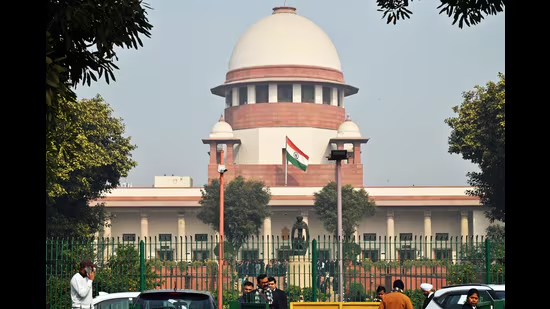
The Supreme Court ruled that non-parties can be held liable for contempt of Court if they knowingly aid in the disobedience of court orders
What is Contempt of Court?
In legal terms, Contempt of Court is a power vested in the judiciary to ensure that judicial orders are respected and that the court functions without interference.
The power to punish for contempt is constitutional, derived directly from the "Court of Record" status.
Contempt of Courts Act, 1971: Regulates the procedure and defines the types of contempt, although the Supreme Court has ruled that its constitutional power (Art 129) cannot be restricted by this Act.
Types of Contempt (Section 2 of the 1971 Act)
Exemptions (What is NOT Contempt?)
Judicial Intervention
Purpose of Contempt Power
Free Speech vs Judicial Accountability
Bureaucratic Accountability
What are the key challenges regarding contempt laws in India?
Vagueness of "Scandalising the Court"
The term "scandalising" under Section 2(c)(i) of the 1971 Act is not clearly defined. This subjectivity allows for wide judicial discretion, which critics argue can lead to arbitrary application.
Conflict with Fundamental Rights
Unlike most restrictions on speech, contempt power is an "inherent power." Critics argue it creates a "chilling effect" on journalists and activists who fear legal action for legitimate criticism.
The "Judge in Own Cause" Principle
In suo motu (self-initiated) cases, the judiciary acts as the accuser, the prosecutor, and the judge. This is seen by legal experts as a violation of the principles of Natural Justice.
Archaic Nature
Many developed democracies, including the UK (the source of India's contempt laws), abolished the offence of "scandalising the judiciary", arguing that a judge's reputation should rest on their judgments, not on legal protection.
High Burden of the "Truth" Defence
While "Truth" was introduced as a defence in 2006, the accused must prove the statement was made in "public interest" and with "bona fide" (good faith) intent, which is a high evidentiary bar.
Executive Non-compliance (Civil Contempt)
A rising challenge is the "dilatory tactics" used by government officials to bypass court orders, leading to a massive backlog of civil contempt petitions.
Way Forward
Narrowing the Definition
Parliament should amend the 1971 Act to restrict "Criminal Contempt" only to acts that pose a "clear and present danger" or a "substantial risk" to the administration of justice, rather than mere "scandalising".
Adopting the "Broad Shoulders" Approach
The Supreme Court in the Shanmugam v. Madras HC (2025) said that the judiciary should ignore personal insults and only intervene when the actual process of justice is blocked.
Independent Prosecution
In suo motu cases, the court could appoint an Independent Amicus Curiae or a separate prosecutor to frame charges, ensuring the bench remains an impartial arbiter.
Strengthening Civil Contempt Enforcement
To ensure the Rule of Law, strict timelines and personal accountability (fines/penalties) should be enforced on high-ranking bureaucrats who willfully delay judicial orders.
Judicial Accountability
Implementing a robust separate mechanism for handling complaints against judges would reduce the public's need to resort to "scandalising" as a means of seeking judicial accountability.
Conclusion
The Supreme Court establishes that the power of contempt must serve as a "measure of last resort" to protect the administration of justice rather than a tool to shield individual judicial dignity from democratic dissent
Source: LIVELAW
|
PRACTICE QUESTION Q. In the context of Criminal Contempt, whose prior written consent is mandatory for a private individual to initiate proceedings in the Supreme Court? A) The President of India B) The Chief Justice of India C) The Attorney General for India D) The Law Minister Answer: C Explanation: According to Section 15 of the Contempt of Courts Act, 1971, for a private individual to initiate criminal contempt proceedings in the Supreme Court, the mandatory prior written consent of the Attorney General for India (or Solicitor General) is required. |
The power is derived from Article 129, which declares the Supreme Court a "Court of Record," and Article 142(2), granting power to investigate and punish contempt.
Civil Contempt is willful disobedience of court orders; Criminal Contempt involves scandalizing the court or obstructing the administration of justice.
Under Section 16 of the 1971 Act, a judge, magistrate, or other person acting judicially can also be held liable for contempt of their own or another court.



© 2026 iasgyan. All right reserved