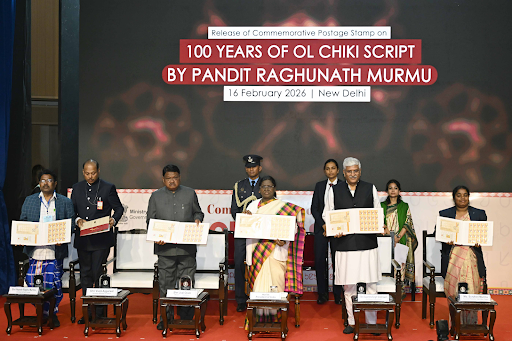
The Ol Chiki script’s centenary, inaugurated by President Droupadi Murmu, marks 100 years since Pandit Raghunath Murmu created it for Santhali. As a distinct scientific alphabet, it preserves tribal identity. With Santhali in the Eighth Schedule, focus now shifts to NEP-aligned mother tongue education, digital inclusion, and Bhashini-led integration.
Copyright infringement not intended
Picture Courtesy: PIB
Context
The President of India inaugurated the Centenary Celebrations of the Ol Chiki script, marking 100 years since its invention in 1925.
What is Ol Chiki Script?
The Ol Chiki script (also known as Ol Cemet’ or the Santali alphabet) is the official writing system for the Santali language, an Austroasiatic language spoken primarily in India, Bangladesh, and Nepal.
Inventor: The script was created by Pandit Raghunath Murmu, revered as "Guru Gomke" (the Great Teacher). Not adapted from Brahmi/Roman roots.
Pre-Ol Chiki Era: Before 1925, Santhali was an oral language written using various scripts like Bengali, Odia, or Roman, which could not accurately represent its unique phonetic sounds.
Phonetic Design: It consists of 30 letters. Unlike many other Indian scripts, it is a true alphabet where each symbol represents a single vowel or consonant sound.
Nature-Inspired Shapes: The letters are based on natural elements, human body parts, and everyday objects related to Santhal life.
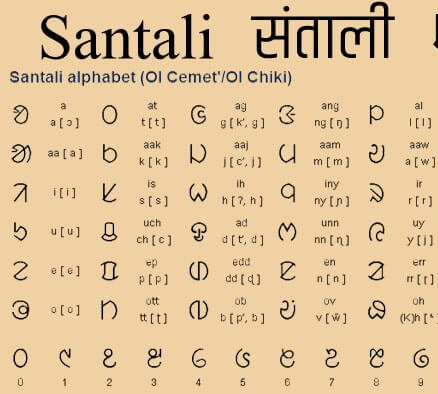
Scientific Features: It includes specialized marks to capture unique sounds like glottal stops and nasalized vowels.
Two Styles: It can be written in a standard print style (Chhapa) or a cursive style (Usara).
Cultural Unifier: Tool for cultural preservation and unity for the Santal population spread across Jharkhand, West Bengal, Odisha, Assam, and neighboring countries.
Demographic Importance: Santhali is the most spoken tribal language in India, with over 7 million speakers. (Source: Census 2011)
Constitutional Status of Santhali language
Eighth Schedule: In 2003, via the 92nd Constitutional Amendment Act, Santhali was included in the 8th Schedule of the Constitution, with Ol Chiki recognized as its official script.
Official Language Status: It is an Additional Official Language in Jharkhand and West Bengal.
Article 29: Grants all citizens the right to conserve their distinct language, script, and culture.
Article 350A: Directs states to provide facilities for primary education in the mother tongue for children from linguistic minority groups.
In 2025, Indian Constitution was translated into Santhali using the Ol Chiki script.
Source: PIB
|
PRACTICE QUESTION Q. The Ol Chiki script is the official writing system for which language? A) Mundari B) Ho C) Santali D) Kurukh Answer: C Explanation: The Ol Chiki script, developed in 1925 by Pandit Raghunath Murmu (Guru Gomke), is the official writing system for the Santali language. It has 30 letters, is written left to right, and features characters inspired by nature and daily objects. Ol Chiki was recognized as the official script when Santali was added to the Eighth Schedule of the Indian Constitution in 2003 (92nd Amendment). |
The Ol Chiki script was invented by Pandit Raghunath Murmu, also known as "Guru Gomke," in 1925.
Unlike most Indic scripts which are abugidas (syllabic), Ol Chiki is a true alphabet. Its character shapes are derived from nature (like the earth or a plough), making it distinct and easier for the agrarian Santal community to learn.
Santhali is listed in the Eighth Schedule of the Indian Constitution, added via the 92nd Amendment Act in 2003. It is also an Additional Official Language in Jharkhand and West Bengal.


© 2026 iasgyan. All right reserved