RBI’s 'Payments Vision 2028' shifts focus to trust, introducing a shared fraud liability framework and Payments Switching Service (PaSS). It empowers MSMEs via TReDS interoperability and uses MuleHunter AI to secure India's global leadership in Digital Public Infrastructure
Why In News?
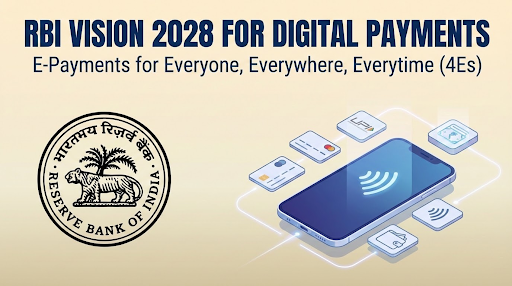
The Reserve Bank of India (RBI) announced the ‘Payments Vision 2028’, outlining a roadmap to strengthen and expand the digital payments ecosystem.
What are the key highlights of the "Payments Vision 2028"?
The Core Philosophy: From 'Quantity' to 'Quality'
The central theme of Vision 2028 is "Shaping India’s Payment Frontier."
|
Vision 2025 vs Vision 2028 |
||
|
|
Payments Vision 2025 |
Payments Vision 2028 |
|
Theme |
E-Payments for Everyone, Everywhere (4Es) |
Shaping India's Payment Frontier |
|
Primary Goal |
Expansion (Volume & User Acquisition) |
Trust & Resilience (Safety & Quality) |
|
Key Metric |
Number of Digital Transactions |
Reduction in Fraud / Cyber Hygiene |
|
Global Focus |
Launching UPI International |
Benchmarking & Cross-Border Efficiency |
|
Regulation |
Rules for Payment Aggregators (PAs) |
Shared Liability & E-commerce Regulation |
The 5 Strategic Pillars of Vision 2028
Pillar A: User Protection & "Trust"
Shared Liability Framework: Both the issuer bank (Victim’s bank) and the beneficiary bank (fraudster's bank) will share the financial liability for unauthorized transactions.
"Switch On/Off" Facility: Similar to debit/credit cards, users will get a facility to "switch off" or set limits for all digital payment modes (like UPI, Net Banking) when not in use.
Cyber Key Risk Indicators (KRIs): Non-bank payment operators (like wallets, fintechs) must now track and report specific cyber risk metrics, ensuring they aren't the "weak link" in the chain.
Pillar B: Consumer Convenience & Portability
Payments Switching Service (PaSS): A centralized system to move all payment instructions (SIPs, EMIs, Bill Payments) from one bank to another automatically.
Electronic Cheques (e-Cheques): The RBI plans to introduce e-cheques to combine the legal certainty of a paper cheque with the speed of digital transfer.
Pillar C: Supporting MSMEs (Economic Growth)
TReDS Interoperability: The Trade Receivables Discounting System (TReDS) allows MSMEs to sell unpaid invoices for quick cash. Currently, platforms are siloed.
Pillar D: Global Leadership (International Relations)
Cross-Border Payment Efficiency: Establishing a "Single-Window" authorization system for cross-border payments to reduce friction and cost.
Global Benchmarking: Periodic reports to compare India's transaction speeds and costs against the top global economies, ensuring India remains the "Vishwaguru" of digital payments.
Pillar E: Innovation & Regulation
Small Payment System Providers (SPSPs): A new category for niche players (e.g., a startup focusing only on offline payments for farmers) to operate under a Perpetual Regulatory Sandbox, promoting innovation without heavy compliance burdens initially.
Domestic Legal Entity Identifier (DLEI): A unique ID for non-individual entities to prevent financial crimes and money laundering.
What is the significance of the Payments Vision 2028?
Combating the "Mule Account" Economy
The Shared Liability Framework incentivizes beneficiary banks to scrutinize high-risk accounts. Previously, banks receiving stolen funds had little liability; now, they share the financial loss, forcing a crackdown on money laundering.
Empowering Consumer Choice (Financial Democracy)
The Payments Switching Service (PaSS) introduces "Account Portability." By allowing users to move SIPs and EMIs effortlessly, it forces traditional banks to improve service quality or risk losing customers to agile Fintechs.
MSME Liquidity & Credit Ease
TReDS Interoperability creates a unified pool of financiers. This competition ensures that small businesses get their invoices discounted at much lower interest rates, improving their working capital cycle.
Global Soft Power (UPI Diplomacy)
By streamlining Cross-Border Payment authorization, India positions its indigenous tech (UPI/RuPay) as a cost-effective, real-time alternative to the Western SWIFT system for the Global South.
Legal Modernization
The introduction of e-Cheques bridges the gap between the traditional legal certainty of the Negotiable Instruments Act and the speed of the digital era.
What are the challenges in implementing the Payments Vision 2028?
High Compliance Cost for Small Banks
Implementing advanced Cyber Key Risk Indicators (KRIs) and real-time fraud monitoring requires massive CAPEX. Rural Cooperative Banks and RRBs may struggle with these costs.
Privacy vs Oversight
The proposed AI-enabled Data Repository for monitoring systemic risks raises concerns regarding "State Surveillance" and data privacy, especially without a fully operationalized Data Protection Board.
The "Digital Illiteracy" Barrier
Advanced safety features like "Switch On/Off" require users to be tech-savvy. In rural areas, accidental deactivation could lead to financial exclusion or "digital lockout".
Cyber Warfare & Sophistication
Fraudsters are moving toward AI-driven Phishing and Deepfakes. Regulatory visions often struggle to keep pace with the evolving speed of cyber-crime.
Way Forward
Tiered Regulatory Support
The RBI should provide Technical Subsidies or a longer transition period for smaller banks to adopt the new Cyber KRI framework to prevent them from being pushed out of the ecosystem.
Public Awareness
A vernacular campaign is needed to teach rural users how to use features like PaSS and Switch On/Off, ensuring safety doesn't become a barrier to access.
Global Standard Setting
India should lead a "Global Digital Payment Alliance" to create common standards for cross-border QR codes and real-time settlement, similar to how GSM standardized mobile roaming.
Collaboration with Big Tech
Since most payments happen on third-party apps (Google Pay, PhonePe), the RBI must ensure that Big Tech companies are equally liable under the Shared Liability Framework.
Sandbox for Storage Solutions
Accelerate the Regulatory Sandbox for "Offline Digital Payments" to ensure that even in areas with poor internet (Media-Dark zones), the 2028 vision remains truly inclusive.
Conclusion
The Payments Vision 2028 represents a shift from "Digital India" to "Secure Digital India." While the hurdles of cost and literacy are real, the focus on "Trust" ensures that the foundation of India’s $5 Trillion economy is built on a resilient, globalized, and fraud-proof payment frontier.
Source: NEWSONAIR
|
PRACTICE QUESTION Q. Digital payments have transitioned from a 'convenience' to a 'necessity' in the Indian economy. Critically analyze. 150 words |
It is a strategic roadmap by the Reserve Bank of India focused on deepening consumer trust, ensuring cyber resilience, and consolidating India's global leadership in digital payments, pivoting away from mere numerical expansion.
It proposes a "Shared Liability" framework where both the issuing bank and the beneficiary bank share liability for unauthorized transactions. This forces stricter KYC norms. It also leverages advanced tools like MuleHunter AI to detect illicit 'money mule' accounts.
PaSS is an upcoming facility that allows bank customers to easily migrate their payment instructions, such as auto-debits, salaries, and EMIs, when switching from one bank account to another, thereby reducing friction in everyday banking.


© 2026 iasgyan. All right reserved