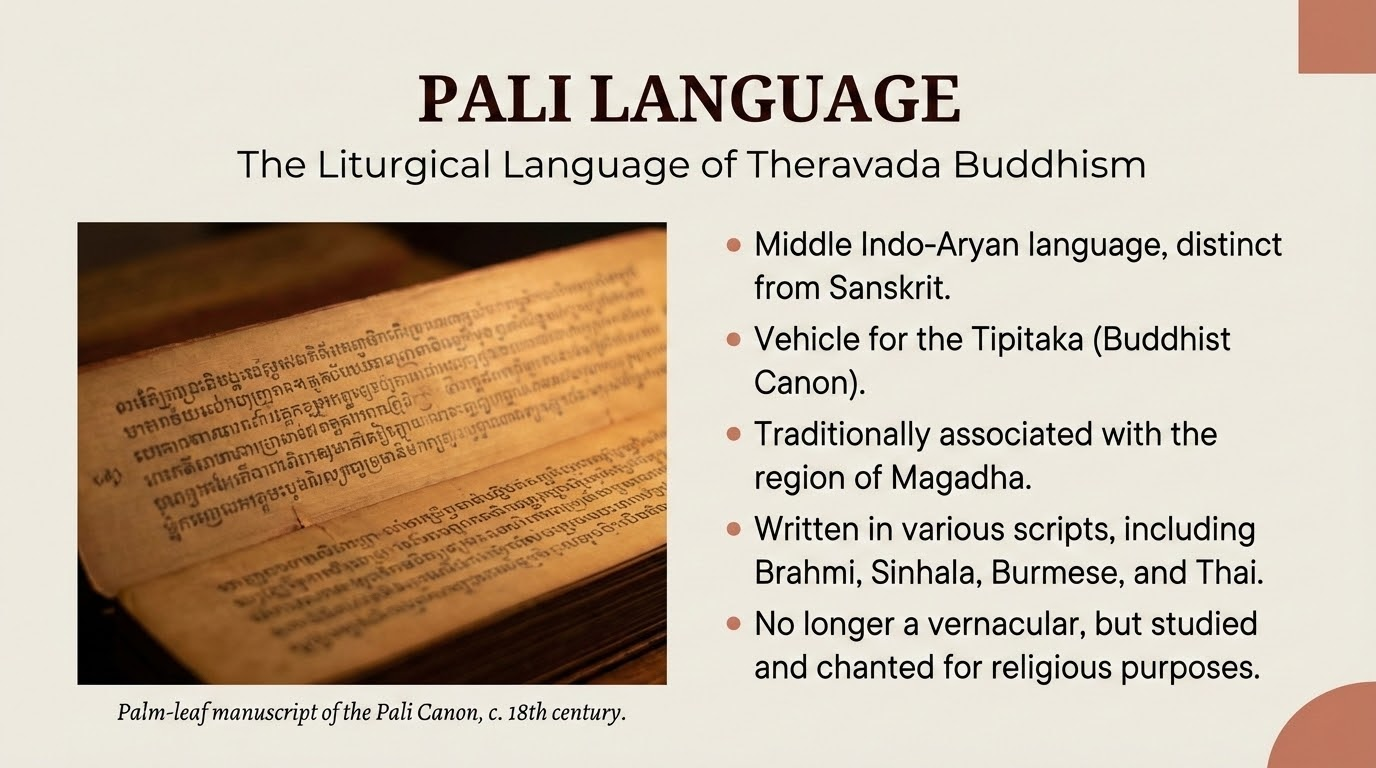
Pali, an ancient Middle Indo-Aryan language, served as the primary medium for Theravada Buddhist scriptures (the Tripitaka). Closely related to Sanskrit, it gained prominence during the Maurya Empire as a liturgical language, preserving the historical teachings of Lord Buddha.
Why In News?
The BHASHINI Sanchalan/Seva Workshop on Pali Language Preservation and Digital AI Model Development was organised at the University of Delhi.
About Pali Language
Pali is an ancient Middle Indo-Aryan language that serves as the liturgical and scholarly language of Theravada Buddhism.
Origin and Evolution
The exact geographical origin of Pali remains a subject of academic debate among linguists and historians.
The "Magadhi" Theory: Buddhist tradition identifies Pali with Magadhi Prakrit, the language used by the Buddha in the Magadha kingdom.
Linguistic Consensus: Modern scholars suggest Pali is a "synthetic" or "literary" language based on several western and central Indian dialects, likely standardized to preserve the Buddha's teachings across the region.
Linguistic Characteristics
Pali occupies a middle ground between the complexity of Sanskrit and the simplicity of later Prakrits.
Relationship with Sanskrit: While sharing a common root with Sanskrit, Pali simplified phonetics and grammar. For example, the Sanskrit Dharma became Dhamma, and Karma became Kamma.
Script: Pali is a phonetic language and does not have a script of its own. It has been written in Brahmi (ancient India), Devanagari, Sinhala (Sri Lanka), Burmese, and Thai scripts.
Democratic Nature: Unlike Sanskrit, which was the language of the elite and the Vedas, Pali was accessible to the common masses, aligning with the Buddha’s philosophy of universal liberation.
The Pali Canon: Tripitaka
|
Basket |
Name |
Content |
|
Vinaya Pitaka |
Basket of Discipline |
Rules and regulations for monks (Bhikkhus) and nuns (Bhikkhunis). |
|
Sutta Pitaka |
Basket of Discourses |
Contains the Buddha’s sermons, including the famous Dhammapada. |
|
Abhidhamma Pitaka |
Basket of Higher Teachings |
Philosophical and psychological analysis of the Buddha’s teachings. |
Non-Canonical Pali Literature.
Jataka Tales: Part of the Sutta Pitaka, describe the previous births of the Buddha, providing insights into ancient Indian folklore and social conditions.
Milinda Panha: (Questions of King Milinda) A record of the dialogue between the Indo-Greek King Menander I and the Buddhist sage Nagasena.
Sri Lankan Chronicles: The Deepavamsa and Mahavamsa provide a historical account of Buddhism and the political history of ancient India and Sri Lanka.
Current Status
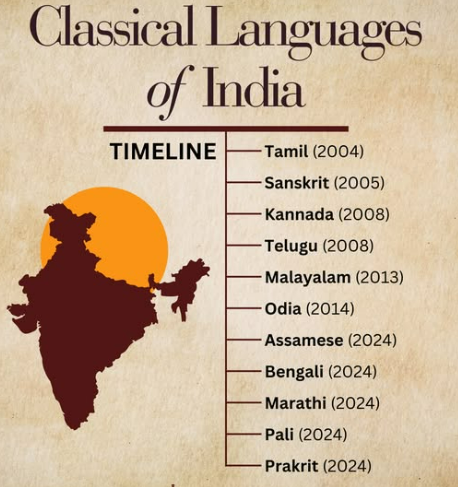
Pali is recognized as one of the 11 Classical Languages of India.
Source: NEWSONAIR
|
PRACTICE QUESTION Q. Consider the following statements regarding Pali literature: 1. The Vinaya Pitaka deals with the philosophical doctrines and higher teachings of the Buddha. 2. The Milinda Panha is a historical and philosophical dialogue between the Indo-Greek King Menander I and the Buddhist sage Nagasena. Which of the statements given above is/are correct? a) 1 only b) 2 only c) Both 1 and 2 d) Neither 1 nor 2 Answer: b Explanation: Statement 1 is incorrect: The Vinaya Pitaka does not deal with philosophical doctrines. Instead, it contains the rules of discipline, codes of conduct, and monastic regulations (monastic rules) for the Buddhist order (Sangha). The philosophical doctrines and higher teachings are primarily found in the Abhidhamma Pitaka, while the sermons are in the Sutta Pitaka. Statement 2 is correct: The Milinda Panha (or Milindapanho) is a Pali text that records a historical and philosophical dialogue between the Indo-Greek King Menander I (known in Pali as Milinda) and the Buddhist sage Nagasena, which took place in the 2nd century BC. |
Pali was granted Classical Language status in October 2024 because it met the revised criteria set by the Linguistic Experts Committee. This includes having a high antiquity of early recorded history spanning 1500 to 2000 years and possessing an original, distinct literary tradition that shaped Indian history.
Pali is the primary liturgical and scholarly language of Theravada Buddhism. It was used to compile the Tripitaka (the foundational Buddhist canon) and democratized religious knowledge by making the Buddha's teachings highly accessible to the common masses, breaking away from the elitist restrictions of Sanskrit.
The Tripitaka, or "Three Baskets," consists of the Vinaya Pitaka (strict rules for monastic discipline), the Sutta Pitaka (discourses, dialogues, and sermons of the Buddha), and the Abhidhamma Pitaka (scholastic and psychological analysis of the Buddha's teachings).



© 2026 iasgyan. All right reserved