The Namo Drone Didi Yojana empowers Women SHGs with an 80% subsidy for agricultural drones, advancing Agriculture 5.0. By promoting precision farming and liquid Nano Urea, it modernises rural economies, though success requires linking SHGs with Farmer Producer Organisations.
Why In News?
Karnataka has emerged as the leader in training the highest number of women Self-Help Groups (SHGs) as certified drone pilots under the Namo Drone Didi Yojana (NDDY).
What is the Namo Drone Didi Scheme?
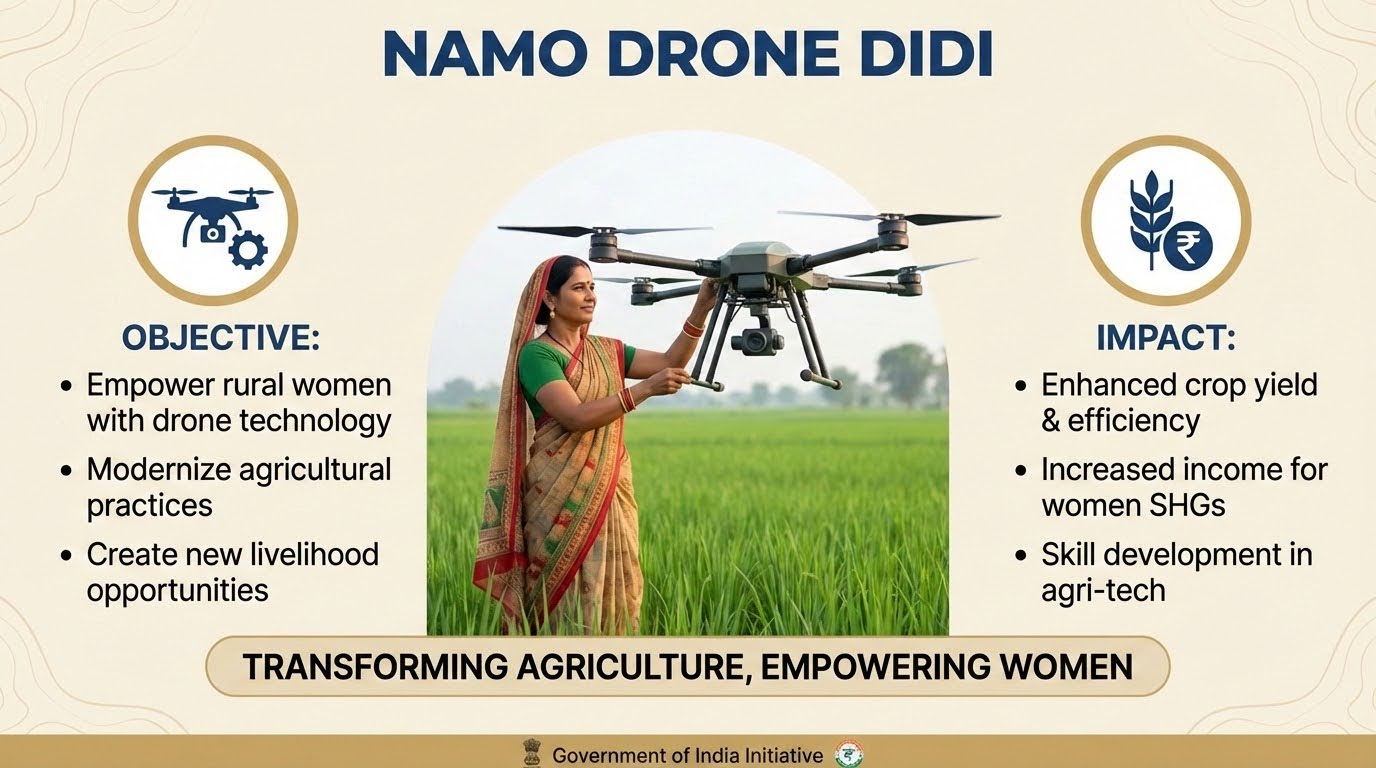
It is a Central Sector Scheme to empower rural women by transforming them into agri-tech entrepreneurs, blending the objectives of agricultural modernization, women-led development, and rural prosperity.
Core Objectives of the Scheme
Technological Empowerment: To equip 15,000 selected women Self Help Groups (SHGs) with agricultural drones between 2024-25 and 2025-26. (Source: PIB)
Agricultural Modernization: To promote precision agriculture by using drones for efficient application of liquid fertilizers (like Nano Urea) and pesticides, thereby enhancing crop yield and reducing input costs.
Rural Entrepreneurship: To create a new cadre of rural entrepreneurs by enabling SHGs to offer drone rental services to farmers, generating an expected additional annual income of at least ₹1 lakh per SHG.
Skill Development: To train rural women as certified drone pilots and technicians, bridging the gender and technology gap in rural India.
Key Features and Financial Outlay
The scheme has been approved with a total financial outlay of ₹1,261 crore for the period from 2023-24 to 2025-26 (Source: PIB).
|
Feature |
Detailed Provisions |
|
Financial Assistance |
|
|
Training & Certification |
|
|
Institutional Framework |
|
|
Monitoring Mechanism |
|
Significance and Potential Impact
Agricultural Transformation
Enhanced Efficiency: Traditional manual spraying of 1 acre takes roughly 3–4 hours; drones reduce this to 7–10 minutes, increasing labor productivity by nearly 20 times. (Source: ICAR)
Precision Farming & Resource Optimization
Promotion of Nano-Fertilizers: Drones are the primary vehicle for Nano Urea and Nano DAP, which have a nutrient use efficiency of over 80% compared to 30–40% for conventional granular urea. (Source: IFFCO R&D Reports)
Socio-Economic Empowerment
The "Lakhpati Didi" Connection: The scheme is a core pillar of the mission to raise the annual income of 3 crore women to at least ₹1 Lakh. (Source: Interim Budget 2024-25)
Breaking the "Glass Ceiling" in Agri-Tech: Traditionally, "tractorization" and "mechanization" were male-dominated; NDDY shifts the technical leadership to women SHGs, fostering a new class of rural technocrats.
Livelihood Diversification: Beyond spraying, SHGs can diversify into crop health monitoring and yield estimation using drone sensors, creating a year-round service model.
Digital Inclusion: By handling GPS-enabled devices and flight controllers, rural women are integrated into the Digital India ecosystem, reducing the "gender-technology gap".
Health and Safety Impact
Occupational Health: Drone spraying eliminates the risk of respiratory and skin disorders caused by the direct inhalation of pesticides during manual "back-pack" spraying.
What are the challenges with the implementation of the Namo Drone Didi Yojana?
Financial Burden on SHGs: While the 80% subsidy is significant, the remaining 20% is still a high-capital entry for many rural SHGs, even with the 3% interest subvention under the AIF.
Technical Constraints: Current drone batteries last 20-30 minutes, requiring multiple sets and charging infrastructure in regions with erratic power supply.
The "Trust Deficit" in Traditional Farming: Small and marginal farmers hesitant to pay for drone services over traditional manual labor due to a lack of awareness regarding long-term yield benefits.
Inadequate Service Ecosystem: Absence of local repair hubs (Drone Clinics) means that a technical issue during the peak spraying window can render the asset idle, leading to financial loss for the SHG.
The "Double Burden" on Women: Women entrepreneurs often face the "Time Poverty" challenge—balancing high-tech field operations with deep-rooted domestic and caregiving responsibilities.
Way Forward
Establishing Rural 'Drone Clinics': Setting up block-level maintenance centers through Public-Private Partnerships (PPP) to ensure minimal downtime, as recommended by the Economic Survey 2023-24.
Aggressive Campaigns: Utilizing Krishi Vigyan Kendras (KVKs) to conduct live demonstrations for farmers, proving the 90% water saving and 25% pesticide efficiency of drones (Source: ICAR)
Synergy with FPOs: Linking Drone Didis with Farmer Producer Organizations (FPOs) to aggregate demand and ensure a guaranteed "business pipeline" for the SHGs.
Incentivizing 'Make in India': Under the PLI (Production Linked Incentive) Scheme for Drones, the government aims to localize the supply chain for batteries and motors to reduce replacement costs for SHGs
Expansion of Use-Cases: Beyond spraying, training women to use drones for PM Fasal Bima Yojana (PMFBY) crop loss assessments and digitizing land records.
Conclusion
The Namo Drone Didi Scheme creates a strategic convergence of agricultural modernization and women’s economic empowerment, revolutionizing rural landscapes by transforming women into high-tech service providers to drive inclusive, technology-led development.
Source: THEHINDU
|
PRACTICE QUESTION Q. Consider the following statements regarding the 'Namo Drone Didi Yojana': 1. It is a Centrally Sponsored Scheme aimed at providing drones to women SHGs. 2. The scheme provides a Central Financial Assistance of 80% of the cost of the drone and its accessories. 3. Beneficiaries can avail of credit support through the Agriculture Infrastructure Fund (AIF) with an interest subvention of 3%. How many of the above statements are correct? a) Only one b) Only two c) All three d) None Answer: b) Explanation: Statement 1 is incorrect: It is a Central Sector Scheme, not a Centrally Sponsored Scheme. Central Sector Schemes are 100% funded by the Union Government and implemented by central agencies. Statement 2 is correct: The scheme provides Central Financial Assistance (CFA) of 80% of the cost of the drone and its accessories, up to a maximum limit of ₹8 lakh per SHG. Statement 3 is correct: For the remaining 20% of the cost, beneficiaries can avail of credit support through the Agriculture Infrastructure Fund (AIF), which offers an interest subvention of 3%. |
The Namo Drone Didi Yojana (NDDY) is a Central Sector Scheme designed to create an ecosystem of women-led technological intervention in rural India. It provides 15,000 agricultural drones to selected women Self-Help Groups (SHGs) to promote precision farming and rural female empowerment.
The government provides a Central Financial Assistance (subsidy) of 80% of the cost of the drone and its accessories, capped at ₹8 lakhs per SHG. The remaining 20% can be financed through the Agriculture Infrastructure Fund (AIF) with an interest subvention of 3%.
The scheme shatters patriarchal occupational stereotypes by shifting women from low-yield, home-based micro-enterprises into high-tech roles. By offering drone-on-rent services for agricultural spraying, certified women pilots are generating significant independent income, sometimes up to ₹1 lakh per month.


© 2026 iasgyan. All right reserved