India faces the second-highest global maternal deaths, struggling to meet SDG 2030 targets. Overcoming regional disparities and inadequate postnatal care requires increasing health expenditure to 2.5% of GDP and potentially shifting 'Health' to the Concurrent List for uniform standards.
Why In News?
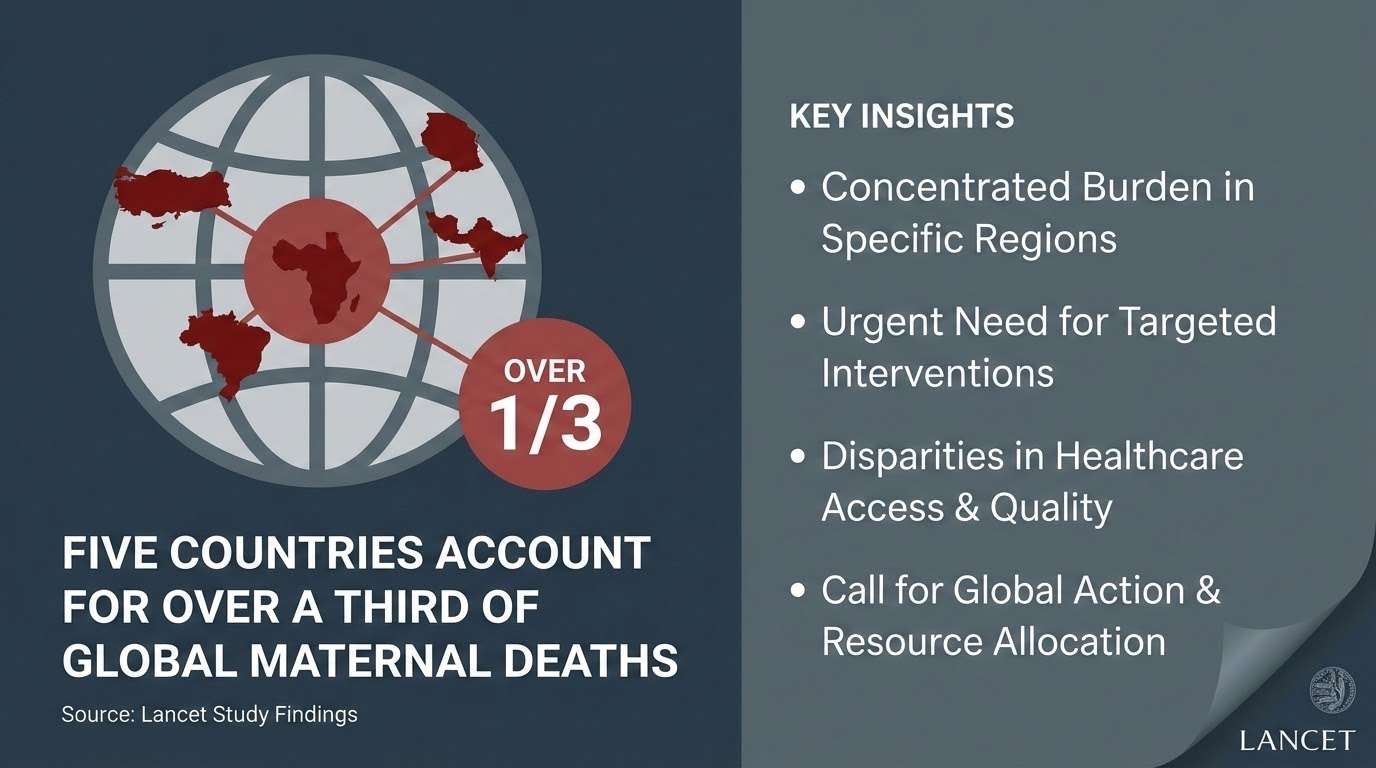
A Lancet study indicates that five countries, led by Nigeria and India, account for over one-third (36%) of global maternal deaths, highlighting a stagnation in progress since 2016.
What are the key findings of the Lancet 2026 Study?
Concentrated Global Burden
Maternal Mortality Ratio (MMR) Trends
While the global MMR has declined, India's progress remains a concern, with a notable difference between international and domestic data.
|
Metric |
MMR (Deaths per 100,000 live births) |
Source |
|
Global MMR (2023) |
190.5 |
The Lancet, 2026 |
|
India's MMR (Estimate) |
116 |
The Lancet, 2026 |
|
India's MMR (Official) |
88 |
Sample Registration System (SRS), 2021-23 |
Off-Track for SDG Target 3.1
Leading Causes of Maternal Deaths
Rise in Late Maternal Deaths
A concerning trend is the doubling of "late maternal deaths" (fatalities between 43 days and one year after childbirth). This share has increased globally from 1.3% in 1990 to 3.2% in 2023, indicating a major gap in long-term postnatal care.
Why Do Gaps in Maternal Healthcare Persist?
Socio-Economic & Regional Disparities: National averages hide vast differences.
Inadequate Public Health Financing: Government Health Expenditure was only 1.9% of GDP in FY25. This results in high out-of-pocket expenditure (OOPE), preventing poor women from seeking timely and quality care.
Postnatal Care Gaps: Current systems prioritize immediate childbirth, often neglecting the long-term follow-up necessary to prevent late maternal deaths from complications like hypertension.
Staffing & Infrastructure Shortages: Rural areas lack gynaecologists and anaesthesiologists in Community Health Centres (CHCs), causing critical delays in emergency interventions.
Government Initiatives for Maternal Health
Pradhan Mantri Matru Vandana Yojana (PMMVY): A conditional cash transfer scheme to compensate for wage loss and encourage institutional delivery and better nutrition.
Janani Suraksha Yojana (JSY) & Janani Shishu Suraksha Karyakaram (JSSK): JSY provides cash assistance for institutional births, while JSSK guarantees free and cashless services, including C-sections, in public health facilities.
LaQshya (Labour Room Quality Improvement Initiative): A focused program to improve the quality of care in labour rooms and maternity operation theatres to prevent avoidable deaths.
Surakshit Matritva Aashwasan (SUMAN): An initiative that assures zero-cost, dignified, and quality healthcare for every woman and newborn at public facilities.
Way Forward
Increase Public Health Spending: Government must act on the National Health Policy 2017 recommendation to increase health expenditure to 2.5% of GDP.
Extend the Postnatal Care Window: Maternal care protocols must be redesigned to officially track mothers for up to one year post-delivery. ASHA and ANM workers should be trained to monitor for late complications like hypertension.
Shift 'Health' to the Concurrent List: As recommended by the N.K. Singh Committee, this constitutional shift would empower the Centre to enforce uniform standards and drive targeted financing in lagging states.
Address Data Discrepancies: Reconcile the data gap between international (Lancet's report) and national (SRS) figures through transparent, real-time, digitized maternal death audits at the district level
Leverage Telemedicine: Integrate AI-driven tools and telemedicine in rural PHCs to help manage high-risk pregnancies and track chronic conditions, especially hypertensive disorders.
Learn Lessons from Successful Model
|
Model |
Key Strategy |
|
Sri Lanka: Midwifery Model |
Invested in a strong cadre of Public Health Midwives (PHMs) for community-based tracking, ensuring nearly 100% skilled birth attendance. (Source: WHO) |
|
Rwanda: Mutuelles de Santé |
Utilized a community-based health insurance scheme covering over 90% of the population, removing financial barriers to emergency care. (Source: World Bank) |
|
Jharkhand, India: Targeted Intervention |
Reduced MMR to 54, well below the SDG target. Success was driven by tribal outreach, strengthening the ASHA worker network, and improving district hospitals. |
|
Tamil Nadu, India: CEmONC Network |
Operationalized Comprehensive Emergency Obstetric and Newborn Care (CEmONC) centres 24/7, linked with an efficient ambulance network to ensure timely care within the 'golden hour'. |
Conclusion
India's progress in reducing maternal mortality is offset by high absolute numbers and vast regional disparities, necessitating a concerted push of increased public investment, strengthened postnatal care, and technology integration to meet the SDG 3.1 target.
Source: DOWNTOEARTH
|
PRACTICE QUESTION Q. Consider the following statements regarding government initiatives for maternal health in India: 1. Pradhan Mantri Matru Vandana Yojana (PMMVY) provides conditional cash transfers to pregnant women to compensate for wage loss and promote institutional deliveries. 2. Surakshit Matritva Aashwasan (SUMAN) aims to provide completely free and cashless delivery exclusively for cesarean sections at public health institutions. Which of the statements given above is/are correct? a) 1 only b) 2 only c) Both 1 and 2 d) Neither 1 nor 2 Answer: a Explanation: Statement 1 is correct: The Pradhan Mantri Matru Vandana Yojana (PMMVY) is a centrally sponsored scheme under the Ministry of Women and Child Development that provides conditional cash transfers (₹5,000 for the first child, and ₹6,000 for the second if it's a girl) to pregnant and lactating mothers to partially compensate for wage loss and promote institutional deliveries and improved nutritional health. Statement 2 is incorrect: Surakshit Matritva Aashwasan (SUMAN) does not provide free delivery exclusively for cesarean sections. Instead, it aims to provide assured, dignified, respectful, and quality healthcare at no cost to every woman and newborn visiting a public health facility, which includes both normal and cesarean section deliveries, along with free transport and ANC checkups. |
According to a 2026 Lancet study, India's estimated MMR is 116 deaths per 100,000 live births in 2023. However, India's own Sample Registration System (SRS) 2021-23 bulletin provides a lower estimate of 88 deaths per 100,000 live births.
SDG Target 3.1 mandates reducing the global maternal mortality ratio to fewer than 70 deaths per 100,000 live births by the year 2030. India is currently striving to meet this target at the national level.
Persistent gaps are driven by deep socio-economic and regional disparities (e.g., Kerala vs. Assam), inadequate public health financing resulting in high out-of-pocket expenditure, deficiencies in postnatal care beyond the six-week mark, and severe shortages of specialized medical staff in rural areas.

© 2026 iasgyan. All right reserved