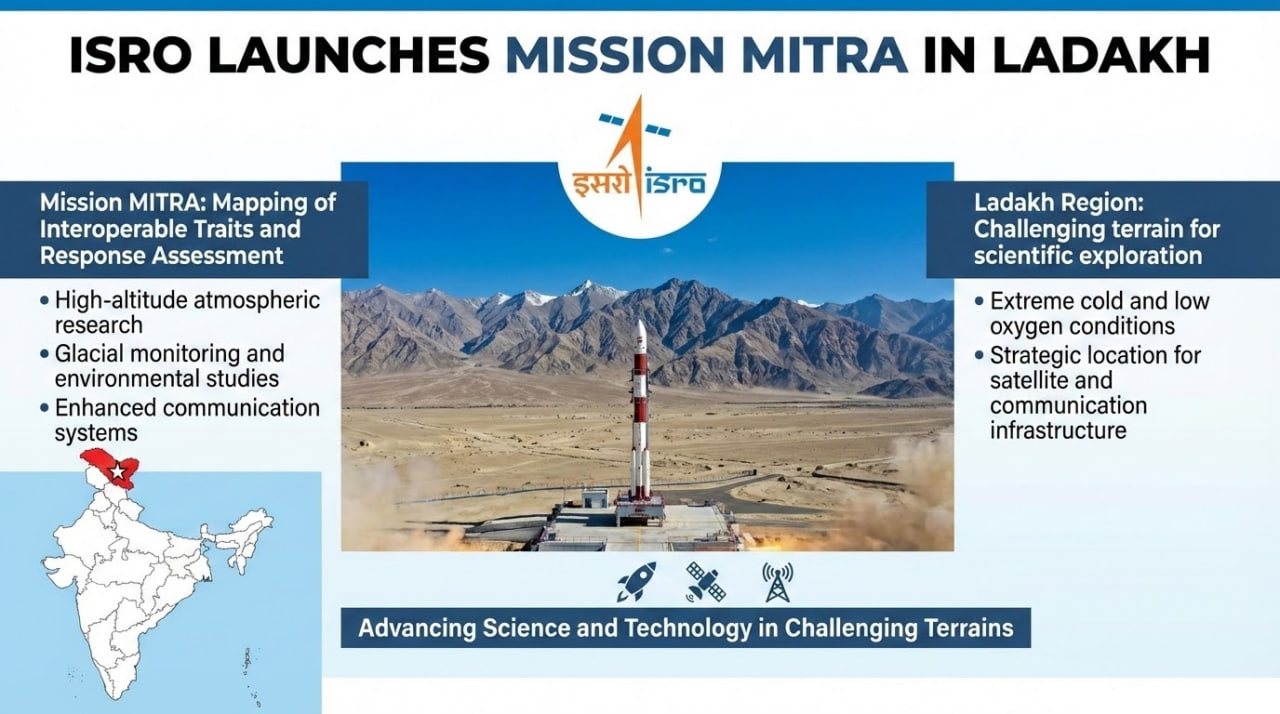
ISRO’s Mission MITRA (Mapping of Interoperable Traits and Response Assessment) is a 2026 analogue mission in Ladakh. It simulates space-like isolation and hypoxia to evaluate the psychological resilience and team interoperability of India’s Gaganyatris, ensuring mission success.
Why In News?
The Indian Space Research Organisation (ISRO) operationalized Mission MITRA, a high-altitude analogue space mission in Ladakh.
What is Mission MITRA?
This initiative is a critical precursor to the Gaganyaan mission, focusing on the "human element" of spaceflight rather than just hardware.
Why Ladakh?
Core Objectives
Mission MITRA shifts the focus from engineering to Human Factors Engineering (HFE):
Significance
Human Factors Engineering (HFE): This marks India's transition from focusing solely on "Hardware" (Rockets) to "Software" (The Human Element).
Strategic Self-Reliance (Atmanirbhar Bharat): By developing indigenous analogue training protocols, India joins an elite group of nations (USA, Russia, China, EU) capable of conducting high-fidelity space simulations.
Foundation for BAS (2035): The data from MITRA is foundational for the Bharatiya Antariksha Station and future Lunar missions slated for 2040 (Source: PMO/ISRO).
Source: TIMESOFINDIA
|
PRACTICE QUESTION Q. Mission MITRA is classified as an "Analogue Mission." What is the primary purpose of such missions? A) To test the aerodynamic stability of the GSLV Mk III rocket. B) To simulate space-like physical and psychological conditions on Earth. C) To launch small-scale satellites using portable launchers. D) To establish permanent human colonies in high-altitude regions. Answer: B Explanation: Mission MITRA (Mapping of Interoperable Traits and Response Assessment) is an analogue mission launched by ISRO in Ladakh to simulate space-like physical and psychological conditions on Earth. |
It stands for Mapping of Interoperable Traits and Response Assessment. It is an advanced astronaut training experiment.
An analogue mission uses Earth-based locations that have physical similarities to space environments (like extreme cold or isolation) to test personnel and equipment before an actual mission.
Ladakh offers hypoxia (low oxygen), extreme cold, and geographical isolation, mimicking the barren, hostile conditions of the Moon or Mars.



© 2026 iasgyan. All right reserved