The 9th India International Water Week occurs 22–26 September 2026 at Bharat Mandapam, New Delhi. Themed "Climate Resilient Water Management," this global forum connects policymakers and experts to address water security through technical sessions, high-level plenaries, and innovative exhibitions.
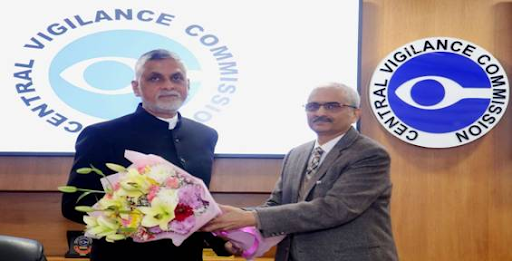
The 9th India International Water Week (IIWW-2026) was officially launched by the Union Minister of Jal Shakti.
It is a global platform dedicated to addressing the world’s most pressing water challenges through innovation, policy dialogue, and international cooperation.
The 9th India International Water Week (IIWW) is scheduled for 22–26 September 2026 at Bharat Mandapam, New Delhi. Organized by the Ministry of Jal Shakti.
While various regions host their own versions (such as Singapore, Stockholm, or India), the collective goal is to achieve Water Security in alignment with the United Nations Sustainable Development Goal 6 (SDG 6): Clean Water and Sanitation for All.
Core Pillars of International Water Week
Adapting infrastructure via Nature-based Solutions (NbS) like wetland restoration for flood resilience.
Transitioning to a circular economy using the 3Rs: Reduce, Recycle, and Reuse.
Managing the nexus where agriculture uses 70% of freshwater through smart irrigation and desalination.
Using the UN Water Convention to govern over 260 transboundary basins and prevent conflict.
Core Objectives of IIWW-2026
Integrated Water Resources Management (IWRM): Promoting the management of water, land, and related resources to maximize socio-economic welfare without compromising ecosystem sustainability.
Technological Exchange: Showcasing innovations in desalination, wastewater recycling, and smart water metering.
Global Collaboration: Partnering with nations (such as Denmark, Israel, and Australia) to adopt international best practices in river rejuvenation and groundwater recharge.
Major Challenges Highlighted at IIWW
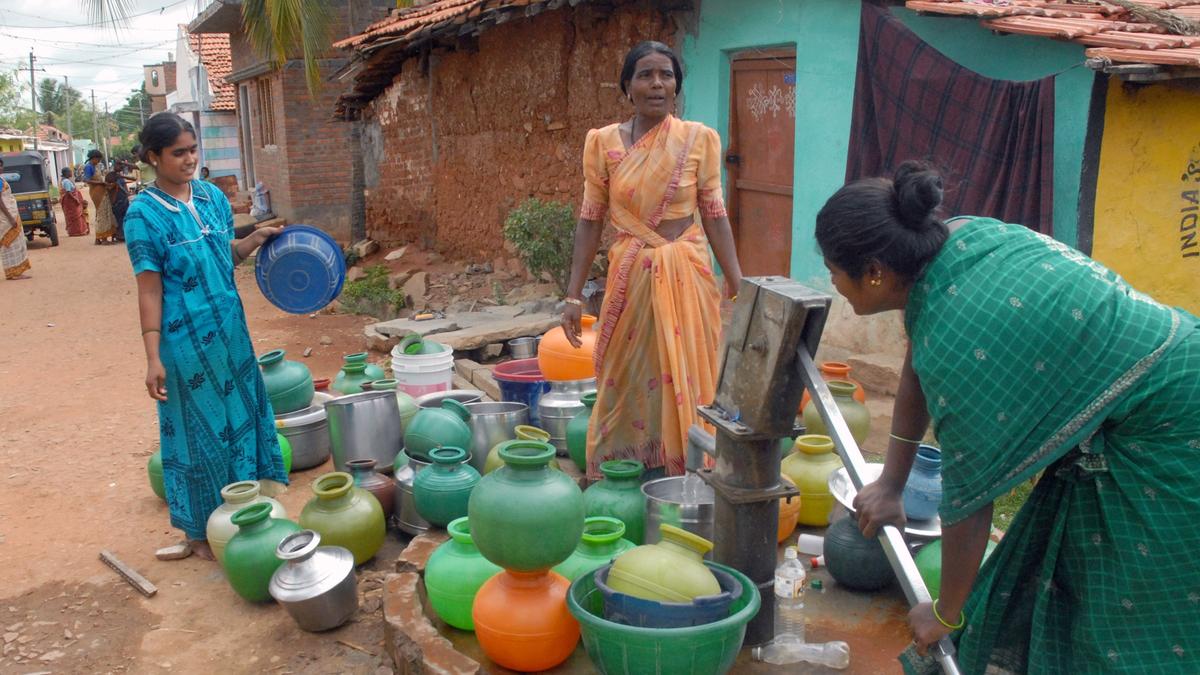
Water Stress: India supports 18% of the world's population with only 4% of its freshwater resources.
Groundwater Depletion: India is the world's largest extractor of groundwater, exceeding the combined usage of the US and China.
Wastewater Management: Only about 28-30% of municipal sewage in India is currently treated, with the rest polluting water bodies. (Source: CPCB)
IIWW-2026 emphasizes the transition toward a Circular Water Economy:
Source: INDIANEXPRESS
|
PRACTICE QUESTION Q. Consider the following pairs of domestic water management initiatives and their primary features: 1. Atal Bhujal Yojana : Community-led sustainable groundwater management 2. PM Krishi Sinchayee Yojana : Promotion of micro-irrigation systems 3. Sujalam Abhiyan : Management of rural greywater through soak pits How many pairs given above are correctly matched? a) Only one pair b) Only two pairs c) All three pairs d) None of the pairs Answer: c Explanation: Atal Bhujal Yojana: This is a Central Sector Scheme focused on community-led sustainable groundwater management through participatory approaches like water budgeting and the preparation of Water Security Plans at the Gram Panchayat level. PM Krishi Sinchayee Yojana (PMKSY): The "Per Drop More Crop" component of this scheme specifically focuses on the promotion of micro-irrigation systems (drip and sprinkler irrigation) to enhance water use efficiency in agriculture. Sujalam Abhiyan: This campaign, launched by the Ministry of Jal Shakti, focuses on the management of rural greywater, primarily through the construction of household and community soak pits to prevent the open discharge of wastewater into villages. |
The Right to Water is implicitly protected as a Fundamental Right under Article 21 (Right to Life), a precedent set by the Supreme Court in the Subhash Kumar vs. State of Bihar (1991) case. Additionally, Article 51A(g) establishes a fundamental duty for citizens to protect and improve the natural environment, including lakes and rivers.
The 2016 Mihir Shah Committee highlighted that India manages surface and groundwater in fragmented silos. It recommended dismantling the Central Water Commission (CWC) and Central Ground Water Board (CGWB) and merging them to form a unified, multidisciplinary National Water Commission (NWC).
The Circular Water Economy is an approach based on the 5R Principle: Reduce, Recycle, Reuse, Recover, and Redefine. Instead of a linear 'use and dispose' model, it treats wastewater as a resource. A successful domestic example is Surat's Tertiary Treatment Plants, which treat municipal sewage and sell the water to local industries.


© 2026 iasgyan. All right reserved