A CAG report reveals 315 lakes in Jammu and Kashmir have vanished due to encroachment and administrative apathy. To avert ecological collapse, the report advocates for unified governance, GIS mapping, and community-led restoration models inspired by Odisha’s Chilika Lake.
Why In News?
A 2026 Comptroller and Auditor General (CAG) report reveals a severe ecological crisis in Jammu and Kashmir, where 315 of 697 lakes have vanished since 1967.
What are the Key Highlights of the CAG Report?
Vanished Water Bodies: Out of the 697 lakes recorded in the base year (1967), 315 lakes (45%) have entirely disappeared.
Shrinking Habitats: Another 203 lakes have witnessed a sharp decline in water spread, with 63 losing more than half their size and facing a high risk of extinction.
Loss by Region: Of the 315 vanished lakes, 259 were in the Jammu region and 56 in the Kashmir Valley.
Flood Vulnerability: The audit links the destruction of these natural "sponges" to increased flood risks, citing the devastating 2014 floods as a direct consequence of the region's inability to absorb heavy rainfall.
What are the Key Reasons for the Disappearance of Lakes?
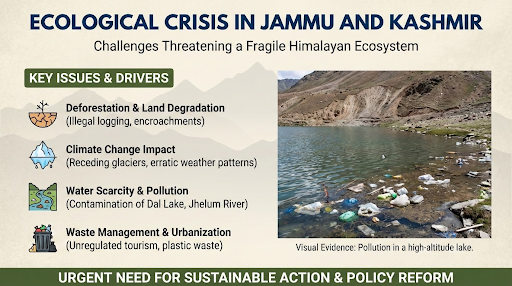
Institutional Fragmentation: Responsibility for managing lakes is divided among multiple departments like Revenue, Agriculture, and Forests, leading to a lack of coordinated action.
Rampant Encroachment & Land-Use Change: Failure to demarcate lake boundaries has enabled widespread illegal encroachment.
Pollution and Infrastructure Deficit: Urban lakes like Dal Lake are polluted due to malfunctioning Sewage Treatment Plants (STPs) and the direct inflow of untreated sewage.
Financial Neglect: Between 2017-2022, a mere 1% of J&K’s capital expenditure budget was allocated for lake conservation, and it was restricted to only six major lakes. The remaining 691 lakes received no dedicated funding or management plans.
Socio-Economic and Ecological Impact
Climate Resilience & Flood Regulation: Lakes and wetlands act as natural sponges. Their degradation reduced the Jhelum river basin's carrying capacity, a key factor behind the devastating 2014 Kashmir floods.
Biodiversity Loss: J&K's wetlands are critical habitats on the Central Asian Flyway. The degradation of Hokersar and Wular lakes threatens migratory birds like the Greylag Goose and has decimated local aquatic flora and fauna.
Economic Devastation: Livelihoods of thousands are at risk. Wular Lake, which supports nearly 60% of Kashmir's fish yield, is shrinking.
Way Forward
Establish a Unified Nodal Authority: Create a single, empowered statutory body like the Chilika Development Authority with jurisdiction over all documented lakes to end departmental silos.
Leverage Technology for Demarcation: Use modern tools like drone-based GIS mapping under schemes such as SVAMITVA to notify and demarcate lake boundaries and prevent further encroachment.
Unlock Financial Resources: J&K must prepare Comprehensive Management Action Plans (CMAPs) for all lakes to access funds under the central National Plan for Conservation of Aquatic Ecosystems (NPCA).
Ensure Community Participation: Integrate local communities, especially the traditional Hanji (lake-dwelling) community, into conservation efforts. This will transform them into custodians of the ecosystem rather than encroachers.
Learn from Best Practices in Lake Conservation
|
Case Study |
Problem |
Action Taken |
Outcome & Key Takeaway |
|
Chilika Lake, Odisha |
Siltation, weed infestation, and loss of salinity. |
Formation of a single nodal agency, the Chilika Development Authority (CDA). Scientific intervention by opening a new mouth to the sea. |
Restored ecosystem, increased fish catch. Removed from Montreux Record. Lesson: An empowered, single authority is critical. |
|
Jakkur Lake, Bengaluru |
Severe pollution from urban sewage. |
An integrated system combining STPs with constructed wetlands and algal ponds to naturally purify water. |
Self-sustaining lake with recharged groundwater. Lesson: Nature-based solutions can augment engineering solutions effectively. |
|
Lake Biwa, Japan |
Eutrophication from industrial and domestic waste. |
Implemented Integrated Lake Basin Management (ILBM) with strict laws, effluent standards, and citizen participation. |
Stabilized water quality. Lesson: A combination of strong legislation and community involvement is key. |
Conclusion
Reversing the crisis of J&K's vanishing lakes requires Integrated Lake Basin Management (ILBM), unified governance, and community action to ensure climate resilience.
Source: DOWNTOEARTH
|
PRACTICE QUESTION Q. Regarding the conservation of lakes and wetlands in India, consider the following statements: 1. The National Plan for Conservation of Aquatic Ecosystems (NPCA) is implemented by the Ministry of Jal Shakti. 2. Hokersar wetland is a designated Ramsar site located in Jammu and Kashmir. Which of the statements given above is/are correct? (a) 1 only (b) 2 only (c) Both 1 and 2 (d) Neither 1 nor 2 Answer: b Explanation: Statement 1 is incorrect. The National Plan for Conservation of Aquatic Ecosystems (NPCA) is a Centrally Sponsored Scheme implemented by the Ministry of Environment, Forest and Climate Change (MoEF&CC). Statement 2 is correct. Hokersar wetland is a designated Ramsar site (designated on November 8, 2005) located near Srinagar in Jammu and Kashmir, known as the 'Queen Wetland of Kashmir'. |
The lakes are vanishing largely due to man-made disasters, including administrative apathy, institutional fragmentation (multiple departments handling water bodies without coordination), unchecked land encroachment, urban pollution, and a severe lack of financial planning and allocation for conservation.
The disappearance of these lakes drastically reduces the region's natural flood buffering capacity (which worsened the 2014 floods), destroys the habitats of migratory birds along the Central Asian Flyway, and leads to a massive loss of local aquatic flora and fauna.
The CAG performance audit revealed that out of 697 lakes documented in 1967, 315 have vanished and 203 have shrunk. It exposed that 99% of the state's capital expenditure for lake conservation was spent on just six lakes, leaving the remaining water bodies with zero planning or central funding assistance.



© 2026 iasgyan. All right reserved