

The Union Environment Ministry’s Expert Appraisal Committee (EAC) has asked the Tamil Nadu government to revise the design of the proposed International Dugong Conservation Centre at Manora in Thanjavur district. Although the project aims to support dugong research, rescue, rehabilitation, and awareness, the committee raised concerns because most of the proposed construction falls within ecologically sensitive Coastal Regulation Zone (CRZ) areas, including a No Development Zone and regions with mangroves and seagrass meadows.
The EAC objected to the heavy use of conventional concrete structures in such a fragile coastal environment and recommended adopting low-impact, eco-friendly construction methods. It also suggested relocating as many facilities as possible outside the restricted zones and studying best practices from similar conservation centres. The project will be reconsidered only after a revised, environmentally sensitive plan is submitted.
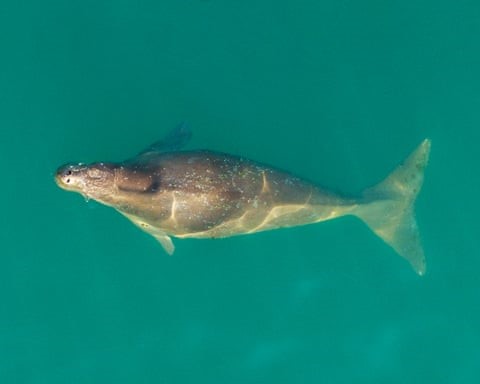
Copyright infringement not intended
Picture Courtesy: The Guardian
The Expert Appraisal Committee (EAC) of the Union Ministry of Environment, Forest and Climate Change has asked the Tamil Nadu government to substantially revise the design of the proposed International Dugong Conservation Centre at Manora in Thanjavur district, citing concerns over extensive concrete construction in ecologically sensitive coastal areas.
|
Must Read: DUGONG | Dugong conservation reserve | |
Dugong:
The dugong (Dugong dugon) is a large marine mammal often called a “sea cow” because of its gentle grazing habits. It belongs to the same biological group as manatees, but unlike them, dugongs live exclusively in marine (saltwater) environments.
Distribution in India
Dugongs prefer shallow, warm coastal waters where seagrass meadows are abundant. In India, their presence is mainly recorded in:
These regions provide suitable feeding grounds and relatively calm waters essential for their survival.
Ecological role: Dugongs are strict herbivores, feeding primarily on seagrass varieties such as Cymodocea, Halophila, Thalassia, and Halodule.
While grazing, they disturb the sea floor, which helps recycle nutrients and encourages new seagrass growth. Because of this ecological function, they are often referred to as “farmers of the sea.”
Lifespan: Dugongs are long-lived animals, with a lifespan that can extend to around seven decades. They are generally solitary, though they may sometimes be seen in small groups or as mother–calf pairs, especially during early life stages.
Reproductive Characteristics
Dugongs have a slow reproductive cycle, which makes population recovery difficult:
This low reproductive rate leads to very gradual population growth.
Population status:
The dugong population in Indian waters has declined sharply and is now estimated to be around 200 individuals. Habitat degradation, accidental entanglement in fishing gear, boat strikes, and loss of seagrass beds have reduced both their numbers and geographic range.
Conservation status:
Dugongs receive the highest level of legal protection under Schedule I of the Wild Life (Protection) Act, 1972, which prohibits hunting and trade.
Dugong conservation reserve:
In 2022, India notified its first Dugong Conservation Reserve in Palk Bay, Tamil Nadu. The protected area spans 448.3 square kilometres and focuses on safeguarding critical seagrass habitats and reducing human-induced threats.
Agreements:
India supports global dugong conservation through:
Challenges in Dugong Conservation:
Conclusion:
Dugong conservation remains a challenge because the species depends on fragile seagrass habitats, reproduces slowly, and lives in coastal areas heavily used by humans. Habitat loss, fishing-related deaths, pollution, and climate change together make population recovery difficult, highlighting the need for strong habitat protection and community-based conservation.
Source: The Guardian
|
Practice Question Q. Despite legal protection, dugong populations in India continue to decline. Examine. (150 words) |
A dugong (Dugong dugon) is a large, herbivorous marine mammal often called a “sea cow” because it grazes on seagrass. It is closely related to manatees but lives only in saltwater habitats.
In India, dugongs are mainly found in the Gulf of Mannar, Palk Bay, Gulf of Kutch, and the Andaman & Nicobar Islands, were shallow coastal waters support seagrass meadows.
They have a slow reproductive rate, depend entirely on fragile seagrass habitats, and live in shallow coastal areas heavily used by humans, exposing them to fishing nets, boat strikes, and habitat degradation.

© 2026 iasgyan. All right reserved