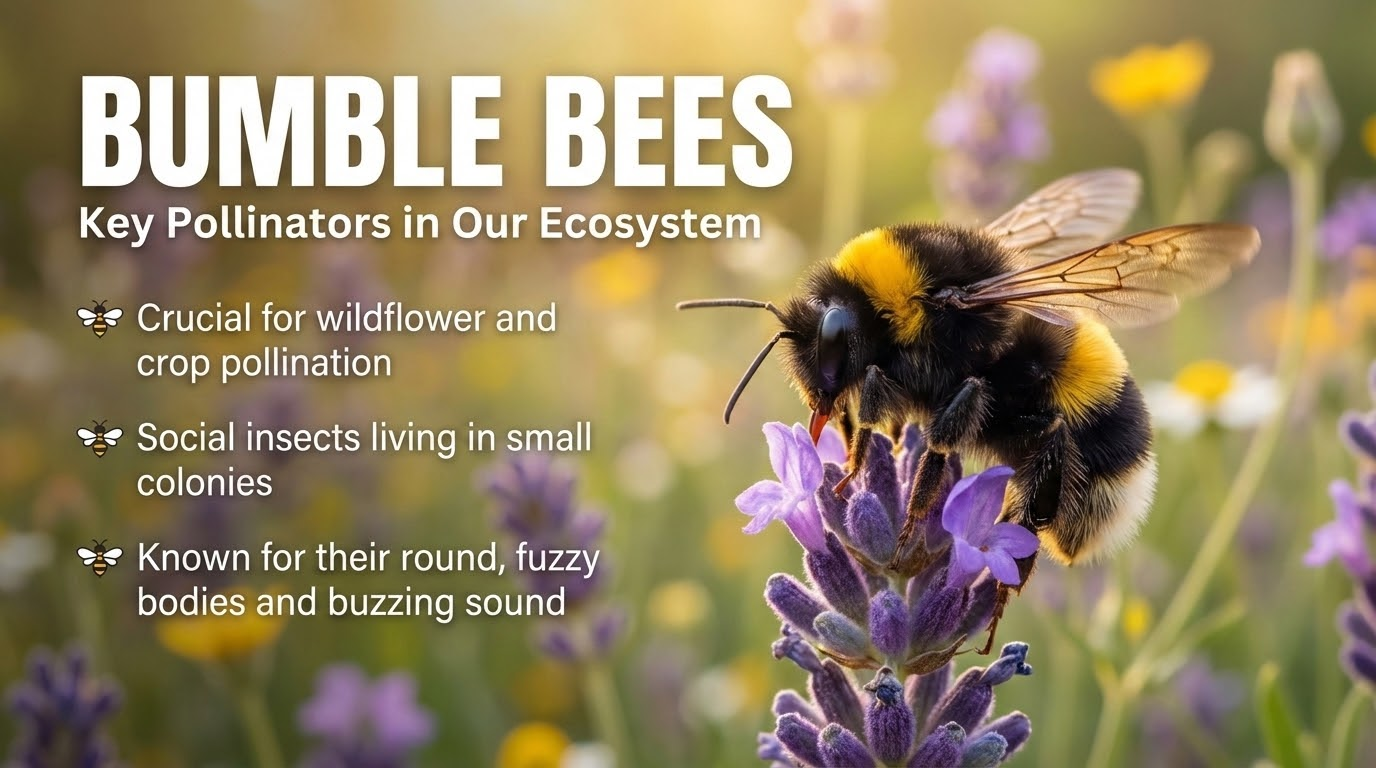
Bumblebees are social pollinators known for their distinctive buzz and fuzzy bodies. Beyond their role in crop pollination, recent research shows they possess a rare rhythmic intelligence, allowing them to recognize and adapt to musical patterns across various tempos.
Why In News
A research published in Science reveals that bumble bees can recognize and adapt to rhythmic patterns across different tempos, an ability previously thought to be limited to only a few mammals and birds.
What are Bumblebees?
Bumblebees are large, fuzzy insects belonging to the family Apidae. While they are cousins to the common Honeybee (Apis mellifera), they possess distinct biological and behavioral traits:
Physicality: They are larger, "fuzzier" (covered in dense pile/hair), and have distinct black and yellow bands.
Thermoregulation (Endothermy): Unlike most insects, bumblebees can regulate their body temperature.
Social Structure: They are eusocial but form annual colonies, not perennial ones.
Buzz Pollination
Bumblebees are the only major pollinators capable of sonication.
Habitat in India
India is home to approximately 48–57 species of Bumblebees, predominantly found in the Indian Himalayan Region (IHR).
IUCN Status
Global: Many species (e.g., Bombus affinis in North America) are Critically Endangered.
India: Most Indian bumblebee species are listed as "Data Deficient" or "Not Evaluated" by the IUCN Red List due to a lack of comprehensive surveys.
Source: SCIENCE
|
PRACTICE QUESTION Q. With reference to Bumblebees (Bombus species), consider the following statements:
Which of the statements given above is/are correct? A) 1 only B) 1 and 3 only C) 2 and 3 only D) 1, 2, and 3 Answer: B) 1 and 3 only Statement 1 is Correct: Bumblebees can "shiver" their flight muscles to generate heat, enabling them to fly in temperatures where honeybees would freeze. Statement 2 is Incorrect: Bumblebees do not store surplus honey like honeybees (Apis species). Their colonies are annual, not perennial, so they don't need large food stores for winter. Statement 3 is Correct: They vibrate their muscles to release pollen from "poricidal anthers" in Solanaceae crops, a feat honeybees cannot perform. |
Launched in February 2026, it is an infrastructure policy by the National Highways Authority of India aimed at building "Ecological Infrastructure". It mandates planting native, nectar-rich trees in clusters every 500m to 1km along highways to prevent habitat fragmentation and support wild pollinator populations.
Unlike honeybees, bumblebees are warm-blooded (endothermic), allowing them to survive in freezing high-altitude Himalayan environments. They do not store harvestable honey or form perennial colonies. Additionally, they are uniquely capable of "buzz pollination."
Buzz pollination is a process where bumblebees bite a flower and vibrate their flight muscles at a specific acoustic frequency. This violent shaking forcibly dislodges tightly packed pollen, a mechanism crucial for fertilizing crops like tomatoes, brinjals, and potatoes.



© 2026 iasgyan. All right reserved