India condemns attacks on UNIFIL peacekeepers, prioritizing "Blue Helmet" protection. As a top contributor, India advocates for UNSC Resolution 2589 accountability. Future success requires mandate reforms, technology integration, and shifting from conflict management to resolution, reflecting Vasudhaiva Kutumbakam.
Why In News?
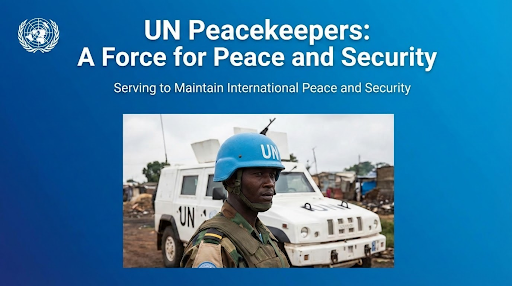
India has strongly condemned the recent attacks on UN peacekeepers deployed in southern Lebanon.
What is UN Peacekeeping?
United Nations (UN) Peacekeeping helps countries transition from conflict to peace by deploying troops, police, and civilian personnel from around the world.
The "Blue Helmets": Established in 1948, Peacekeepers include soldiers, police officers, and civilian personnel. They are easily identified by their iconic blue helmets or berets.
Legal Basis: While not explicitly mentioned in the UN Charter, peacekeeping falls between Chapter VI (Pacific Settlement of Disputes) and Chapter VII (Actions with respect to threats to peace).
Command and Control: Missions are deployed by the UN Security Council (UNSC), while the Department of Peace Operations (DPO) directs them from New York.
The Three Basic Principles
To maintain legitimacy, all UN peacekeeping operations must adhere to three "bedrock" principles:
India and UN Peacekeeping
Troop Contribution: India is currently among the top three troop-contributing countries, with over 6,000 personnel deployed across 10 missions.
Historic "Firsts": India deployed the first all-female police unit to a UN mission in Liberia (UNMIL) in 2007.
Sacrifice: India has lost more peacekeepers in the line of duty than any other nation, with over 180 bravehearts making the ultimate sacrifice.
Technological Leadership: India launched the UNITE AWARE platform—a situational awareness software—to provide terrain-related information and enhance the safety of peacekeepers.
Challenges Facing Modern Missions
Asymmetric Warfare: Peacekeepers are increasingly targeted by non-state actors and terrorists, moving away from traditional state-vs-state conflicts.
Mandate Creep: Missions are often given over-ambitious goals (e.g., nation-building, human rights monitoring) without sufficient funding or personnel.
Funding Crisis: The peacekeeping budget is separate from the UN regular budget. Major delays in payments by member states often hamper operations.
Legitimacy Issues: Instances of sexual exploitation and abuse by some peacekeepers have severely damaged the UN’s reputation in host countries.
Way Forward
Specialized Pre-Deployment Training
Robust, terrain-specific training is crucial. India's Centre for United Nations Peacekeeping (CUNPK) in New Delhi is a global benchmark, having trained thousands of Indian and foreign personnel in skills before deployment.
Integration of Advanced Technology
The UN must ensure equitable distribution of modern technology like observation drones, early-warning radar systems, and Mine-Resistant Ambush-Protected (MRAP) vehicles to all contingents.
Inclusive Mandate Formulation
The UN Security Council must involve major TCCs like India in the mandate-drafting process. The old model of Western nations designing missions and Global South nations providing troops is no longer viable.
Strict Enforcement of Accountability
The international community must enforce UNSC Resolution 2589 by imposing sanctions on state and non-state actors who target UN personnel.
Conclusion
India’s UN Peacekeeping role reflects Vasudhaiva Kutumbakam, strengthening its bid for a permanent UNSC seat. While its sustained contribution is a key credential, the sensitive debate over transitioning from "peacekeeping" to "peace enforcement" will define the Blue Helmets' future.
Source: ANINEWS
|
PRACTICE QUESTION Q. Consider the following statements regarding the United Nations Interim Force in Lebanon (UNIFIL): 1. It is a peacekeeping mission deployed to monitor the "Blue Line," the demarcation line between Lebanon and Israel. 2. India is historically the single largest current contributor of troops to the UNIFIL mission. 3. Targeting UN peacekeepers constitutes a violation of international humanitarian law and UNSC Resolution 1701. Which of the above statements is/are correct? A) 1 only B) 2 only C) Both 1 and 2 D) Neither 1 nor 2 Answers: b Explanation: Statement 1 is correct. UNIFIL is a peacekeeping mission established in 1978 and enhanced in 2006 to monitor the "Blue Line," which acts as the de facto demarcation line between Lebanon and Israel. Statement 2 is correct. The UN Secretary-General and UNIFIL have stated that targeting UN peacekeepers is a "grave violation of international humanitarian law and of Security Council resolutions," including Resolution 1701. |
Piloted by India in August 2021, UNSC Resolution 2589 is a landmark measure that demands host countries investigate and bring to justice individuals responsible for acts of violence against UN peacekeeping personnel, ensuring strict accountability to protect the "Blue Helmets."
India actively aligns with UNSC Resolution 1325 on Women, Peace, and Security. A major milestone was achieved in 2007 when India deployed the UN's first all-women Formed Police Unit (FPU) to Liberia. India is currently on track to meet the UN Gender Parity Strategy target of 25% female deployment by 2028.
India strongly advocates for "explicit mandates," arguing that major Troop Contributing Countries (TCCs) from the Global South must have a direct voice in the mandate-drafting process rather than just supplying troops. Additionally, India pushes for the systematic integration of modern technology and a philosophical shift from merely managing conflicts to actively resolving them.


© 2026 iasgyan. All right reserved