Shigellosis is a highly contagious bacterial gastrointestinal infection caused by Shigella, following a faecal-oral route. It requires a very low infectious dose to cause bacillary dysentery and high fever.
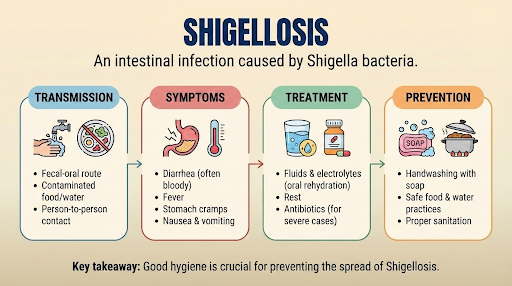
Why In News?
Kerala reported a fresh outbreak of Shigellosis, a highly contagious intestinal infection.
What is Shigellosis?
Shigellosis is a highly infectious gastrointestinal condition caused by a group of bacteria known as Shigella.
Pathogen Type: Gram-negative, non-spore-forming, rod-shaped bacteria.
Transmission: It follows a faecal-oral route. Infection occurs through contaminated food or water, or direct person-to-person contact.
Target Group: While it affects all ages, children under five are the most vulnerable, particularly in low-to-middle-income countries.
Symptoms and Clinical Manifestations
The infection primarily targets the lining of the large intestine (colon).
Prevention
Source: THEHINDU
|
PRACTICE QUESTION Q. With reference to 'Shigellosis', consider the following statements: 1. It is a viral infection that primarily affects the respiratory system. 2. It has a very low infectious dose, meaning only a few bacteria can cause the disease. 3. The rise of Extensively Drug-Resistant (XDR) strains is a major global health concern. Which of the statements given above is/are correct? (a) 1 and 2 only (b) 2 and 3 only (c) 3 only (d) 1 and 3 only Answer: b Explanation: Statement 1 is Incorrect: Shigellosis is a bacterial infection caused by the Shigella genus of bacteria, not a virus. Furthermore, it primarily affects the digestive system (intestines), leading to symptoms like bloody diarrhoea, rather than the respiratory system. Statement 2 is Correct: One of the most dangerous characteristics of Shigella is its high infectivity; an extremely low infectious dose of just 10 to 100 organisms is sufficient to cause illness. Statement 3 is Correct: The emergence of Extensively Drug-Resistant (XDR) Shigella strains, which show resistance to all commonly recommended antibiotics (like ciprofloxacin and azithromycin), has become a significant global health threat. |
Shigellosis is a highly contagious gastrointestinal infection caused by a group of bacteria called Shigella. It primarily attacks the lining of the large intestine, causing inflammation and severe diarrhea.
The bacteria follow a faecal-oral route. This means it spreads through contaminated food or water, surfaces touched by an infected person, or direct person-to-person contact. It is notorious for its "low infectious dose," meaning only 10 to 100 bacteria are enough to make a person sick.
Most mild cases are "self-limiting" and managed with Oral Rehydration Salts (ORS) and rest. Antibiotics are only prescribed for severe cases or for vulnerable groups (like the elderly or immunocompromised) to shorten the illness and prevent spread.



© 2026 iasgyan. All right reserved